

For much of the twentieth century, international politics could be understood through a relatively simple lens.
- The Cold War Had Blocs. The New World Has Networks.
- The Network Is Becoming More Important Than the Alliance
- The Rise of the “Plurilateral” World
- Look at India
- But Networks Create a New Problem
- The United States Is Also Building Networks
- China Is Building Networks Too
- Technology May Become the Most Important Network
- Defence Networks Are Changing Too
- The Drone Is a Perfect Example
- Economic Networks May Be Even More Powerful
- Energy Is Becoming a Network
- The Danger of Weaponised Interdependence
- What Does This Mean for India?
- India Can Become the Bridge
- But There Is a Limit
- The New Measure of National Power
- The Strategic Lesson
- India’s Opportunity
There were two major camps.
- The United States and its allies on one side.
- The Soviet Union and its allies on the other.
Countries were often judged by which side of the ideological and military divide they occupied.
That world is gone.
But what is replacing it?
The answer may not be another bipolar system.
It may be something far more complicated:
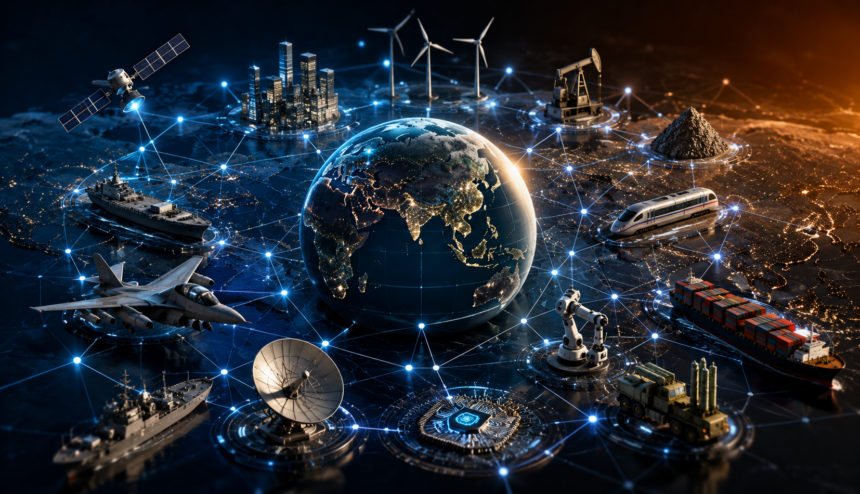
A world of overlapping strategic networks.
And this distinction could define geopolitics for the next several decades.
The Cold War Had Blocs. The New World Has Networks.
During the Cold War, alliances were relatively predictable.
NATO represented the Western security architecture.
The Warsaw Pact represented the Soviet bloc.
Economic, military and ideological relationships broadly followed these divisions.
Today’s geopolitical environment is very different.
India can be a member of the Quad with the United States, Japan and Australia while simultaneously being a member of BRICS with China and Russia.
It can deepen defence cooperation with Washington while maintaining major defence and energy relationships with Moscow.
It can compete with China along the Himalayan border while remaining economically engaged with Beijing.
It can cooperate with Israel on defence and technology while maintaining relationships with Iran and the Arab Gulf.
This is not contradiction.
It is the emerging architecture of international relations.
The Network Is Becoming More Important Than the Alliance
The traditional alliance asks:
Who is on your side?
The network asks:
Who can you work with on this particular issue?
That is a fundamental change.
A country may cooperate with one group on defence.
Another on technology.
Another on energy.
Another on trade.
Another on maritime security.
Another on climate.
Another on artificial intelligence.
The same country can therefore belong to several overlapping strategic ecosystems without formally belonging to one geopolitical camp.
This is increasingly visible in India’s own foreign policy.
The country’s participation in both BRICS and the Quad is perhaps the clearest illustration.
India is not trying to choose between East and West.
It is attempting to remain relevant to both.
The Rise of the “Plurilateral” World
This transformation is not merely theoretical.
The IMF’s June 2026 analysis describes an emerging plurilateral world in which smaller, issue-specific and sometimes temporary coalitions are increasingly replacing the assumption that large universal institutions alone will drive international cooperation.
The implication is profound.
The future may not be dominated by one organisation.
Instead, different networks may govern different problems.
- Security may be handled by one group.
- Technology by another.
- Energy by another.
- Trade by another.
- Critical minerals by another.
- Maritime security by another.
- Artificial intelligence by yet another.
The global system could therefore become less like a chessboard and more like a web.
Look at India
India may be particularly well suited to this emerging world.
New Delhi has spent decades developing relationships without permanently locking itself into formal alliances.
That history gives India unusual diplomatic flexibility.
Consider the architecture around India:
- QUAD — United States, Japan, Australia and India
- BRICS — a broader grouping including China, Russia and other major emerging economies
- SCO — China, Russia, India and other Eurasian states
- G20 — major developed and developing economies
- I2U2 — India, Israel, UAE and United States
- India-France — strategic and defence partnership
- India-UAE-Saudi — growing economic and strategic connectivity
- India-Russia — longstanding defence and energy relationship
- India-US — increasingly important technology and defence relationship
These are not interchangeable organisations.
Each serves a different purpose.
That is precisely the point.
India’s strategic power increasingly comes from being connected to multiple networks simultaneously.
But Networks Create a New Problem
There is a danger.
The more networks a country joins, the more difficult it becomes to maintain coherence among them.
Consider India’s position in BRICS.
India assumed the BRICS presidency in 2026, but the expanded grouping contains increasingly divergent strategic interests. Recent BRICS ministerial discussions demonstrated these contradictions, particularly over the Middle East, where members struggled to reach consensus.
This is the paradox of networked geopolitics:
More connections create more influence—but also more friction.
India’s challenge is therefore not simply to join more organisations.
It is to ensure that its different partnerships do not begin working against one another.
The United States Is Also Building Networks
The network model is not unique to India.
The United States increasingly operates through overlapping alliances and partnerships.
NATO remains the core transatlantic security institution.
But NATO itself maintains partnerships with dozens of non-member countries and organisations.
In the Indo-Pacific, NATO has deepened engagement with Australia, Japan, South Korea and New Zealand.
The architecture is therefore no longer simply:
USA → NATO
It increasingly resembles:
USA → NATO → AUKUS → QUAD → bilateral partnerships → technology partnerships → regional security networks
The connections overlap.
The same country can participate in several networks without being a member of all of them.
China Is Building Networks Too
China’s strategic influence also increasingly operates through networks.
- Economic relationships
- Infrastructure
- Trade
- Technology
- Energy
- BRICS
- SCO
- Belt and Road
- Regional partnerships
The objective is not necessarily to recreate the Soviet model of a tightly controlled ideological bloc.
It is to create interdependencies that translate into strategic influence.
That distinction is crucial.
The modern form of geopolitical power may not be:
“Do what I say.”
It may be:
“You cannot afford to ignore me.”
Technology May Become the Most Important Network
The next great geopolitical competition may not be primarily about territory.
It may be about technology ecosystems.
Who controls:
- Semiconductors?
- AI models?
- Cloud infrastructure?
- Satellite networks?
- Quantum technology?
- Critical minerals?
- 5G/6G standards?
- Defence electronics?
- Cyber infrastructure?
- Autonomous systems?
These technologies create networks of dependency.
A country may be politically independent but technologically dependent.
That is a new form of strategic vulnerability.
Defence Networks Are Changing Too
The military implications are enormous.
The future battlefield is unlikely to consist only of one country’s armed forces fighting another country’s armed forces.
Instead, we are likely to see networks of:
- Satellites
- Drones
- Sensors
- AI systems
- Electronic warfare
- Cyber systems
- Long-range missiles
- Naval platforms
- Command-and-control networks
The most powerful military may therefore be the one that can connect the largest number of sensors and effectors into a resilient network.
This is why modern warfare is increasingly moving from:
Platform-centric warfare
towards
Network-centric warfare.
And eventually:
AI-enabled network warfare.
The fighter aircraft, tank or drone remains important.
But the network connecting them may become even more important.
The Drone Is a Perfect Example
Consider the humble drone.
A drone by itself is a platform.
Connect it to:
- A satellite
- An ISR aircraft
- A ground sensor
- An AI-enabled target-recognition system
- An electronic-warfare system
- A command network
- Another drone
- A precision weapon
It becomes something entirely different.
It becomes a node in a combat network.
This is why the future military competition may not simply be about who builds the best drone.
It may be about who builds the best drone ecosystem.
The same principle applies to satellites, electronic warfare, cyber systems and air defence.
Economic Networks May Be Even More Powerful
Defence is only one part of the story.
Consider the global semiconductor ecosystem.
One country may design the chip.
Another may manufacture the equipment required to produce it.
Another may fabricate the semiconductor.
Another may package it.
Another may provide the software.
Another may provide critical minerals.
Another may provide the market.
No country necessarily controls the entire chain.
Yet every country in the chain possesses some degree of strategic influence.
This is the new geopolitics of interdependence.
Energy Is Becoming a Network
The same transformation is occurring in energy.
- Oil and gas flows
- LNG
- Renewables
- Nuclear technology
- Critical minerals
- Hydrogen
- Electricity grids
- Energy storage
- Supply chains
Countries increasingly need multiple sources of energy security.
India understands this particularly well.
India’s strategic relationships with Russia, the Gulf, the United States and other energy producers cannot be viewed separately.
They form part of a broader energy-security network.
The Danger of Weaponised Interdependence
Networks create enormous benefits.
But they also create vulnerabilities.
If a country controls a critical node, it can potentially use that position as leverage.
- Technology restrictions can become strategic weapons.
- Sanctions can become instruments of statecraft.
- Export controls can affect military capability.
- Supply chains can become targets.
- Financial infrastructure can become geopolitical leverage.
This means that connectivity itself has become a strategic asset—and a vulnerability.
What Does This Mean for India?
India should not attempt to join every network.
It should identify the networks that matter most to its national interests.
And then it should seek to become a critical node rather than a dependent node.
That distinction could define India’s grand strategy.
India should not merely participate in semiconductor supply chains.
It should become important to them.
India should not merely buy defence technology.
It should develop technology that others need.
India should not merely consume satellite services.
It should provide them.
India should not merely import drones.
It should build complete unmanned-system ecosystems.
India should not merely participate in the Indian Ocean.
It should help shape its security architecture.
Influence comes from indispensability.
India Can Become the Bridge
There is another opportunity.
India’s unique relationships place it in a position to act as a bridge between otherwise competing networks.
India can talk to Washington.
It can talk to Moscow.
It can engage Beijing.
It can work with Europe.
It can work with the Gulf.
It can work with the Global South.
This does not make India a neutral power.
It makes India a network power.
The objective should not be to mediate every dispute.
It should be to ensure that India’s strategic relevance increases as the world becomes more fragmented.
But There Is a Limit
India must also recognise that strategic flexibility has limits.
If every crisis produces a different position, partners may eventually question India’s reliability.
If India tries to keep everyone happy, it may satisfy nobody.
Strategic autonomy therefore cannot mean permanent ambiguity.
There will be moments when India must choose.
The real objective is to ensure that when those moments arrive, India chooses from a position of strength rather than dependence.
The New Measure of National Power
For centuries, national power was measured primarily through:
- Territory
- Population
- Military strength
- Economic size
These remain important.
But the networked world adds another measure:
Connectivity
How many important networks can a country access?
How many can it influence?
How many depend upon it?
How quickly can it shift from one network to another?
How resilient are its critical connections?
These questions may become as important as GDP or military expenditure.
The Strategic Lesson
The twentieth century rewarded countries that built strong alliances.
The twenty-first century may increasingly reward countries that build strong networks.
The distinction is subtle but fundamental.
An alliance says:
“We stand together.”
A network says:
“We can work together where our interests converge.”
The first is rigid.
The second is flexible.
The first is easier to understand.
The second is harder to manage.
But the second may be better suited to a fragmented world.
India’s Opportunity
India should therefore not fear the fragmentation of the international system.
It should exploit its strategic geography, economic scale, demographic strength, technological ambitions and diplomatic relationships to become one of the central nodes of the emerging networked order.
India’s objective should be simple:
Connected to everyone.
Dependent on no one.
Useful to many.
Indispensable to some.
That is a far more powerful form of strategic autonomy than simply staying outside alliances.
Conclusion
The world is not necessarily heading back to the Cold War.
It is becoming something different.
- A United States-led network
- A China-centred network
- European security networks
- Regional Middle Eastern networks
- Indo-Pacific networks
- Technology networks
- Energy networks
- Financial networks
- Defence-industrial networks
And increasingly, these networks overlap.
Countries will move between them according to their interests.
Some partnerships will last decades.
Others may last only for a particular crisis or technology programme.
The great geopolitical question of the coming decades may therefore not be:
“Which bloc are you in?”
It may be:
“How many networks can you belong to, influence and connect—without losing your freedom of action?”
For India, that question could define the next phase of its rise.
The future may not belong to the country with the largest alliance.
It may belong to the country sitting at the centre of the largest number of strategic networks.
And India has an opportunity to be exactly that country.