

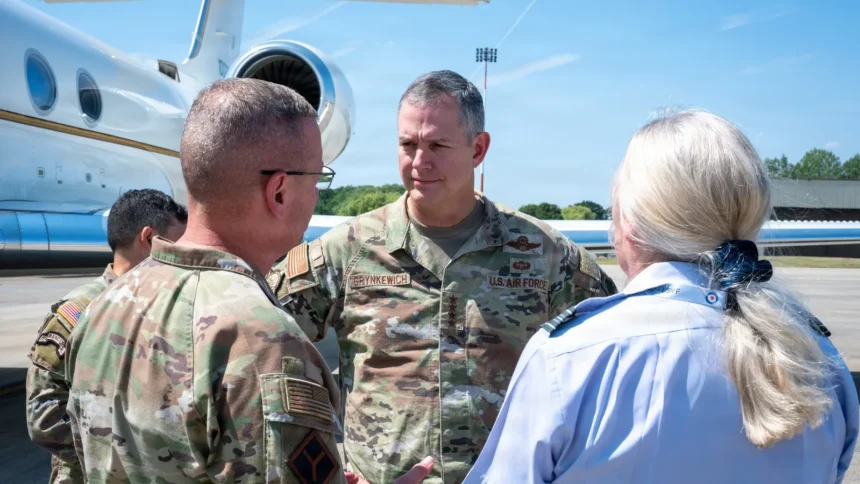
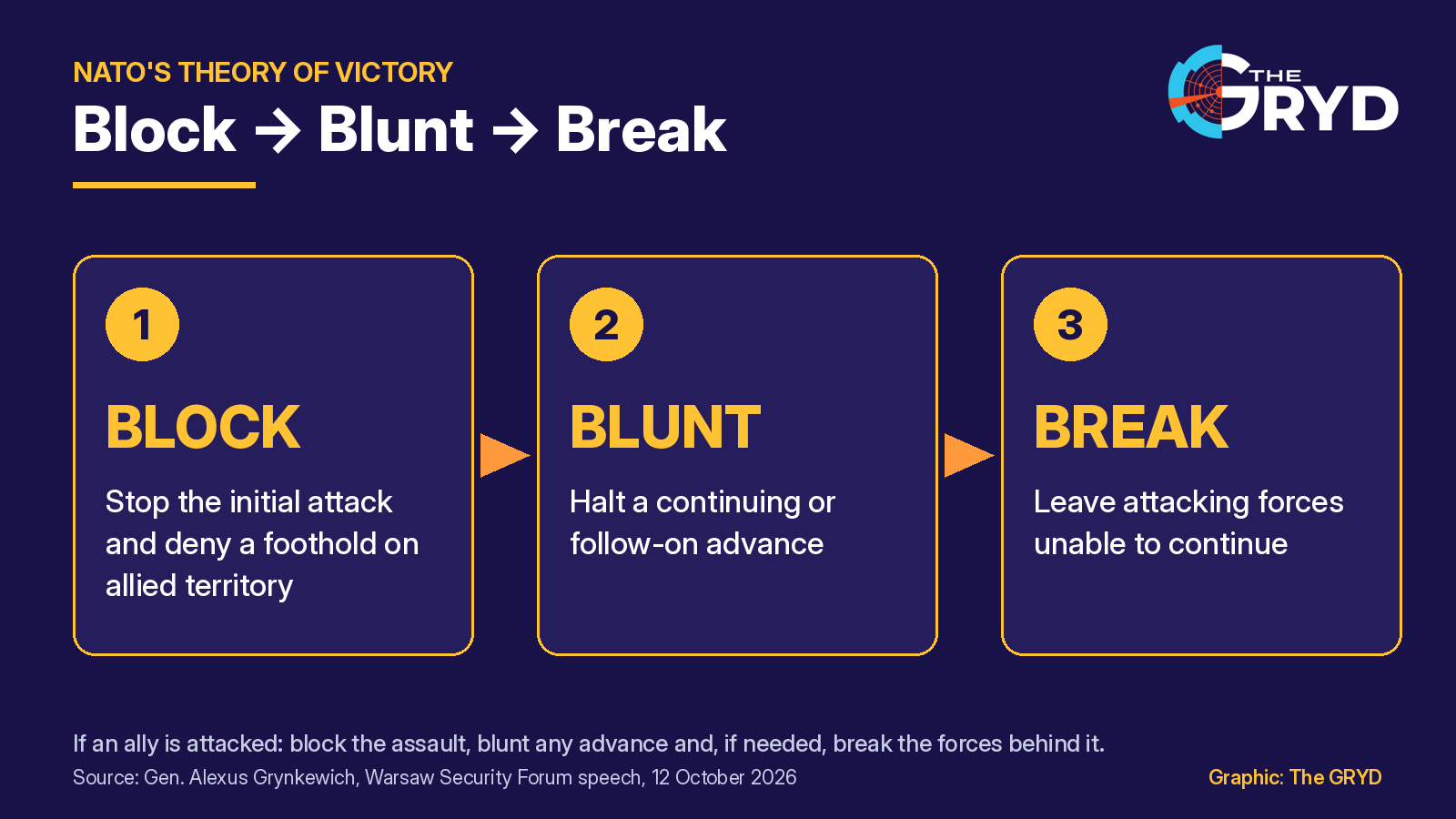
NATO’s top commander, Gen. Alexus Grynkewich, publicly set out the alliance’s “Theory of Victory” at the Warsaw Security Forum on 12 October 2026: if an ally is attacked, NATO would block the assault, blunt any advance and, if needed, break the forces behind it. He stressed that conflict is neither imminent nor inevitable.
Key takeaways
- Three stages: block the initial attack, blunt a continuing advance, break the attacker’s “operational war-fighting system” (speech video, Warsaw Security Forum).
- The theory rests on NATO’s Deterrence and Defence of the Euro-Atlantic Area strategy, agreed by all 32 allies. Grynkewich said the final, classified version was completed “about 3 months ago”.
- The stated aim is to deny an attacker NATO territory, not to inflict a strategic defeat on the adversary.
- It pairs expensive precision munitions with “an overpowering mass of affordable and scalable systems”, drawing on lessons from Ukraine and the Middle East.
- The speech came as drones sank a merchant ship off Bulgaria, a NATO member, on the night of 12–13 October (AP).
What we know: what Grynkewich said
Grynkewich, who is both Supreme Allied Commander Europe (SACEUR) and head of US European Command, summed up the idea in one line. “My theory of victory is simple. We will block the initial attack. If the attack persists, we will blunt it and prevent enemy advance. And if required, we will break the enemy’s forces and the operational war-fighting system that is arrayed against us,” he said, according to the Warsaw Security Forum’s video of the speech.
He said the concept is based on the alliance’s Deterrence and Defence of the Euro-Atlantic Area (DDA) strategy, “agreed to by all 32 allies”, and draws on “the lessons of modern warfare from Ukraine and in the Middle East”. In the first stage, forward land forces would move to stop an assault at the border. Then, “using advanced sensors, autonomous systems, and multi-domain forces, we will deny the attacker the ability to generate momentum or gain the initiative.” If the attack continued, NATO would target “not just the attacking force itself, but anything and everything that supports, sustains, or controls that force.”
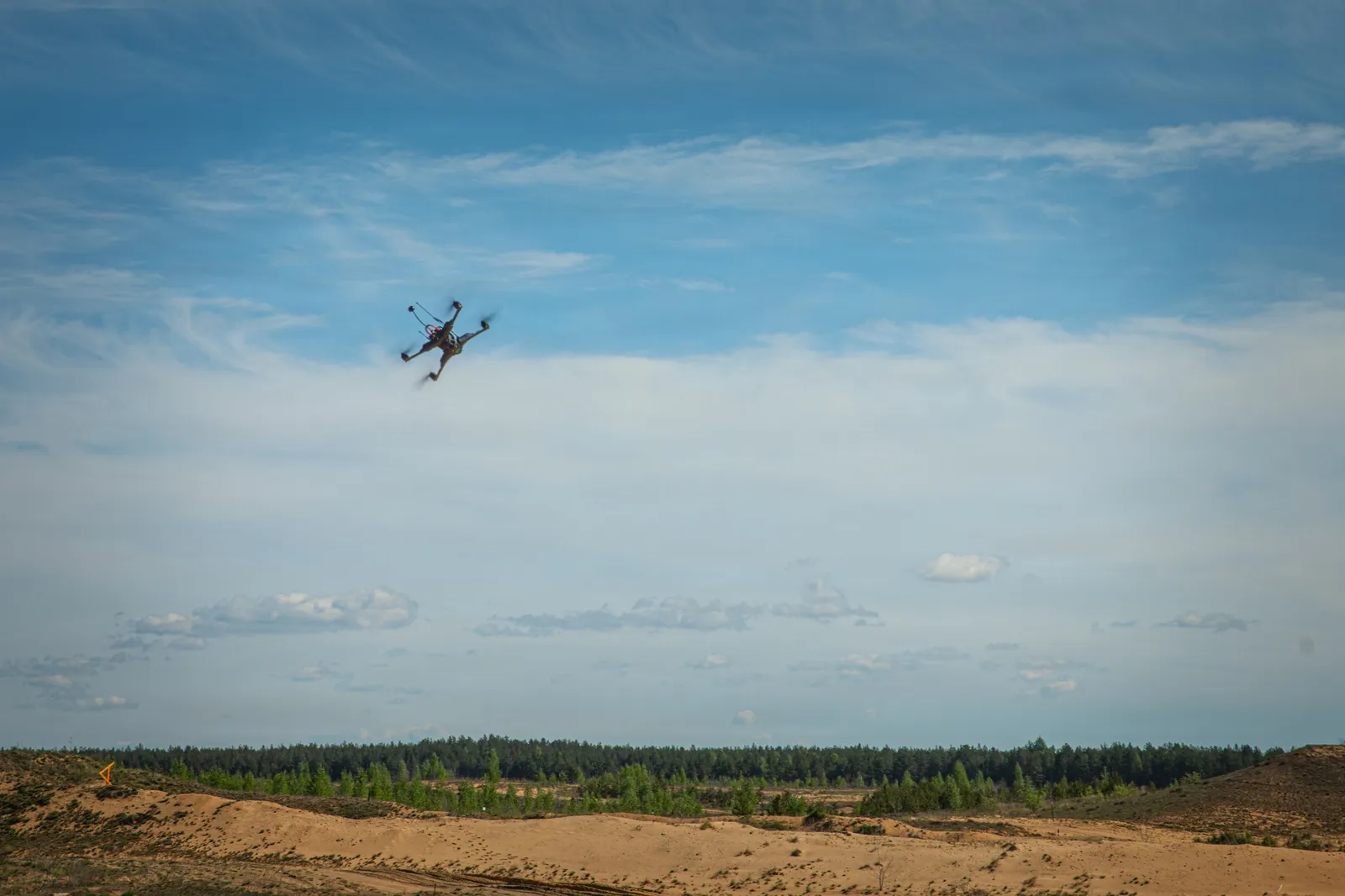
“To do this, we will layer high-end and highly effective precision munitions with an overpowering mass of affordable and scalable systems,” he said. He named investment in “high-end and affordable long-range precision strike capabilities, sensor networks, and a war-fighting cloud” as priorities.
Background: from tripwire to forward defence
NATO first put multinational battlegroups in Estonia, Latvia, Lithuania and Poland in 2017, after its 2016 Warsaw Summit. After Russia’s full-scale invasion of Ukraine in 2022, allies added four more battlegroups, in Bulgaria, Hungary, Romania and Slovakia, and agreed to scale them up from battalions to brigades “where and when required”, according to NATO’s eastern flank page.
As of June 2026, NATO’s Forward Land Forces comprise nine battlegroups, with Finland the newest. The UK leads the one in Estonia and Canada the one in Latvia.
Allies approved new regional defence plans at the 2023 Vilnius Summit. Grynkewich’s theory explains how those forces would fight. For the wider debate on Europe’s reliance on Washington, see Can Europe survive without the USA?
The three stages at a glance
| Stage | Goal | Main tools named in the speech | Source |
|---|---|---|---|
| Block | Stop the initial attack and deny a foothold on allied territory | Forward land forces on the eastern flank; intelligence and “advanced algorithms” for early warning | Speech video, 12 Oct 2026 |
| Blunt | Halt a continuing or follow-on advance | Advanced sensors, autonomous systems, air and maritime forces, multi-domain effects | Speech video, 12 Oct 2026 |
| Break | Leave attacking forces unable to continue | Strikes on whatever supports, sustains or controls the attacking force; kinetic and non-kinetic pressure | Speech video, 12 Oct 2026 |
Compiled by GRYD from the Warsaw Security Forum video of the 12 October 2026 speech.
Why it matters
It is a public statement of denial defence. For years NATO’s eastern flank relied on tripwire forces: small multinational units whose main job was to guarantee that reinforcements would follow. Grynkewich’s framing goes further. “We are only seeking to stop any attack in its tracks, to deny the ability to seize and hold our territory,” he said.
The implied message to Moscow, in GRYD’s reading, is that a quick land grab followed by talks, often discussed for the Baltic states, would not be allowed to stand.
It deliberately limits the war aim. “We are not seeking to impose a strategic defeat on our adversary. Nor do we need to do so,” he said.
Success “requires the tactical and operational defeat of the forces being employed against us, but no more.” That matters for escalation and nuclear signalling (for Russia’s side of that equation, see The Dead Hand): NATO is saying it would defeat an invading force, not march on Moscow.
It is a shopping list. The mix of expensive missiles and cheap, numerous drones is the clearest lesson of the war in Ukraine, where both sides burn through munitions faster than industry can replace them.
For allies such as the UK and Canada, which lead battlegroups in Estonia and Latvia, the named priorities (long-range strike, sensor networks, a shared war-fighting cloud) indicate where NATO’s planners want money to go. The Warsaw Security Forum’s pre-event release pointed to 2029 as the key horizon for preparing European and American forces (WSF).
It is also reassurance. Asked why NATO was going public, Grynkewich pointed to “sabotage and arson” across Europe and said he wanted to “assure the 1 billion citizens of our alliance that we’ve got this.” The Wall Street Journal described the speech as an attempt to steady an anxious Europe. “If attacked, we are ready to fight tonight, but we are not complacent,” he said.
The Black Sea backdrop
The speech landed in a tense week. Drones struck two merchant ships off Bulgaria’s coast on the night of 12–13 October. The Guinea-Bissau-flagged cargo ship HS Dignity sank; five sailors were rescued and 11 were still missing as of 13 October, according to AP.
All 15 crew of the Ukrainian-operated, Maltese-flagged Chelsea 3 were rescued. Prime Minister Rumen Radev said Bulgaria had no clear evidence of who was responsible, while saying the outcome benefited Russia. It came a week after two other merchant ships were attacked in Bulgaria’s exclusive economic zone (Euronews).
NATO Secretary General Mark Rutte said the alliance would keep monitoring the region and adjust its “deterrence and defence posture as needed” (Euronews). Attacks like these sit below the threshold of an armed attack on an ally, which shows the limits of any theory built mainly around stopping an invasion at a border.
What’s uncertain
- The operational version is classified. No force numbers, timelines or national roles were published.
- Grynkewich cited sabotage and arson as a reason for going public, but the speech focused on conventional attack. How NATO answers grey-zone pressure was not set out in detail.
- Asked whether US troops would be among the ground forces, he said “it’s a political decision about who’s providing troops where”, while insisting no one should question the US commitment.
- Delivering “mass” depends on European production and budgets that are still being decided.
What to watch next
Grynkewich said forward land forces on the eastern flank will “exercise and demonstrate their ability to block any attack”, and air and maritime forces their ability to blunt one, so expect exercises framed in these terms, plus allied decisions on long-range strike and drone production. For further reading on cheap drone warfare, see The evolving anti-drone tech, and on the sensor and jamming fight the “blunt” stage depends on, The invisible battlefield: electronic warfare. More in our Geopolitics section.
Sources & further reading
- Warsaw Security Forum: “Theory of Victory”, Gen. Alexus Grynkewich, full speech and Q&A (video), 12 Oct 2026
- TVP World: NATO’s top commander in Europe unveils ‘Theory of Victory’, 12 Oct 2026
- Defence Industry Europe: NATO’s top commander outlines ‘Theory of Victory’, 12 Oct 2026
- Breaking Defense: NATO SACEUR bullish on ‘block, blunt, break’ theory of victory, 12 Oct 2026
- The Wall Street Journal: NATO’s top commander lays out plan to thwart a Russian attack, 12 Oct 2026
- Warsaw Security Forum press release (PDF)
- AP: Drones hit ships in Black Sea, sinking one, 13 Oct 2026
- Euronews: NATO will adjust defences ‘as needed’, Rutte says, 13 Oct 2026
- NATO: Strengthening NATO’s eastern flank (topic page, updated 29 Sep 2026)
- NATO: Deterrence and defence (topic page)