

Introduction:
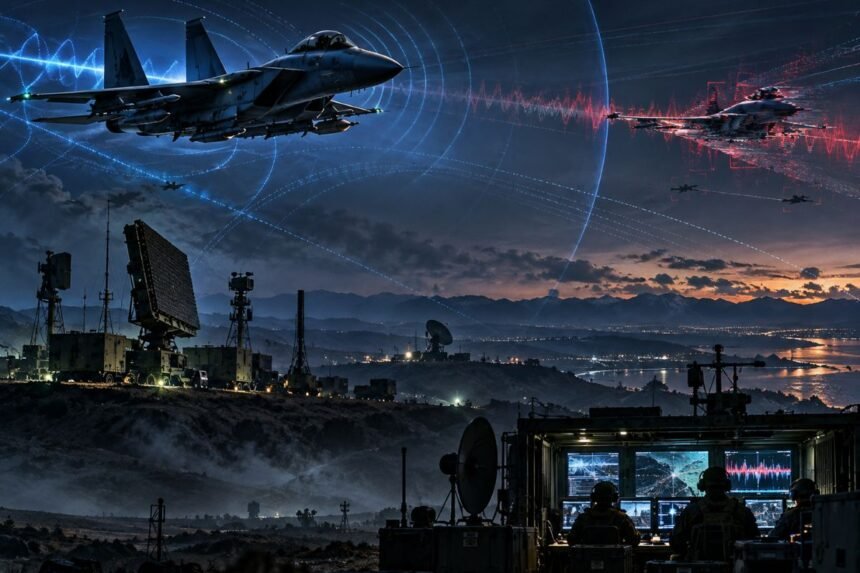
Electronic warfare in modern war may matter as much as, or more than, missiles, tanks, and aircraft. By controlling the electromagnetic spectrum (EMS), a military can protect its own communications and sensors while disrupting an opponent’s GPS, radar, data links, and command networks.
- Introduction:
- What is electronic warfare?
- What happens when the spectrum goes dark?
- Precision weapons lose accuracy:
- Communications and command break down:
- Radar pictures become unreliable:
- Drones lose their links:
- Ukraine’s electronic warfare lessons:
- Why jamming works?
- Fiber optic drones bypass RF jamming:
- Cognitive electronic warfare and DRFM:
- How DRFM deception works:
- China’s Information Support Force:
- Implications for India and the LAC:
- India’s electronic warfare response:
- Ground and naval EW systems:
- Rudram and anti radiation warfare:
- Directed energy weapons:
- NavIC and resilient navigation:
- Quantum communications and navigation:
- Why electronic warfare may matter more than missiles?
- Conclusion
For generations, military power was measured mainly by explosive force, armor, aircraft speed, and missile range. Modern conflict has changed that calculation. Networked forces now depend on reliable signals, satellite navigation, data links, and real time intelligence. When those systems are jammed, spoofed, or deceived, advanced weapons can lose much of their effectiveness before a kinetic strike begins.
India’s Defence Minister Rajnath Singh has described the changing character of warfare in the context of grey-zone and hybrid conflict. Cyberattacks, disinformation, and electronic warfare can pursue strategic objectives without immediately firing a missile. The result is a battlefield measured in seconds and decision cycles rather than only in months of campaigning.
What is electronic warfare?
Electronic warfare is the military use of the electromagnetic spectrum to sense, protect, attack, and exploit electromagnetic emissions. It is commonly divided into three functions:
- Electronic support: detecting, identifying, locating, and analyzing enemy emissions.
- Electronic attack: jamming, spoofing, deception, or directed energy intended to degrade enemy systems.
- Electronic protection: hardening friendly systems against interference, deception, and electromagnetic attack.
Modern electronic warfare is closely linked to cyber operations, space systems, intelligence, surveillance, and reconnaissance. It is not simply a contest between a jammer and a radio. It is a struggle over who can observe, communicate, navigate, decide, and act under pressure.
What happens when the spectrum goes dark?
A modern military depends on a connected C4ISR architecture: command, control, communications, computers, intelligence, surveillance, and reconnaissance. A theater-wide electromagnetic attack can create cascading failures across that architecture.
Precision weapons lose accuracy:
Many precision guided munitions use satellite navigation from systems such as GPS, Galileo, or NavIC to update their inertial navigation systems. Jamming can block those signals, while spoofing can provide false position or timing data. Without reliable updates, inertial drift increases and weapons may miss narrow targets by a significant distance.
The operational effect is larger than a single missed round. If a weapon’s probability of success falls, commanders may need to fire more munitions against the same target. That raises cost, consumes stocks, and weakens the ability to conduct sustained precision strikes.
Communications and command break down:
Jamming satellite, HF, or tactical communications can isolate frontline units from higher headquarters. Forces may have to rely on pre planned instructions and local initiative, slowing the Observe, Orient, Decide, and Act (OODA) loop.
The loss of communications also increases the risk of fratricide. Units may lack a common operating picture, while commanders lose the ability to redirect forces as the situation changes.
Radar pictures become unreliable:
Electronic attack can interfere with integrated air-defense systems through noise jamming, deceptive returns, and false tracks. A radar operator may struggle to distinguish a real cruise missile or aircraft from a computer-generated target.
This creates two dangers: defenders may waste interceptors on false targets, or they may hesitate while a real threat approaches. Deception can therefore be as valuable as raw jamming power.
Drones lose their links:
Small unmanned aircraft depend on command, telemetry, navigation, and video links. RF jamming can sever the operator’s connection, while GNSS spoofing can disrupt navigation. A drone may crash, land automatically, or become vulnerable to capture.
This does not eliminate unmanned systems, but it changes which designs are useful. Forces increasingly need autonomous navigation, frequency agility, anti jam links, inertial backup, and multiple control pathways.
Ukraine’s electronic warfare lessons:
The war in Ukraine has become one of the most important real world tests of electronic warfare. It has shown that precision weapons and drones are not independent of the spectrum. Their performance depends on how well they operate inside a contested electromagnetic environment.
Public reporting has described significant problems for GPS dependent systems in heavily jammed areas. Excalibur artillery rounds, JDAM family weapons, GLSDB, and HIMARS-launched munitions have all been discussed in relation to navigation interference, although exact performance varies by weapon version, software, mission profile, environment, and countermeasure configuration.
The broader lesson is more reliable than any single battlefield figure: satellite navigation is powerful but vulnerable. A resilient strike system needs several layers, including inertial navigation, terrain or image matching, anti jam antennas, alternative navigation methods, and disciplined target verification.
Why jamming works?
GNSS signals arrive at Earth at extremely low power. A nearby jammer can therefore overwhelm a receiver with a much stronger signal. Spoofing is more subtle: the attacker transmits false signals designed to look legitimate and gradually shifts the receiver’s calculated position, time, or velocity.
Encryption can strengthen resistance to unauthorized access, but it does not make a receiver invulnerable to all forms of interference. Systems must also detect abnormal signal behavior and maintain independent navigation options.
Fiber optic drones bypass RF jamming:
Fiber optic FPV drones illustrate how quickly combatants adapt. Instead of controlling the drone through a radio link, the operator communicates through a thin fiber optic cable that unspools behind the aircraft.
The cable carries commands and video as light, so conventional RF jamming cannot break the control link. The drone also does not need GNSS for communication. This creates a difficult counter-drone problem because defenders cannot rely on passive RF detection alone.
Fiber optic drones still have important limitations:
- The cable and spool add weight.
- Range is limited by cable length.
- The cable can snag on vegetation, structures, or uneven terrain.
- The drone remains vulnerable to visual, radar, acoustic, infrared, and kinetic defenses.
The tactical response is a layered counter UAS network. Defenders need multiple sensors, including radars capable of detecting small targets and propeller micro Doppler, followed by electronic, cyber, interceptor-drone, or physical defeat options where appropriate.
Cognitive electronic warfare and DRFM:
Traditional electronic warfare often relies on threat libraries. A receiver identifies characteristics such as pulse repetition frequency, modulation, bandwidth, and frequency, then selects a programmed response. This approach becomes less reliable against low probability of intercept radars and rapidly changing waveforms.
Cognitive electronic warfare uses machine learning, deep neural networks, and other adaptive methods to classify signals and select responses in near real time. It can process raw in phase and quadrature data, identify unfamiliar emissions, and update its behavior as the electromagnetic environment changes.
How DRFM deception works:
Digital Radio Frequency Memory (DRFM) systems capture an enemy radar signal, digitize it, and retransmit a coherent copy after modifying its timing, phase, or Doppler characteristics. Because the replica resembles the original waveform, the radar may treat the false return as a genuine target.
Common techniques include:
- Range Gate Pull Off (RGPO): the false return is delayed progressively, encouraging the radar to track a false range before the deception is removed.
- Velocity Gate Pull Off (VGPO): the Doppler shift is altered so the radar follows a false target speed.
When cognitive algorithms are combined with DRFM, electronic attack can become more adaptive. The system may learn how a radar behaves, anticipate frequency changes, and tailor deception to the radar’s tracking logic. The central danger is not merely blindness; it is loss of confidence in the sensor picture.
China’s Information Support Force:
China has treated information dominance, cyber operations, space systems, and electronic warfare as closely connected parts of future conflict. The People’s Liberation Army created the Strategic Support Force in 2015, bringing several information related functions under one organization.
In April 2024, the Strategic Support Force was dissolved and replaced by three organizations: the Aerospace Force, the Cyberspace Force, and the Information Support Force. The restructuring reflects an effort to give specialized attention to space, cyber, and information support missions while maintaining direct oversight by the Central Military Commission.
The Information Support Force is significant because it highlights the importance of data movement, battlefield networking, satellite communications, and multi domain information integration. In a crisis, the objective may be to disrupt the opponent’s command system and decision cycle rather than immediately destroy every frontline unit.
Implications for India and the LAC:
The electromagnetic contest is especially important along the Line of Actual Control, where geography, altitude, distance, and communications infrastructure complicate military operations. A force that can monitor emissions, identify radar patterns, disrupt communications, and interfere with navigation can impose delays before kinetic combat begins.
Possible pressure points include:
- Communications between forward posts and higher headquarters.
- GNSS and NavIC support for artillery, drones, and precision weapons.
- Tactical data links and airborne surveillance systems.
- Logistics coordination and battlefield mapping.
- Cellular and satellite communications used by personnel or command nodes.
The practical objective of such an attack would be to damage the OODA loop and create uncertainty. Even partial disruption can force units to use slower, less precise, and more exposed methods of communication.
The Evolution of Indian Ground and Naval EW Systems:
India’s defensive and offensive spectrum capabilities have evolved rapidly from legacy platforms to state of the art cognitive networks, establishing a credible Integrated Electronic Warfare System (IEWS) architecture.
| System Name | Domain | Capability Overview | Strategic Impact |
|---|---|---|---|
| Samyukta | Ground (Tactical) | India’s largest mobile EW system, operating across 145 vehicles. Covers an area of 100km by 70km. Capable of jamming all communication and radar signals from HF to MMW. | Disrupts adversary tank communications, sensors, and artillery observation posts. Suppresses coordination, preventing the enemy from executing counter-attacks. |
| Himshakti | Ground (High Altitude) | A lighter, highly mobile upgrade to Samyukta, specifically designed by DRDO for mountainous terrain like the LAC. Capable of jamming frequencies over a 10,000 square kilometer area. | Can be easily airlifted to mountain peaks. Neutralizes PLA drone swarms and intercepts cellular/satellite communications in extreme environments. |
| Project Sangraha | Naval/Airborne | A comprehensive family of EW systems including KITE, EAGLE, and HOMI for airborne platforms, PORPOISE for submarines, and ELLORA for ships. | Ensures electronic dominance across the Indian Ocean Region (IOR) against regional adversaries. |
| Shakti EW Suite | Naval | An advanced, indigenously developed suite for capital warships capable of accurately intercepting electronic emissions and implementing countermeasures in dense electromagnetic environments. | Provides a critical electronic layer of defense against modern anti-ship missiles and DRFM spoofing, replacing legacy generation systems. |
India’s electronic warfare response:
India has pursued indigenous electronic warfare, anti radiation, navigation, and directed energy capabilities. These efforts support a broader goal: reducing dependence on foreign systems while improving resilience in a contested spectrum.
Ground and naval EW systems:
Reported Indian programs include Samyukta, Himshakti, Project Sangraha, and the Shakti electronic warfare suite. Their intended roles include electronic surveillance, communications disruption, radar and sensor countermeasures, and protection of naval and land forces.
Mountain warfare creates special requirements. Equipment must be mobile, rugged, power-efficient, and capable of operating across difficult terrain and at high altitude. A system designed for plains warfare may not be suitable for rapid deployment along the LAC.
Rudram and anti radiation warfare:
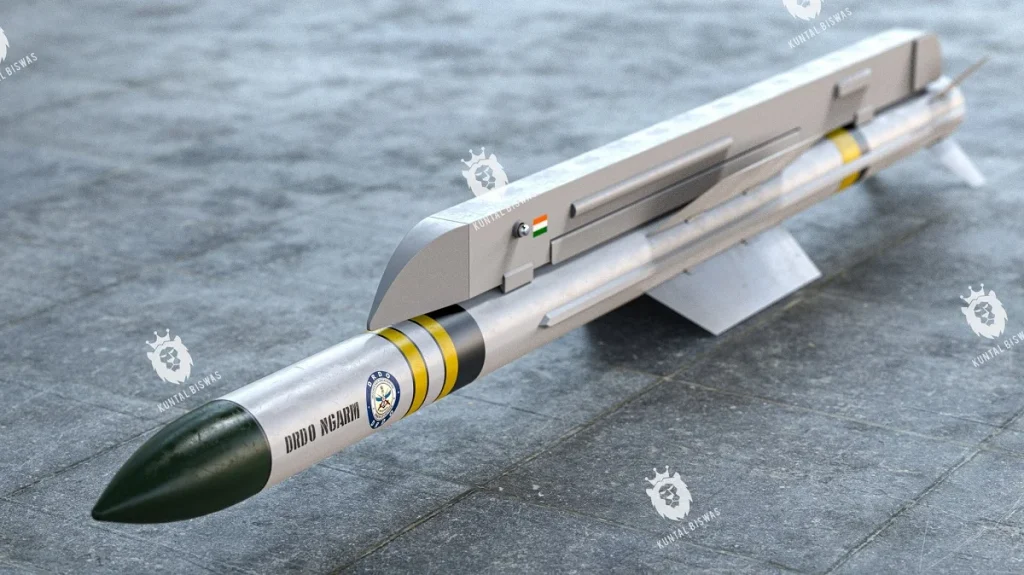
The DRDO developed Rudram 1 is intended for suppression and destruction of enemy air defenses. An anti radiation missile can home on radar emissions, allowing aircraft to attack hostile emitters without relying solely on conventional target coordinates.
Such weapons create a dilemma for air defense operators: transmitting may expose the radar to attack, while shutting down may reduce situational awareness. Modern systems therefore use mobility, emission control, decoys, distributed sensors, and coordinated engagement tactics rather than relying on one radar site.
Directed energy weapons:
High power microwave and other directed energy concepts could eventually help defend against drone swarms, electronics, and selected missile threats. Their advantages may include rapid engagement and a potentially deep magazine, but effectiveness depends on power generation, beam control, atmospheric conditions, range, target vulnerability, and operational maturity.
NavIC and resilient navigation:
NavIC gives India an independent regional satellite navigation capability and can reduce reliance on foreign navigation services. However, independence of constellation does not remove the basic vulnerability of RF navigation signals: they can still be jammed or spoofed.
The strongest architecture is therefore layered. It combines NavIC with inertial navigation, anti jam antennas, terrain or image based navigation, celestial or alternative references, signal authentication methods, and procedures for operating without satellite updates.
Quantum communications and navigation:
India is also examining quantum communications and quantum sensing. Quantum communication may improve the ability to detect interception in specific architectures, while quantum clocks and sensors could support navigation when GNSS is unavailable.
These technologies should be viewed as emerging complements rather than immediate replacements for conventional military networks. Their value will depend on field ruggedness, range, integration, cost, and the ability to operate under combat conditions.
Why electronic warfare may matter more than missiles?
Electronic warfare does not replace missiles. It determines whether missiles, aircraft, radars, drones, and command networks can perform as intended.
A force with large inventories of precision weapons may still struggle if it cannot protect its navigation data, authenticate sensor inputs, maintain communications, and detect deception. Conversely, a force with resilient networks and adaptive EW can impose costs on a stronger opponent by slowing decisions, increasing uncertainty, and forcing the use of less efficient kinetic options.
The most important future capabilities are therefore not only longer-range weapons. They include:
- Distributed and redundant communications.
- Multi source navigation and timing.
- Anti jam and low probability of intercept links.
- Passive sensing and emission control.
- Cognitive EW with human supervision.
- Rapid software updates and adaptable threat libraries.
- Fiber optic and autonomous unmanned systems.
- Layered counter UAS defenses.
- Hard kill options against enemy emitters.
- Training for operations with degraded networks.
Conclusion
The electromagnetic spectrum has become a form of high ground. A military that controls it can protect its own decision cycle while disrupting the opponent’s ability to sense, communicate, navigate, and coordinate.
Ukraine demonstrates that precision weapons and drones can be degraded by persistent electronic attack. China’s military restructuring shows that information support is being treated as a strategic function. India’s investments in EW systems, anti radiation weapons, indigenous navigation, and directed energy research show why spectrum resilience is becoming central to national defense.
The future battlefield will not be purely kinetic or purely digital. It will be a combined contest in which algorithms, antennas, satellites, decoys, autonomous systems, cyber tools, and missiles work together.