

GRYD Explained
- Key takeaways
- In this explainer
- The short answer
- How a steam catapult works
- How EMALS works
- Steam vs EMALS at a glance
- Why Washington is fighting about it
- Timeline
- Who else uses electromagnetic catapults
- GRYD’s view
- Common questions
- Does the Gerald R. Ford use steam catapults?
- Is EMALS faster than steam?
- Why does the type of catapult matter for drones?
- Has the change to steam been approved?
- Sources
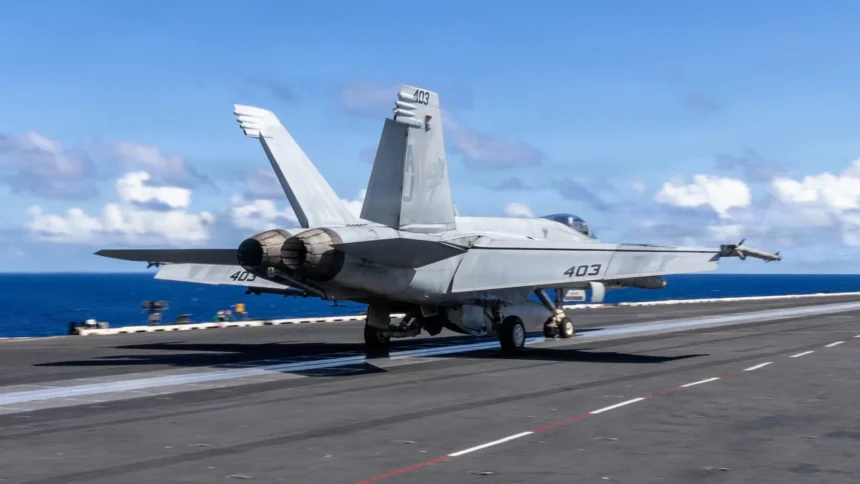
An aircraft carrier catapult flings a fully loaded jet from standstill to flying speed along a track built into the flight deck. Older US carriers do it with high-pressure steam pushing pistons. The new Ford class does it with a linear electric motor called EMALS. Which system future US carriers should use is now a political fight in Washington.
Key takeaways
- Steam catapults (the C-13 family on Nimitz-class carriers) use steam from the ship’s engineering plant to drive two rows of pistons that tow the aircraft along a slotted track.
- EMALS, built by General Atomics for the Ford class, replaces the steam with a linear induction motor whose thrust can be adjusted for each aircraft, from light drones to heavy jets.
- On 13 August 2026 President Donald Trump ordered a plan to fit steam catapults and hydraulic weapons elevators to the fourth Ford-class carrier, the future USS Doris Miller (CVN-81), instead of EMALS and the Advanced Weapons Elevators (White House).
- On 17 November the Republican chairman of the Senate Armed Services Committee, Roger Wicker, called a return to steam a “non-starter” (TWZ).
- China’s Fujian and France’s future carrier France Libre have both chosen electromagnetic catapults, so the debate is also about where carrier technology is heading worldwide.
The short answer
How do aircraft carrier catapults work? A catapult hooks the aircraft’s nose gear to a shuttle that runs in a slot along the deck. On steam catapults, high-pressure steam drives pistons that pull the shuttle. On EMALS, a linear electric motor pulls it instead, with power stored and released in seconds, and its thrust can be tuned for each aircraft.
A carrier’s deck is far too short for a fighter to reach take-off speed on its own engines with a useful load of fuel and weapons. The catapult adds the missing energy. At the other end of the flight, arresting wires catch the aircraft’s tailhook and stop it. Together, launch and recovery systems decide how many aircraft a carrier can send out and bring back each day, which is the number navies care about most: the sortie generation rate.
How a steam catapult works
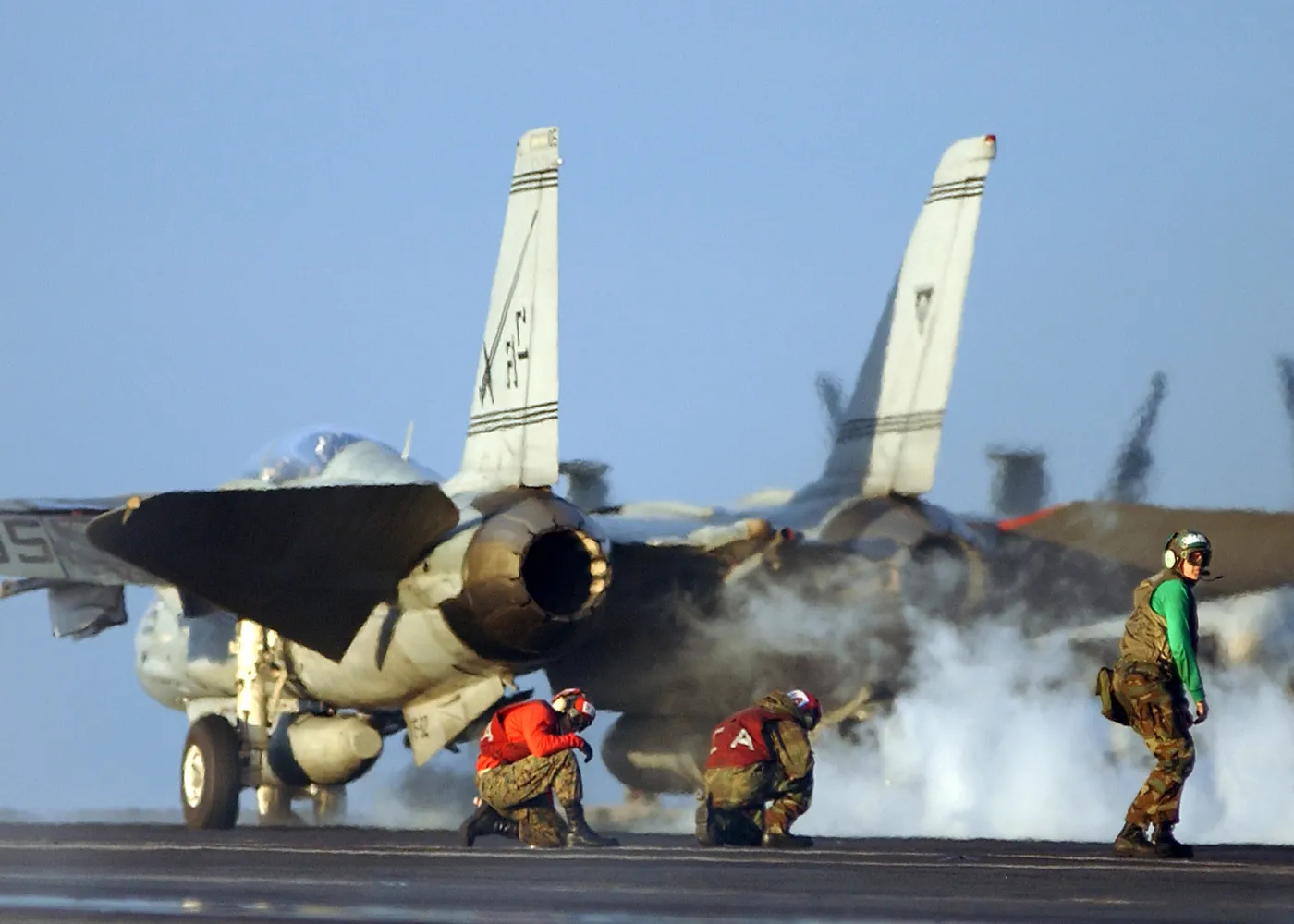
The US Navy’s C-13 catapults, used on all Nimitz-class carriers, are “steam powered, direct drive, flush deck type catapults that consist of two rows of slotted cylinders side-by-side in a trough under the flight deck”, according to a US Navy training system plan for carrier launch and recovery equipment (Navy Training System Plan, hosted by GlobalSecurity). Pistons inside those cylinders are connected to the shuttle that tows the aircraft.
The sequence is simple to describe and hard to engineer:
- Steam from the ship’s engineering spaces fills a large pressure vessel, the steam accumulator.
- The aircraft is connected tightly to the shuttle and held in place while its engines go to full power.
- The launch valve opens, steam rushes into the cylinders and the pistons, shuttle and aircraft accelerate down the track until the jet leaves the deck at flying speed.
- At the end of the stroke a water brake stops the pistons, and a retraction engine returns the shuttle to the start for the next launch.
Steam has a long record. “Steam has served us superbly,” veteran NAVAIR catapult engineer Modest Zacharczenko said in 2015, adding that steam would stay on Nimitz-class carriers “until 2059” (NAVAIR). Its costs are also well known: according to the Navy, each steam launch uses about 125 US gallons (roughly 470 litres) of fresh water, which the ship must make continuously, and the force applied to the aircraft is harder to fine-tune than with an electric motor.
How EMALS works
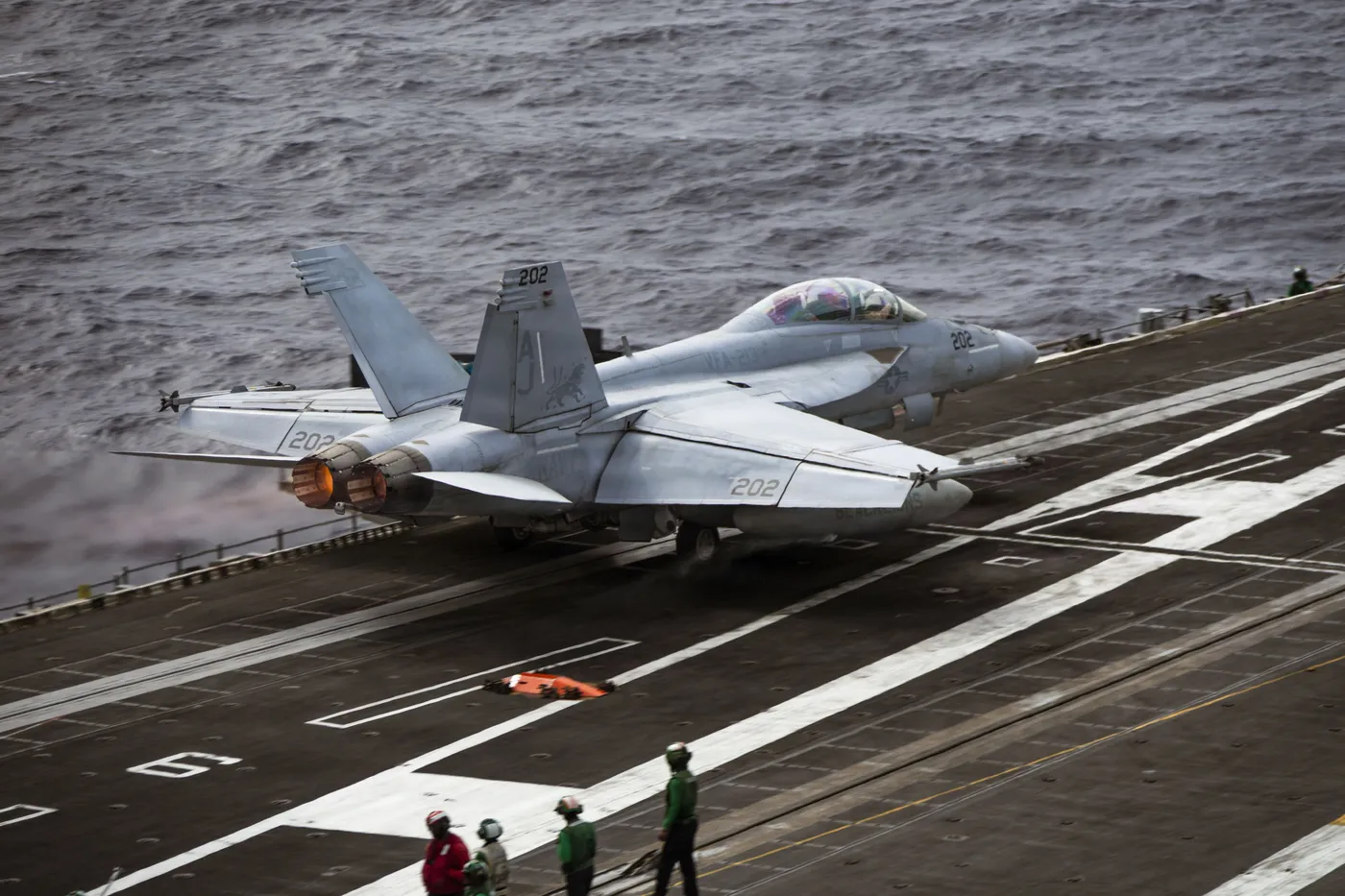
The Electromagnetic Aircraft Launch System replaces steam and pistons with electricity. General Atomics, which builds it, says EMALS is “powered by a linear induction motor with adjustable thrust” and supports aircraft from “emerging lightweight platforms” to strike fighters, electronic warfare jets and airborne early warning aircraft (General Atomics).
In simple terms, a linear motor is an ordinary electric motor unrolled into a straight line. Energy is drawn from the ship’s power plant between launches and stored in large rotating motor-generators. At launch it is released in a burst, converted by power electronics and fed to the motor segments along the track, which push the shuttle forward. Because the computer controls the current, the push can be set for each aircraft’s weight and the speed it needs. General Atomics says the system recharges in under one minute; that is a manufacturer claim.
That controllability is why the Navy chose it. The Senate Appropriations Committee, in a draft funding bill statement this week, singled out unmanned aircraft as one area where the two catapult types differ, and TWZ notes that EMALS can be “more finely tuned” for lighter drones such as the MQ-25 Stingray tanker (TWZ).
The weakness has been reliability. The Pentagon’s Director, Operational Test and Evaluation (DOT&E) has reported for years that EMALS reliability is well below its requirement. Its FY2019 report said the crew cannot readily isolate EMALS components during flight operations because of shared energy storage and power conversion equipment, and that spinning down the motor-generators takes 1.5 hours (DOT&E FY2019). In its FY2024 report, DOT&E said the Ford’s air wing made 8,725 EMALS launches during its deployment, but that reliability had not appreciably changed and reliance on off-ship technical support remained a challenge (DOT&E FY2024).
Steam vs EMALS at a glance
Criteria: how each system works and what has been publicly stated about it, as of 18 November 2026. Figures are attributed to the source shown; where no official figure has been published, the cell says so.
| Feature | Steam catapult (C-13, Nimitz class) | EMALS (Ford class) |
|---|---|---|
| Power source | Steam from the ship’s engineering plant, stored in an accumulator (Navy training plan) | Electricity stored in rotating motor-generators, released through power electronics (DOT&E) |
| What moves the aircraft | Two rows of pistons in slotted cylinders towing a shuttle | Linear induction motor with adjustable thrust (General Atomics) |
| Fresh water use | About 125 US gallons (about 470 litres) per launch (US Navy via NAVAIR) | No steam used for launches |
| Tuning for light drones | Harder to fine-tune for light aircraft (TWZ) | Thrust set per aircraft, including lightweight platforms (General Atomics) |
| Recharge between launches | Not publicly confirmed in a comparable official figure | Under one minute (General Atomics claim) |
| Reliability record | Mature, in fleet service for decades | Below requirement, little change by FY2024 (DOT&E) |
| Sortie rate evidence | Nimitz baseline about 120 sorties in a 12-hour day, 240 in a 24-hour surge (DOT&E via USNI News) | Ford test reported at 120 to 130 percent of Nimitz, credited to the whole ship design (CNO via USNI News) |
| Ships fitted | Nimitz-class carriers | Gerald R. Ford in service; John F. Kennedy and Enterprise to keep EMALS |
One caution on the sortie numbers. Adm. Daryl Caudle, the Chief of Naval Operations, said the Ford’s February 2026 test produced rates “between 120 to 130 percent of Nimitz-class”, but he also said: “It’s not just the catapults and the arresting gear. It’s all the technologies, the whole system” (USNI News). The Navy’s own release said “preliminary reports” show the flight deck design together with EMALS and the Advanced Arresting Gear “have contributed to an increased sortie generation rate compared to that of a Nimitz-class carrier” (US Navy). The full data has not been published, so the test does not isolate how much of the gain comes from the catapults alone.
Why Washington is fighting about it
President Trump has criticised EMALS for years. His 13 August 2026 memorandum on Navy shipbuilding blames “overly complex designs” for cost growth and delays, and says the Department of War “will use proven, reliable, and affordable technologies and ship designs”. Section 2 gave the Secretary of War 60 days to produce a plan “to replace the Electromagnetic Aircraft Launch System and Advanced Weapons Elevators with steam and hydraulic systems for the construction of CVN-81” (White House). Inside Defense reported on 22 October that the Navy had completed that plan and sent it to the White House Office of Management and Budget (Inside Defense).
Congress is pushing back from both parties. At the 17 November confirmation hearing for acting Navy Secretary Hung Cao, Democratic Senator Tim Kaine said sailors on the Ford had told him EMALS works well and warned against a path “that will be more expensive and also less capable” (Breaking Defense). Chairman Wicker, a Republican, then said: “Returning to steam is a non-starter, and everybody needs to understand that” (TWZ).
Cao focused on delays rather than on the catapults themselves. “It’s delaying our carriers by seven years. We’re going to have five years where we’re going to be down to nine carriers,” he said of EMALS and the electromagnetic elevators. When Kaine asked whether that meant a return to steam launches, Cao began his reply with “No, no” and turned to the elevators before he was interrupted, so his position on the catapults remains unclear (TWZ).
The Senate Appropriations Committee went further in the statement accompanying its draft 2027 defence spending bill. It warned that “such a major redesign would result in many billions of dollars in additional costs and many years in program schedule delays”, and asked the Navy for a report comparing sortie rates, aircraft compatibility, manpower and costs for the two systems (quoted by TWZ).
The engineering problem is bigger than swapping one machine for another. TWZ notes that the Ford class was designed around EMALS: steam piping and the large piston systems would need space the ship does not have, and, citing a past Project on Government Oversight report, that the Ford’s reactor plant is set up to produce less steam than a Nimitz’s.
Timeline
- June 2015: EMALS is tested aboard the still unfinished Gerald R. Ford (NAVAIR).
- December 2021: The US notifies Congress of a possible sale to France of EMALS and the Advanced Arresting Gear for its next carrier (Federal Register).
- 22 September 2025: China’s navy says J-15T, J-35 and KJ-600 aircraft completed their first electromagnetic catapult launches on the Fujian (Xinhua, state media).
- 5 November 2025: Fujian commissioned as China’s first carrier with electromagnetic catapults (Xinhua).
- 26 February 2026: US Navy says preliminary data shows a higher sortie rate for the Ford than a Nimitz-class carrier.
- 13 August 2026: Trump memorandum orders a plan to fit steam and hydraulics to CVN-81.
- 22 October 2026: Navy plan reported delivered to the White House budget office.
- 17 November 2026: Senate Armed Services chairman calls a return to steam a “non-starter”.
Who else uses electromagnetic catapults
China. The Fujian, commissioned on 5 November 2025, is described by Chinese state media as China’s first aircraft carrier equipped with electromagnetic catapults. Xinhua reported that the navy said the J-15T fighter, the J-35 stealth fighter and the KJ-600 airborne early warning aircraft had completed catapult launches and arrested landings, and that the system was “fully domestically developed” (Xinhua). Those performance claims have not been independently tested. For the wider naval race, see our analysis of China’s shipbuilding lead over the US.
France. France’s next nuclear-powered carrier, named France Libre in March 2026, will carry three EMALS tracks and three Advanced Arresting Gear wires bought from the US through Foreign Military Sales, with commissioning targeted for 2038 (Naval News). A US notification published in January 2026 added a third EMALS launcher and raised the estimated total case value to US$2.076 billion (Federal Register).
Most other carrier navies, including those of the UK and India, launch jets from ski-jump ramps or vertically, without catapults. Britain is now adding jet-powered drones to its carriers: read our piece on the jet-powered drone heading for a British carrier.
GRYD’s view
In our reading, the steam-versus-EMALS argument is really two arguments mixed together. The first is about the past: EMALS, the arresting gear and the weapons elevators were all put on one ship at once, a decision USNI News links to the reliability problems that followed, and the Ford’s delays were long. That record is real and documented by the Pentagon’s own testers. The second is about the future: a carrier commissioned in the 2030s will serve into the second half of the century, when its air wing is expected to include more uncrewed aircraft. On that question, the evidence points the other way. China and France, the only other countries with catapult carriers in service or on order, both chose electromagnetic launch.
The strongest argument for steam is schedule and maturity, not performance. The strongest argument against it, made this week by senators of both parties, is that redesigning a ship built around electric launch could add the delays it is meant to prevent. Until the Navy’s plan and the full sortie test data are published, both sides are arguing with incomplete numbers. The report the Senate appropriators have asked for would be the first public, like-for-like comparison.
Common questions
Does the Gerald R. Ford use steam catapults?
No. The Ford uses EMALS. The memorandum covers only CVN-81, the future Doris Miller; according to USNI News, the first three ships of the class, including the future John F. Kennedy and Enterprise, keep EMALS (USNI News).
Is EMALS faster than steam?
Not in the sense of a higher launch speed. Both accelerate aircraft to flying speed. The claimed advantages are finer control, less wear on airframes and a quicker reset between launches, which can help sortie rates.
Why does the type of catapult matter for drones?
Light uncrewed aircraft need a gentler, precisely set push. An adjustable electric motor can deliver that more easily than a steam system sized for heavy jets.
Has the change to steam been approved?
No. A plan has been ordered and reportedly delivered, but Congress controls the funding and key senators oppose the change.
For more on how a carrier’s crew and machines are pushed on long deployments, read A Supercarrier Can Stay at Sea. But Can Its Crew? Follow all our naval coverage in the Seapower section and our aircraft carrier coverage.
Sources
- The White House, Rebuilding the United States Navy and America’s Shipbuilding Industrial Base (memorandum), 13 August 2026
- TWZ, Trump’s Demand For Steam Catapults On New Carriers Is A “Non-Starter”: Senate Armed Forces Chair, 17 November 2026
- Breaking Defense, Lawmakers challenge Trump’s push to bring steam catapults back to Ford-class carriers, 17 November 2026
- US Navy, USS Gerald R. Ford Crew Demonstrates Resilience, Readiness During Extended Deployment, 26 February 2026
- USNI News, USS Gerald R. Ford Sortie Test Exceeded Nimitz-class Performance, Says CNO Caudle, 24 August 2026
- USNI News, New White House Memo Calls for Foreign-Built Warships, 13 August 2026
- Inside Defense, Navy delivers steam catapult plan, now under White House review, 22 October 2026
- DOT&E, FY2024 Annual Report, CVN 78 and FY2019 Annual Report, CVN 78
- NAVAIR, Full Steam Ahead: Navy engineer’s career tracks evolution of catapult, 24 June 2015
- US Navy, CV/CVN Aircraft Launch and Recovery Equipment Navy Training System Plan, August 2002 (hosted by GlobalSecurity)
- General Atomics, EMALS and AAG
- Xinhua (state media), Three types of aircraft complete electromagnetic catapult-assisted takeoffs, landings on China’s carrier Fujian, 22 September 2025
- Naval News, France’s Next-Generation Aircraft Carrier Officially Named ‘France Libre’, March 2026
- Federal Register, Arms Sales Notification (France, EMALS), 91 FR 3874, January 2026
Last reviewed: 18 November 2026