

GRYD Explained
- Key takeaways
- In this explainer
- What is the GJ-11?
- How it works
- GJ-11 at a glance
- What the new footage shows
- Development timeline
- How it compares with US programmes
- Strengths and limitations
- Common questions
- Is the GJ-11 the same as Sharp Sword?
- Has the GJ-11 been used in combat?
- Can the GJ-11 fly from ships?
- Is it China’s version of the US CCA?
- Sources
The GJ-11 is China’s stealth uncrewed combat aerial vehicle (UCAV), a tailless flying-wing drone that carries its weapons inside its body. On 9 November 2026 Chinese state broadcaster CCTV aired the closest official footage of it yet and claimed it had completed its first live-fire strike, scoring a hit.
Key takeaways
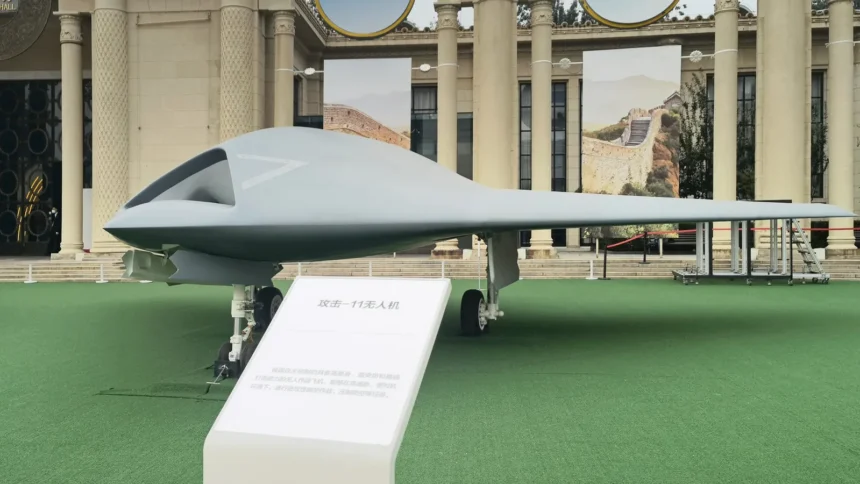
- CCTV’s footage shows the GJ-11’s two internal belly weapons bays, a dorsal air intake, a flattened exhaust and an undernose sensor fairing (Global Times, TWZ).
- CCTV says the drone’s missions include air strikes and suppression of enemy air defences (SEAD).
- The first live-fire hit is a Chinese state media claim: no date, target or weapon was given, and it has not been independently confirmed (The Aviationist).
- Planning scenes show the GJ-11 working with J-16 and J-20 fighters, the manned-unmanned teaming role China has been building towards since at least November 2025.
- Range, weight, payload and the level of autonomy are still not publicly confirmed.
What is the GJ-11?
GJ stands for Gongji, Chinese for “attack”. The GJ-11 is a jet-powered flying wing with no tail and no cockpit, built to fly strike and reconnaissance missions into defended airspace. The People’s Liberation Army Air Force (PLAAF) calls it Xuanlong, which TWZ translates as “Mystery Dragon”. Western sources often still call it Sharp Sword, the name of the earlier demonstrator it grew out of.
Its development is associated with Hongdu Aviation Industry Group, part of the state-owned Aviation Industry Corporation of China (AVIC), TWZ reports. The drone was first shown to the public at the National Day military parade in Beijing in October 2019.
What makes it notable is its class. Most of the military drones in the news, from Ukraine’s long-range strike drones to the US MQ-9 Reaper, are not stealthy and carry weapons outside the airframe. The GJ-11 is designed from the start to be hard to see on radar and to keep its bombs hidden until the moment of release.
How it works
Three design choices do most of the work. First, the engine intake sits on top of the fuselage, which hides the fan face from ground-based radar. Second, the exhaust is flattened and shielded inside the upper rear of the wing, reducing the heat and radar return seen from behind and below. Third, all weapons are carried internally, so there are no pylons or bombs on the outside to reflect radar energy. Chinese commentator Song Zhongping told Global Times the aircraft also uses radar-absorbing coatings; the coating itself cannot be verified from the footage.
The engine is reported to be a WS-13 turbofan, according to TWZ. China has not published thrust, speed or range figures.
The drone is flown by operators sitting in a ground command cabin. According to CCTV, as reported by Global Times, training sessions in the cabin usually run for more than six hours, and the whole cabin can be loaded onto a transport aircraft and moved to the front. The footage shows direct, operator-in-the-loop control; how much the GJ-11 can do on its own has not been disclosed.
GJ-11 at a glance
| Item | What is known | Status | Source |
|---|---|---|---|
| Type | Tailless flying-wing stealth UCAV | Confirmed by official footage | The Aviationist |
| Name | Xuanlong (“Mystery Dragon”) | Official PLAAF name | Global Times |
| Developer | Hongdu Aviation Industry Group (AVIC) | Reported | TWZ |
| Engine | WS-13 turbofan | Reported, not officially confirmed | TWZ |
| Weapons carriage | Two internal belly bays for air-to-surface munitions | Shown in footage; CCTV description | Global Times, TWZ |
| Missions | Air strike, SEAD, loyal wingman to crewed fighters | Chinese state media claim | Global Times |
| Sensors | Undernose electro-optical/infrared (EO/IR) fairing | Outside assessment from footage | TWZ, The Aviationist |
| Wingspan, weight, range, payload | Not publicly confirmed | Unknown | None |
| Service status | PLAAF said it entered service in November 2025 | Chinese state media claim | Global Times |
| Naval variant | GJ-21, claimed first launch and recovery on Type 076 ship Sichuan in October 2026 | Claimed, no footage released | TWZ |
What the new footage shows
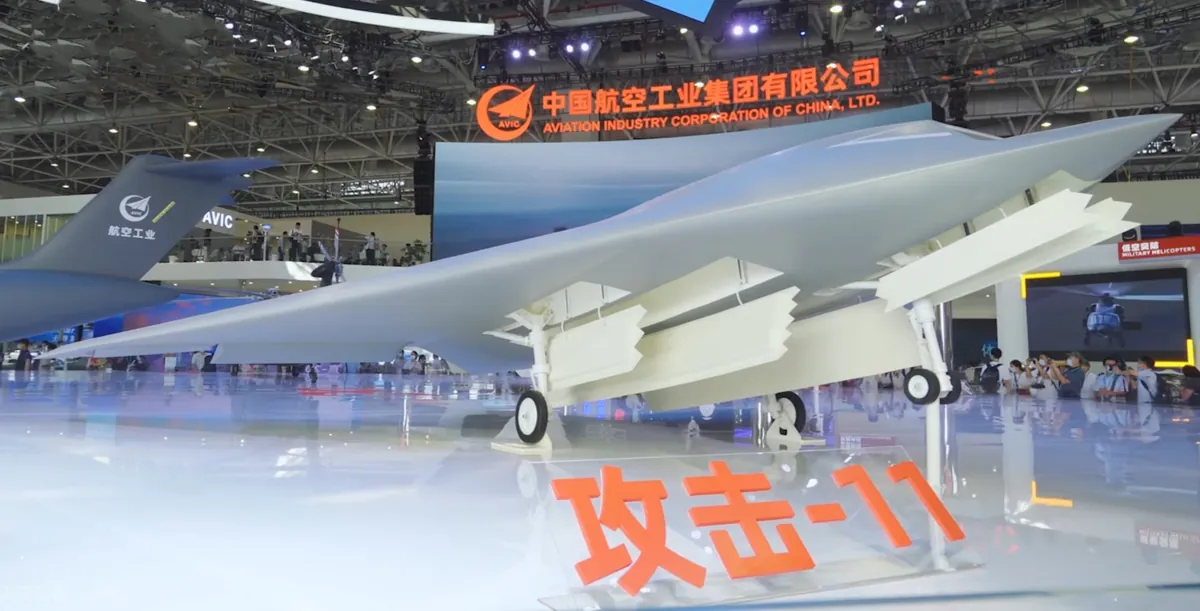
The CCTV segment, released two days before the PLAAF’s 77th anniversary on 11 November, gave outside analysts their first proper look at the real aircraft rather than models. The Aviationist notes the two bays sit between the main landing gear, each with its own doors, and that the doors have serrated edges, a common stealth feature. The bays were previously only shown on a model at Airshow China in 2021.
New sequences also show the landing gear retracting after take-off, which earlier footage did not. TWZ points out that numbers visible on several airframes may be design numbers rather than serials, and cites Andreas Rupprecht, an expert on Chinese aviation, who believes they point to low-rate initial production aircraft. Hangar images show three GJ-11s together and likely a fourth, TWZ notes.
The headline claim is the strike. Operator Shi Xiaoran told CCTV that cloud hid the target on the first pass; after circling again she found it, released the weapon and scored a hit. CCTV did not say when or where this took place or what weapon was used. As TWZ observes, a successful drop proves weapons employment, not autonomous targeting.
Development timeline
- Before 2019: years of work on the experimental Sharp Sword design lay the groundwork for the GJ-11 (TWZ).
- October 2019: the GJ-11 is unveiled at the National Day parade in Beijing.
- 2021: an AVIC model at Airshow China in Zhuhai shows two open weapons bays, each holding several precision-guided bombs, Global Times reporters said.
- July 2024: satellite imagery reviewed by TWZ shows two GJ-11s on the ramp at the Malan test base in Xinjiang.
- August to September 2025: three GJ-11s deploy to Shigatse in Tibet, according to TWZ.
- November 2025: a PLAAF 76th anniversary film shows the GJ-11 flying with a J-20 and a J-16D; Global Times says it revealed the drone had entered service.
- October 2026: China says the GJ-11-derived GJ-21 completed its first launch and recovery aboard the Type 076 amphibious assault ship Sichuan.
- 9 November 2026: CCTV airs close-up footage and claims the first live-fire strike.
How it compares with US programmes
The GJ-11 is often described as China’s answer to the US Air Force’s Collaborative Combat Aircraft (CCA). The comparison only goes so far. The Aviationist assesses it as a “relatively high-end, stealth-focused UCAV” rather than a cheaper, attritable drone, closer to Lockheed Martin’s Vectis concept than to the first-increment FQ-42A and FQ-44A.
The CCA effort is moving fast. Shield AI says its Hivemind autonomy software flew multiple CCAs in formation and ran beyond-visual-range counter-air tactics on 26 October, Defense News reports. The Air Force wants 500 combat-ready systems by 2032 and asked for a total of US$2.37 billion for the programme in its fiscal 2027 budget.
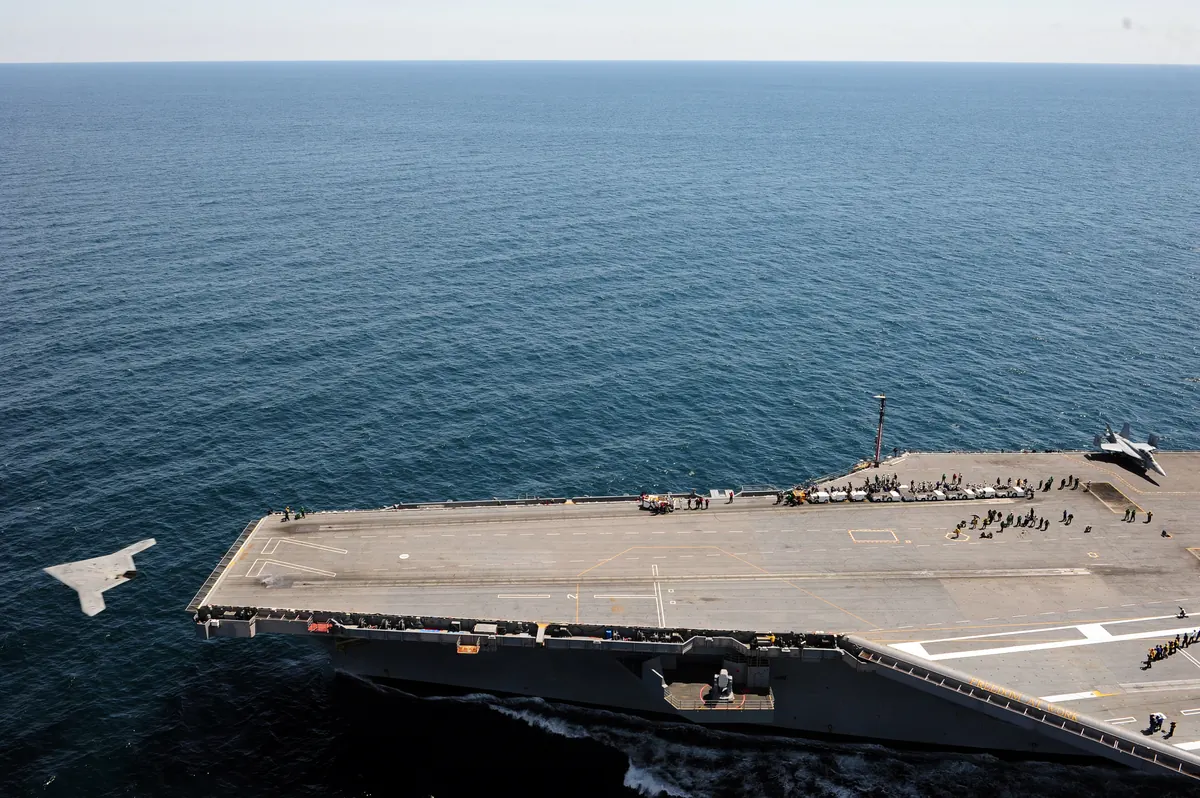
The sharper contrast is with America’s own past. In 2013 the US Navy’s X-47B became the first uncrewed aircraft catapulted from a carrier, and Boeing’s X-45 and Phantom Ray explored the same flying-wing strike concept. None became a publicly acknowledged frontline combat drone. TWZ argues the GJ-11 is “a genuine UCAV, not simply a loyal wingman designed to accompany a crewed fighter,” and calls the lack of a comparable, openly fielded US force a weakness. Classified US programmes may exist, which TWZ also acknowledges.
| Question | China: GJ-11 | US: CCA Increment 1 |
|---|---|---|
| Design priority | Stealth, internal weapons (The Aviationist) | Affordability and numbers (The Aviationist) |
| Shown flying with | J-20, J-16D (2025 film) | F-22 controlled a YFQ-44A in October 2026 (Defense News) |
| Claimed status | In service, first live-fire hit (state media) | In testing; 500 combat-ready planned by 2032 (Defense News) |
| Autonomy | Not disclosed; footage shows direct control | Hivemind multi-ship tactics flown 26 October (company release) |
Strengths and limitations
Strengths. A stealthy airframe with internal bays can go where non-stealthy drones cannot, and losing one costs no pilot. TWZ calls SEAD, hunting air defence radars and launchers, the most dangerous mission for a crewed combat aircraft, which makes it a natural fit. Paired with J-20 or J-16 fighters, the GJ-11 can add sensors and weapons to a formation and take the riskiest tasks.
Limitations and unknowns. Everything about performance rests on Chinese statements or outside inference from video. Range, payload, autonomy and the data links used for teaming are all undisclosed. Direct operator control in the footage suggests that, today at least, the drone depends on a secure link, which an opponent would try to jam. A single claimed hit also says little about reliability in a contested fight.
GRYD’s view. The footage does not reveal a new aircraft; it reveals intent. By putting serial-looking airframes, operators and fighter teaming on prime-time state TV, Beijing is signalling that the GJ-11 is a unit-level capability, not a test article. For the US and its Pacific allies, the question is less whether the GJ-11 is as good as advertised and more how many China builds, and whether the GJ-21 puts the same capability at sea.
Common questions
Is the GJ-11 the same as Sharp Sword?
Not exactly. Sharp Sword was the earlier demonstrator; the GJ-11 is the much more developed aircraft that followed it, though the old name is still widely used.
Has the GJ-11 been used in combat?
There is no public evidence it has. The live-fire strike CCTV described appears to be a training or test event, and no date or location was given.
Can the GJ-11 fly from ships?
The GJ-11 itself is land-based. Its naval derivative, the GJ-21, is designed for ships such as the Type 076, and China claims it has completed a first launch and recovery at sea.
Is it China’s version of the US CCA?
Partly. Both work with crewed fighters, but the GJ-11 appears larger, stealthier and more expensive than the first US CCA designs, and is also meant to fly strike missions on its own.
For more on how stealth fighters compare, read our F-22 Raptor vs J-20 Mighty Dragon comparison, our look at whether a drone can do airborne early warning, and how AI is reshaping war in Battlefield 2.0. Follow all our coverage in the Airpower section and on China.
Sources
- CCTV (state broadcaster), GJ-11 details segment, 9 November 2026 (Chinese)
- Global Times (state media), State media new footage offers rare, multi-angle look at GJ-11 drone, November 2026
- TWZ, China Lifts The Veil On Its GJ-11 Mysterious Dragon Stealth UCAV, 10 November 2026
- The Aviationist, Our Best Look Yet at China’s GJ-11 UCAV, 9 November 2026
- Defense News, First-ever Collaborative Combat Aircraft fly in formation, 10 November 2026
- U.S. Navy, An X-47B launches from USS George H.W. Bush, 14 May 2013
Last reviewed: 11 November 2026