
GRYD Head-to-Head
- Key takeaways
- In this Head-to-Head
- What was tested, and what we are comparing
- MQ-9B LoyalEye vs GlobalEye vs E-7A: the table
- Endurance: the drone’s headline advantage
- Crew: who is doing the thinking?
- Radar: the numbers nobody has published
- Sensors beyond the main radar
- Size, basing and cost
- Maturity and buyers
- What the table can’t show
- So which approach fits whom?
- Sources
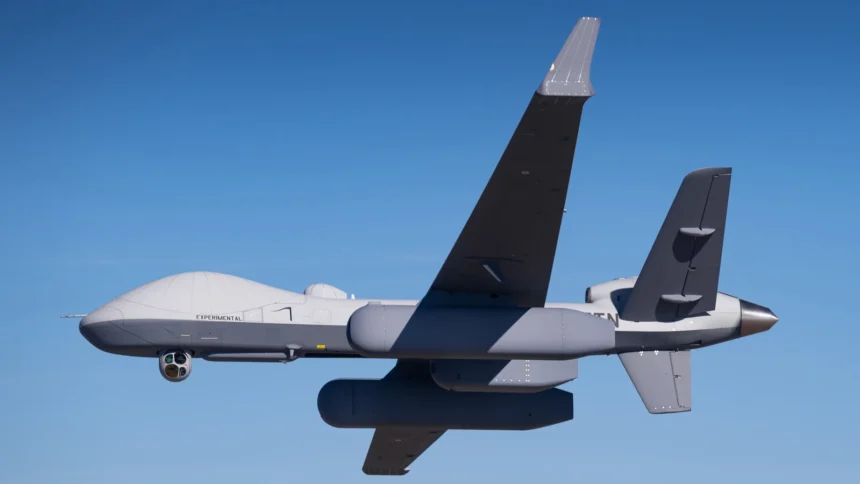
An uncrewed MQ-9B carrying Saab’s LoyalEye radar has tracked several fighter jets and airliners at once over Southern California, General Atomics and Saab said on 28 October 2026. That raises a simple question: can a drone do the job of a crewed early warning jet like GlobalEye or the E-7 Wedgetail?
Key takeaways
- GA-ASI and Saab say an MQ-9B with LoyalEye radar pods tracked several airborne and maritime targets at long range, including multiple instrumented “red” fighter jets.
- Neither company has published LoyalEye’s detection range, the number of sorties flown or a launch customer.
- The MQ-9B can fly for 40+ hours, against more than 12 hours for GlobalEye, but it carries no mission crew on board.
- Both firms pitch the drone as a complement to crewed AEW&C fleets, not a replacement.
What was tested, and what we are comparing
Airborne early warning (AEW) aircraft are flying radar stations. They sit high above friendly territory, look far beyond the horizon that limits ground radars, and spot incoming aircraft, missiles and ships early enough for commanders to react. For decades that has meant big, expensive jets with a team of operators in the back.
According to General Atomics Aeronautical Systems (GA-ASI), testing ran “over the past few months” from its Desert Horizon flight operations facility in Southern California, using a GA-ASI-produced MQ-9B with Saab’s LoyalEye radar installed in payload pods. The company said the aircraft demonstrated “simultaneous tracking of several airborne and maritime targets at long ranges”, and that the airborne targets included “multiple instrumented red fighter jets and several commercial aircraft”. “Red” aircraft are those playing the adversary.
Saab’s release adds that the flight validated the system’s ability to “detect, track, and classify airborne targets from an unmanned platform”, with stakeholders watching in real time. The programme began with a first flight with the AEW pods on 19 May 2026, using a company-owned aircraft.
“This has been one of the most highly anticipated flight tests we have performed,” said GA-ASI President David R. Alexander. “The level of customer interest in AEW capability on MQ-9B throughout the world is extremely high. It just makes sense.”
This Head-to-Head compares three ways of putting a radar in the sky: the uncrewed MQ-9B with LoyalEye, Saab’s crewed GlobalEye business-jet system, and Boeing’s crewed E-7A Wedgetail, using the Royal Australian Air Force (RAAF) version because its specifications are published. The criteria are endurance, crew, radar, platform size, maturity and buyers. Figures come from the manufacturers’ and the RAAF’s own pages as of 29 October 2026. Where a number has not been published, we say so.
MQ-9B LoyalEye vs GlobalEye vs E-7A: the table
| Criterion | MQ-9B + LoyalEye | Saab GlobalEye | E-7A Wedgetail (RAAF) |
|---|---|---|---|
| Crew on board | None (remotely piloted) | Flight crew plus mission operators (number not published by Saab) | Pilot, co-pilot, air battle managers, electronics analysts; 10 mission consoles |
| Endurance | Up to 40+ hours (SkyGuardian) | More than 12 hours | Range 7,040 km; extendable with air-to-air refuelling |
| Main radar | Saab LoyalEye, in payload pods | Saab Erieye ER, AESA | Northrop Grumman MESA |
| Published radar range | Not disclosed (“long ranges”) | Not published (“significantly increased” over earlier Erieye) | In excess of 400 km |
| Other sensors | Not publicly confirmed for the AEW fit | Maritime radar, EO/IR, ESM/ELINT, AIS, IFF/ADS-B | Secondary radar, self-protection, Link 11, Link 16, SATCOM |
| Airframe | MQ-9B, 24 m (79 ft) wingspan | Bombardier Global 6000/6500 business jet | Boeing 737-700, 34.3 m wingspan |
| Status | Flight testing since May 2026 | In service; NATO negotiating for up to ten | In service; six with RAAF No. 2 Squadron |
| Named customer | None announced | Two ordered by a Middle East country; NATO talks | RAAF (six aircraft) |
Endurance: the drone’s headline advantage
Persistence is the MQ-9B’s strongest card. GA-ASI says the SkyGuardian can fly “for up to 40+ hours” via satellite link. That figure is for the standard aircraft; GA-ASI has not said how much the AEW pods reduce it. Saab’s GlobalEye material quotes more than 12 hours of endurance. The RAAF lists the Wedgetail’s range as 7,040 km and notes it can be refuelled in flight, which stretches missions but still depends on crew rest limits.
In practice, keeping one radar orbit going around the clock takes several crewed aircraft rotating through it. A drone that stays up three times longer could, in theory, cover the same orbit with fewer take-offs. That is the core of GA-ASI’s pitch.
Crew: who is doing the thinking?
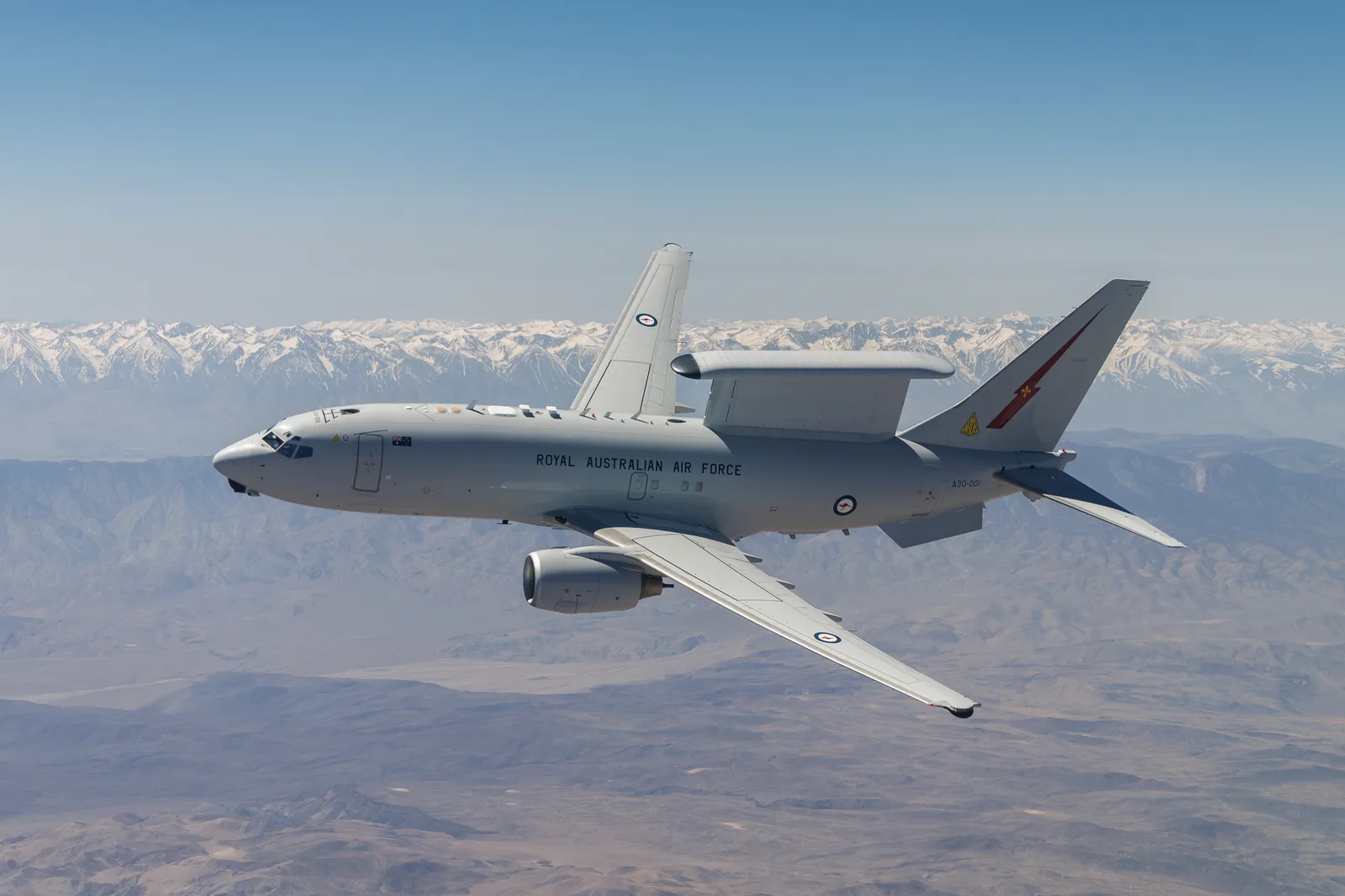
This is the biggest difference, and the hardest to put in a table. The “C” in AEW&C stands for control. On the E-7A, air battle managers sit at 10 consoles and direct fighters in real time from inside the aircraft. GlobalEye also carries operators on board.
The MQ-9B has nobody on board. GA-ASI says battle management, command and control (BMC2) can instead be done “in a distributed fashion” wherever the right infrastructure exists, “whether that be on the ground, on a ship or on an existing manned AEW aircraft”. That removes the risk to crew, which GA-ASI and Saab both stress. It also means the drone’s picture is only as useful as the data links carrying it, and links can be jammed, a problem we covered in our guide to electronic warfare.
Radar: the numbers nobody has published
Only one of the three has a public range figure: the RAAF says the Wedgetail’s MESA radar reaches “in excess of 400km”. Saab describes the GlobalEye’s Erieye ER as an adaptive active electronically scanned array (AESA) with detection and tracking range “significantly increased”, without giving a number. For LoyalEye, the companies say only “long ranges”, and AeroTime notes that GA-ASI did not disclose detection ranges, the number of sorties or the dates of the campaign.
Physics matters here. A radar’s reach depends heavily on antenna size and power, and a pod under a drone’s wing has far less room and electrical power than a large array on a 737 or a Global 6500. So it would be surprising if LoyalEye matched the crewed systems on raw range. Saab does not claim it does. It says LoyalEye “is designed to complement existing AEW&C solutions by providing additional flexibility and persistence”.
Sensors beyond the main radar
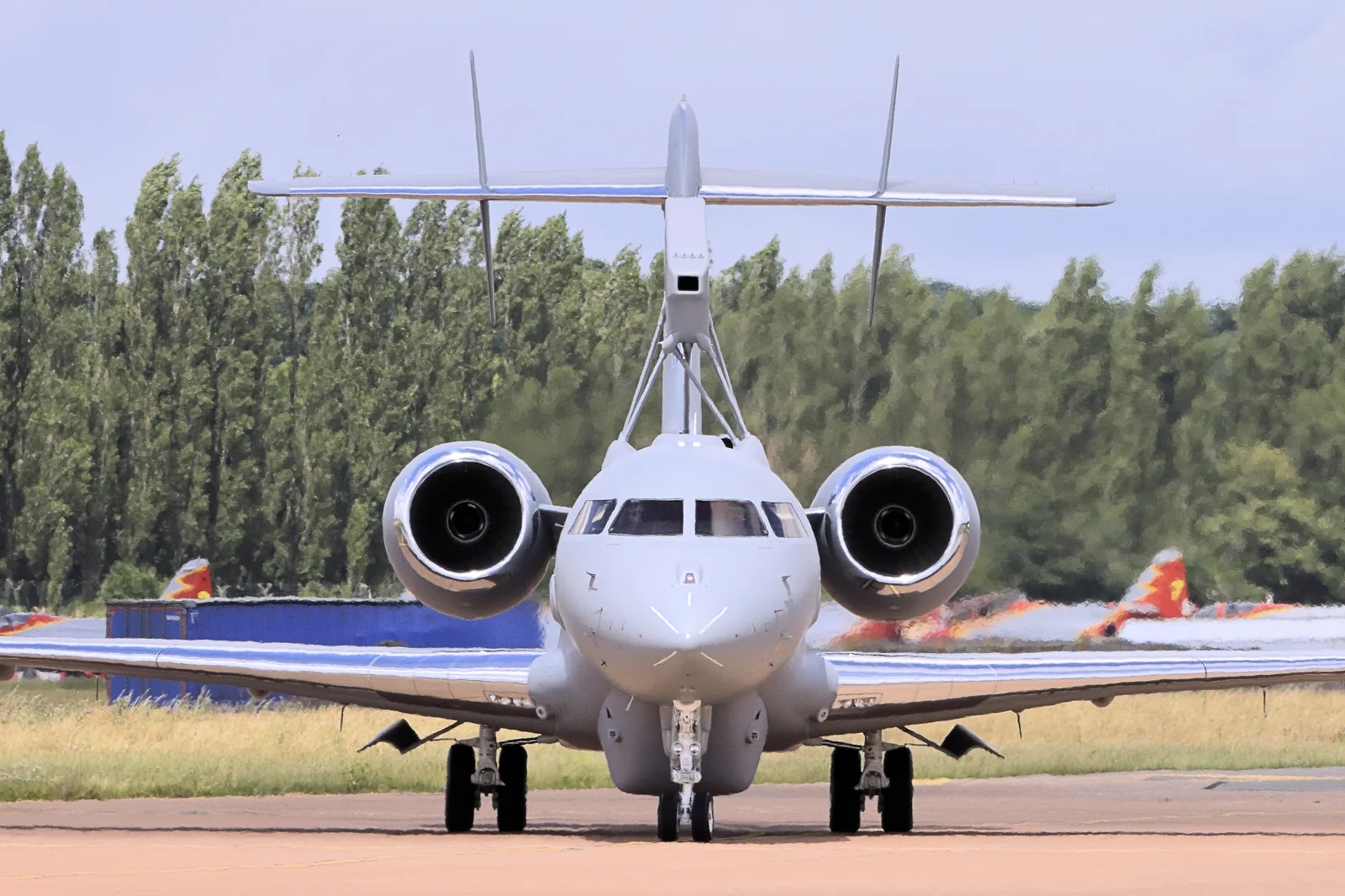
GlobalEye is built as a multi-domain system. Saab lists a separate maritime surveillance radar, an electro-optical sensor, ESM/ELINT for picking up enemy emissions, AIS ship tracking and IFF/ADS-B, and says it can detect objects “down to the size of a periscope”. The Wedgetail pairs its MESA with secondary radar and a wide communications fit, including Link 16. GA-ASI’s AEW page lists electronic warfare capabilities among the MQ-9B AEW offer, but the exact sensor fit flown in the tests has not been published.
Size, basing and cost
The Wedgetail is an airliner-sized aircraft with a 34.3 m wingspan and a maximum take-off weight of 77,565 kg, according to the RAAF. GlobalEye uses a business jet that Saab says needs 6,500 ft of runway. The MQ-9B has a 24 m wingspan, nine hardpoints and up to 2,155 kg of external payload. GA-ASI is also developing an MQ-9B STOL version for naval aircraft carriers, which would put AEW on decks that cannot handle a conventional AEW aircraft.
On cost, GA-ASI’s AEW page claims the drone does the job “at a fraction of the cost of manned platforms”. That is a manufacturer’s claim. No price for the AEW configuration has been published, so it cannot be checked yet.
Maturity and buyers
The crewed systems are proven and selling. The RAAF operates six Wedgetails from RAAF Base Williamtown. Saab said on 7 July 2026 that NATO would begin formal negotiations for up to ten GlobalEye aircraft to replace its existing AEW&C fleet, though no contract has been signed. Saab has also announced an order for two GlobalEye aircraft from a country in the Middle East, worth SEK 10.1 billion with deliveries in 2030, plus a non-binding term sheet with Canada and a letter of intent from the Netherlands.
LoyalEye on the MQ-9B is still in development. GA-ASI says it is “discussing unmanned AEW capabilities on MQ-9B with several customers” but has named none. Its May release said the effort should culminate in a full-capability demonstration later this year. The MQ-9B itself, though, is already in service, including with the UK’s Royal Air Force as the Protector RG Mk1, which gives existing operators a possible upgrade path.
What the table can’t show
- Survivability: GA-ASI argues an uncrewed aircraft can “get closer to an adversary”. A slow, medium-altitude drone is also easier to shoot down. The difference is that losing one costs no lives. Drones are shot down routinely in today’s wars, as our report on Romanian F-16s downing Geran drones shows.
- Test conditions: a test range in California is not a contested, jammed airspace. The companies call the scenario “representative”, but the test details are not public.
- Integration: an AEW picture is only valuable if fighters and air defences can use it. How LoyalEye tracks feed into Link 16 networks has not been detailed.
So which approach fits whom?
There is no single winner here, because the three answer different questions. The E-7A and GlobalEye are complete flying command posts, with long-range radars and people on board to run the air battle. The MQ-9B with LoyalEye is a persistent sensor that can loiter for far longer, put no crew at risk and, if GA-ASI’s cost claims hold, be bought in larger numbers. For a country with no AEW fleet, it could be a first step. For NATO members buying GlobalEye or the E-7, it is more likely to be an extra set of eyes that frees the crewed jets for the hardest missions.
The questions to watch are the range figure for LoyalEye, the first named customer and whether the full-capability demonstration happens before the end of 2026. For how air defences use early warning data once they have it, see our Head-to-Head on SAMP/T NG vs Patriot, and for NATO’s wider plans, our explainer on “block, blunt, break”. More aircraft comparisons live in our Airpower section.
Sources
- GA-ASI: GA-ASI and Saab perform advanced AEW flight testing on uncrewed MQ-9B (28 Oct 2026)
- Saab: Saab and GA-ASI successfully flight test LoyalEye AEW capability on MQ-9B (28 Oct 2026)
- GA-ASI: first flight of MQ-9B with AEW pods (21 May 2026)
- GA-ASI: MQ-9B SkyGuardian and Airborne Early Warning product pages
- Saab: GlobalEye AEW&C and NATO selects Saab’s GlobalEye (7 Jul 2026)
- Royal Australian Air Force: E-7A Wedgetail
- AeroTime: MQ-9B drone tracks fighter jets at long range with Saab’s LoyalEye radar (28 Oct 2026)