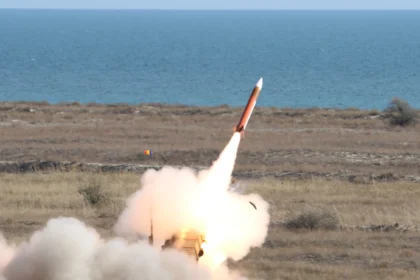


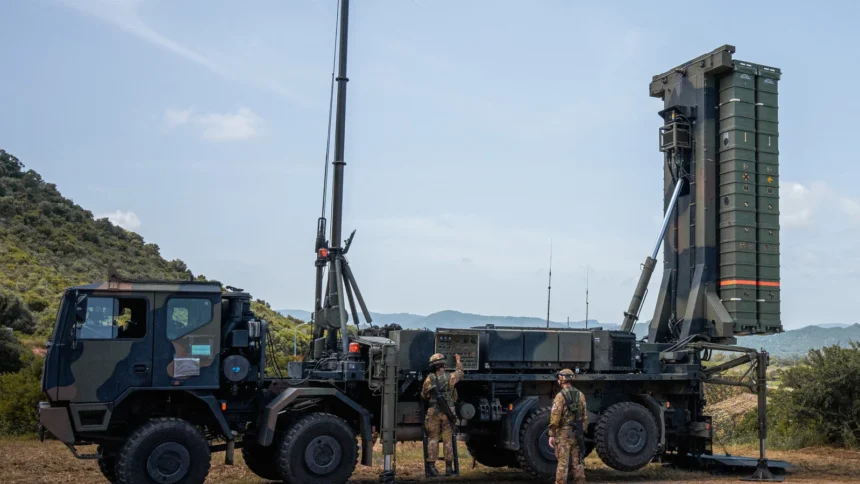
France has ordered four more SAMP/T NG air and missile defence systems, its procurement agency said on 21 October 2026, taking its planned fleet to 12. The Franco-Italian system is Europe’s home-grown challenger to the US-made Patriot. Here is how the two compare on published specifications, users and, above all, delivery.
Key takeaways
- France’s Direction générale de l’armement (DGA) ordered four more SAMP/T NG sections from the Eurosam consortium of MBDA and Thales. Ten of France’s 12 are due by the end of 2030 (DGA statement, 21 October 2026).
- Patriot is far more widespread: Raytheon says it is used by 19 nations and that it has built more than 240 fire units (RTX).
- SAMP/T NG has four declared customers so far: France, Italy, Denmark and Ukraine (DGA).
- Switzerland says its five Patriot fire units now face a delay of five to seven years, and it is weighing a second, preferably European-made, system (armasuisse, 13 May 2026).
- The published figures do not line up neatly: France gives range and altitude for its Aster interceptor, while Lockheed Martin publishes no range figure for the PAC-3 MSE.
What France ordered
The DGA said it ordered four more sections of the SAMP/T NG (Sol-Air Moyenne Portée/Terrestre Nouvelle Génération, a land-based surface-to-air system) from Eurosam, the joint venture of MBDA and Thales, through the Organisation for Joint Armament Co-operation (OCCAR). The order brings the French Air and Space Force’s planned total to 12. Ten will be delivered before the end of 2030, and the first was delivered in early 2026, the agency said in its statement, reproduced in full by Mer et Marine. No contract value was published.
France’s 2024 to 2030 military programming law originally planned eight systems by 2030 and 12 by 2035, the French defence site Opex360 notes. The updated law brings two of those forward to 2030. This is an order, not an induction: most of the 12 do not exist yet.
The DGA’s own claim is ambitious. Paired with the future Aster B1NT missile, it says, SAMP/T NG “sera le seul système européen de défense sol-air capable d’intercepter des menaces balistiques et hypersoniques” (will be the only European surface-to-air system able to intercept ballistic and hypersonic threats; GRYD translation). That is a stated design goal, not a proven combat result.
How we compared them
This Head-to-Head compares the newest versions each buyer in Europe is choosing between today: SAMP/T NG with the Aster 30 B1NT interceptor and the Thales Ground Fire 300 (GF300) radar, against Patriot with the Lockheed Martin PAC-3 MSE (Missile Segment Enhancement) interceptor and Raytheon’s new Lower Tier Air and Missile Defense Sensor (LTAMDS) radar. Older Patriot radars and the earlier SAMP/T, nicknamed Mamba, are still in service and are not the subject here.
Five criteria: the interceptor, the radar, who uses each system, combat record, and how quickly a new buyer can get one. Figures come from governments and the makers, as of 22 October 2026. Where a figure has not been published, the table says so. Makers’ numbers describe the system as offered, not guaranteed performance against every target.
SAMP/T NG vs Patriot at a glance
| Criterion | SAMP/T NG | Patriot (PAC-3 MSE, LTAMDS) | Source |
|---|---|---|---|
| Makers | Eurosam (MBDA, Thales) | Raytheon (system, radar); Lockheed Martin (PAC-3 MSE) | DGA; RTX; Lockheed Martin |
| Main interceptors | Aster 30 B1 and Aster 30 B1NT | PAC-3 MSE, PAC-3 CRI, GEM-T | MBDA; Lockheed Martin; RTX |
| Published interceptor reach | Aster 30 B1NT: 150 km range, intercepts up to 25,000 m altitude | PAC-3 MSE: not published by Lockheed Martin | Defense News; Opex360; Lockheed Martin product card |
| Radar | GF300 (France, Denmark): 360 degrees, 350 km; Italy uses Leonardo’s Kronos Grand Mobile HP | LTAMDS: three arrays for 360-degree coverage; range not published | Opex360; Defense News; RTX |
| Ready missiles | 48 Aster per French section | Up to 12 PAC-3 MSE per launcher | Opex360; Lockheed Martin |
| Users | France, Italy, Denmark and Ukraine have chosen the NG version | 19 nations use Patriot; 17 have chosen PAC-3 | DGA; RTX; Lockheed Martin |
| Combat record | MBDA cites Aster use in the Red Sea and Ukraine; no combat use of the NG version publicly confirmed | 250+ combat engagements by five nations; 150+ ballistic missiles intercepted since January 2015 (Raytheon figures) | MBDA; RTX |
| Delivery outlook | France: 10 of 12 by end-2030. Denmark: from 2028 | Switzerland: delay of five to seven years. Netherlands: delivery could slip to 2033 | DGA; Defense News; armasuisse |
Interceptors: Aster 30 B1NT vs PAC-3 MSE
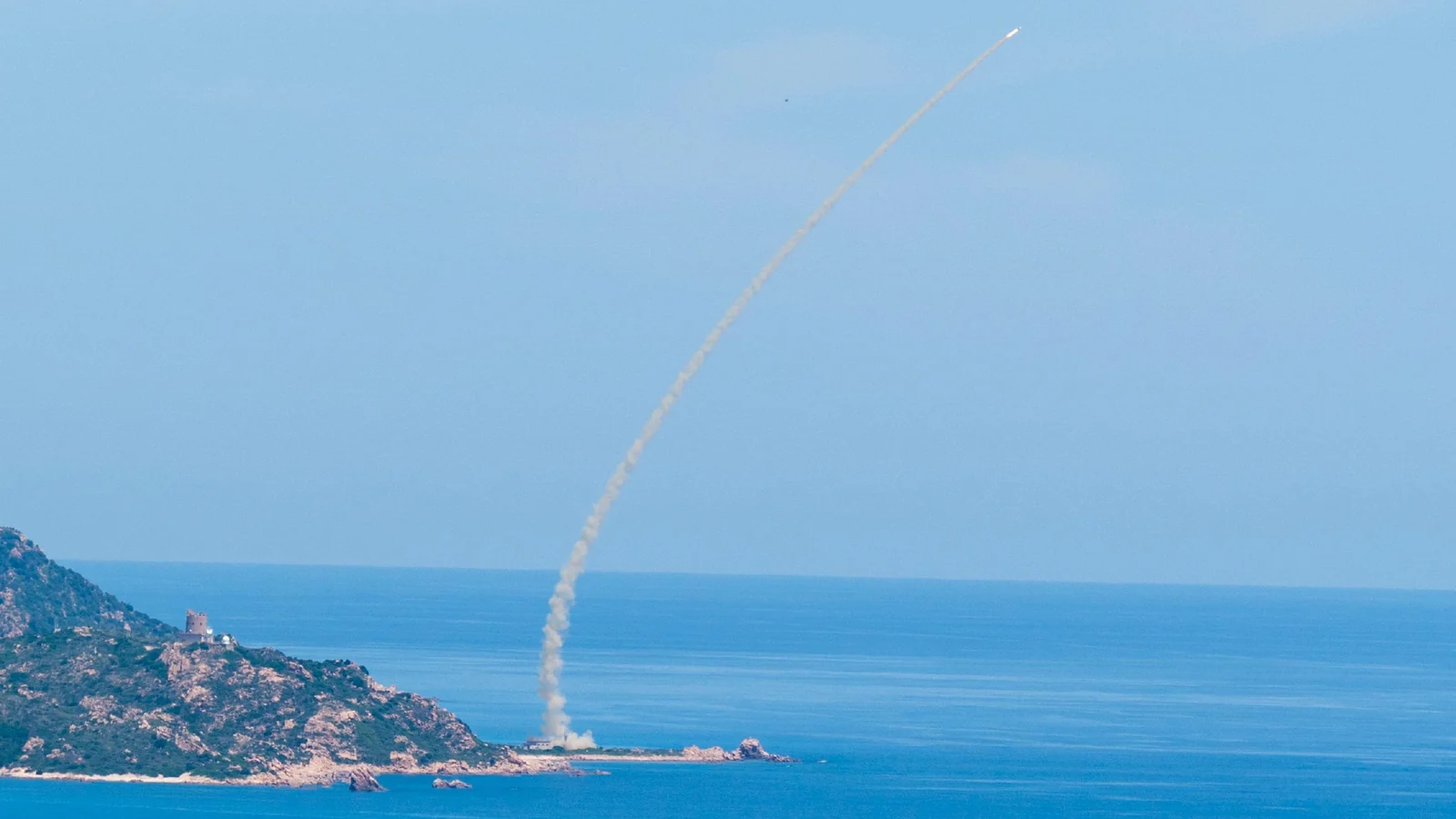
The Aster 30 B1NT is the new interceptor at the heart of SAMP/T NG. Defense News reports it has a 150 km range and a new Ka-band seeker, and is designed to intercept medium-range ballistic missiles as well as hypersonic missiles. It was first test-fired in October 2024, with a second qualification firing in July 2025. MBDA says that second firing validated the missile at very long range and at an altitude beyond 25 km. The DGA still calls it the “futur missile ASTER B1NT”, so it is in qualification, not yet in operational service.
The PAC-3 MSE is in production and in service. Lockheed Martin’s product card says the PAC-3 family uses “direct body-to-body contact” (hit-to-kill) rather than a blast-fragmentation warhead, and that a two-pulse rocket motor gives the MSE more altitude and range than the earlier PAC-3 CRI (Cost Reduction Initiative). It publishes no range figure. Patriot batteries can also fire Raytheon’s GEM-T (Guidance Enhanced Missile-Tactical), which Raytheon describes as a complement to PAC-3 against ballistic missiles, cruise missiles and aircraft.
So the two missiles cannot be ranked on reach from official data: one side publishes a range and the other does not. What can be compared is status. The PAC-3 MSE is a production missile in service with many users; the Aster 30 B1NT is still completing qualification.
Radar and coverage
Both systems are moving to radars that look in every direction at once. The GF300 on France’s SAMP/T NG covers 360 degrees in azimuth and 90 degrees in elevation out to 350 km, and a French section has 48 Aster missiles ready to fire, with an engagement module able to handle up to 100 targets, Opex360 reports. Thales gives the Ground Fire family a claimed range of up to 400 km, Defense News reports. Italy’s version uses a different radar, Leonardo’s Kronos Grand Mobile HP, so “SAMP/T NG” is not one identical package.
On the Patriot side, Raytheon says LTAMDS has a primary array at the front and two secondary arrays at the back, working together to detect and engage threats from any direction. The primary array is about the same size as Patriot’s current array but has “more than twice the power”. Raytheon does not publish a detection range.
Users and combat record
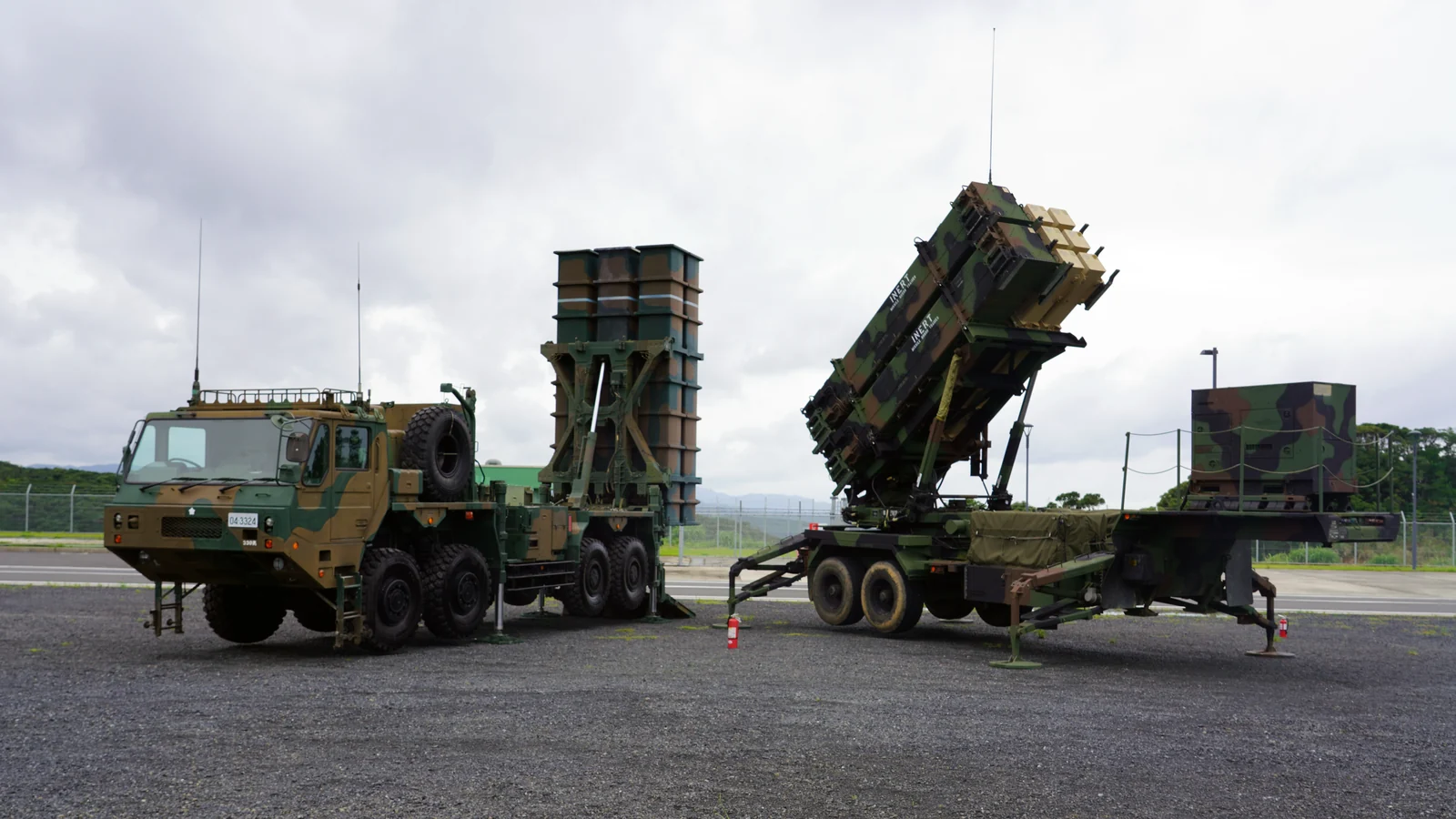
Here Patriot is far ahead. Raytheon says “Patriot is the foundation of integrated air and missile defense for 19 nations”, that five nations have used it in more than 250 combat engagements, and that it has intercepted more than 150 ballistic missiles in combat since January 2015 (RTX). Those are the maker’s figures. Lockheed Martin says 17 nations have chosen PAC-3 and that it has produced more than 2,500 PAC-3 MSEs (PAC-3 Fast Facts).
SAMP/T NG is a much smaller club. France and Italy ordered eight and ten systems respectively in September 2024, and the Italian Army took its first in January 2026, Defense News reports. Denmark signed its orders in the first quarter of 2026. The DGA says Ukraine has also chosen the system. MBDA points to Aster use “in the Red Sea and Ukraine”, but no combat use of the NG version has been publicly confirmed as of 22 October 2026.
Delivery and production: the deciding factor
For European buyers in 2026, the most important line in the table may be the last one. Switzerland’s parliament approved five Patriot fire units in 2022 (Swiss defence department paper). Its procurement office, armasuisse, said in May that the United States had first estimated a four to five year delay after reprioritising deliveries to Ukraine in July 2025, and now expects five to seven years because of the war in the Middle East, with higher costs. Bern is withholding payments until it gets firm terms (armasuisse).
Switzerland has since evaluated firm bids for a second long-range system, with Eurosam’s offer reported to be the favourite, but the purchase will not be completed by the end of 2026 as planned (Swissinfo, 5 October 2026). Bern has set aside CHF6 billion (about US$7.2 billion) for that system and part of the extra Patriot costs. The Netherlands rushed through a Patriot order in March to keep its production slot, which it said could still push delivery back to 2033, according to Defense News.
Denmark made its call earlier. Its Ministry of Defence chose SAMP/T for its long-range needs after “a comprehensive assessment of operative, economic, and strategic factors” (Danish Ministry of Defence, September 2025), and Thales says Danish deliveries start in 2028. Production is rising on both sides: MBDA plans to double Aster output in 2026 (Defense News) and Lockheed Martin says it is tripling PAC-3 MSE production.
GRYD analysis: the pattern is clear even if no government states it so plainly. Patriot wins on track record, numbers in service and interoperability across 19 nations. SAMP/T NG wins on something a growing number of European buyers now say they want: a European supply chain and a delivery date that is not tied to US priorities. France’s order is not a verdict that one system is better. It is a bet that a second, European production line for long-range missile defence is worth paying for, at a time when the Patriot queue is set in Washington. That debate is the same one behind Ukraine’s complaint that Patriot interceptors paid for by Europe are waiting on a US decision.
What the table can’t show
- Real-world kill rates. Neither maker publishes intercept rates that can be checked independently. A test success is not combat reliability.
- Unit cost. No contract value was published for France’s order, and package prices include radars, launchers, missiles, training and support, so they cannot be divided into a per-system price.
- Like-for-like range. France publishes 150 km for the Aster 30 B1NT; Lockheed Martin publishes no PAC-3 MSE range. Any head-to-head range figure would be a guess.
- Configuration. Italy’s SAMP/T NG uses a different radar from France’s and Denmark’s, and Patriot users field a mix of old and new radars and missiles.
- How many missiles each buyer can get. Interceptor stocks, not launchers, decide how long a battery can keep firing. Those numbers are classified.
What to watch next
- Switzerland’s choice of a second long-range system, which will not be completed in 2026 as first planned.
- The Aster 30 B1NT’s move from qualification into service, and the first confirmed combat use of SAMP/T NG.
- LTAMDS fielding, and Lockheed Martin’s PAC-3 Edge, a new interceptor it unveiled on 9 October 2026 for the US Army’s future interceptor programme (Lockheed Martin).
- Whether other European buyers follow Denmark. The DGA says other nations have shown interest but did not name them.
For more on Europe’s air defence gap, see our report on Romanian F-16s downing Russian-made drones over the Black Sea, our explainer on NATO’s “block, blunt, break” plan, and all our missiles and air defence coverage.
Sources
- DGA statement, 21 October 2026, reproduced by Mer et Marine: La DGA commande quatre systèmes supplémentaires de défense sol-air SAMP/T NG (French)
- Opex360 (Zone Militaire): DGA orders four more SAMP/T NG systems, 21 October 2026 (French)
- Defense News: Denmark to receive first SAMP/T NG air-defense system in 2028, 21 April 2026
- MBDA: Denmark chooses European SAMP/T NG to protect its sky, 8 October 2025
- Danish Ministry of Defence: Parties to the Defence Agreement approve historic investment in ground-based air and missile defence systems, 2025
- RTX Raytheon: Global Patriot
- RTX Raytheon: LTAMDS
- RTX Raytheon: Patriot Guidance Enhanced Missile
- Lockheed Martin: PAC-3 MSE product card (PDF)
- Lockheed Martin: PAC-3 Fast Facts, 2026 (PDF)
- Lockheed Martin: PAC-3
- armasuisse: Patriot, Schweiz prüft US-Optionen, 13 May 2026 (German)
- Swiss Federal Department of Defence (VBS): Bodluv GR, weiteres Vorgehen, discussion paper (German, PDF)
- Swissinfo: Swiss procurement of second missile defence system faces delays, 5 October 2026