

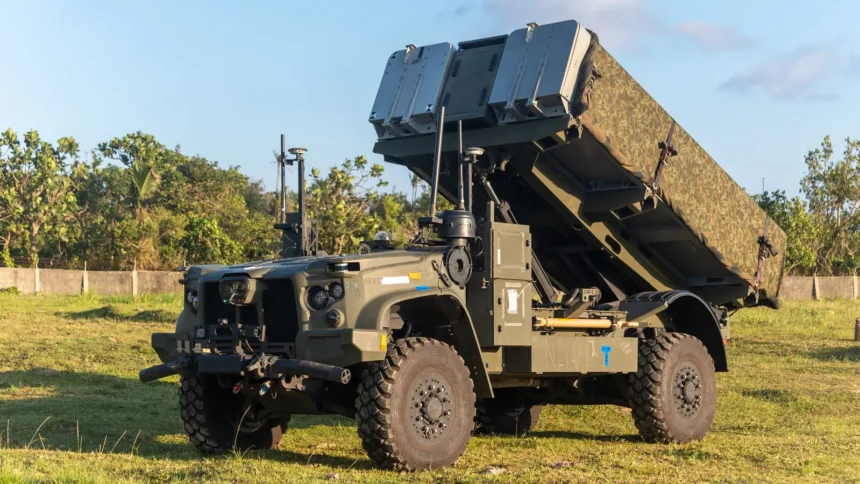
The US Marine Corps has turned 1st Battalion, 10th Marine Regiment at Camp Lejeune, North Carolina, from an artillery battalion into its first medium-range missile battalion, built around the NMESIS anti-ship missile launcher. The 2nd Marine Division said the re-designation took effect on 9 October 2026.
Key takeaways
- 1st Battalion, 10th Marines (1/10) is the first unit of its kind in the Marine Corps, and its conversion is “the start” of modernising the service’s artillery battalions, the 2nd Marine Division said.
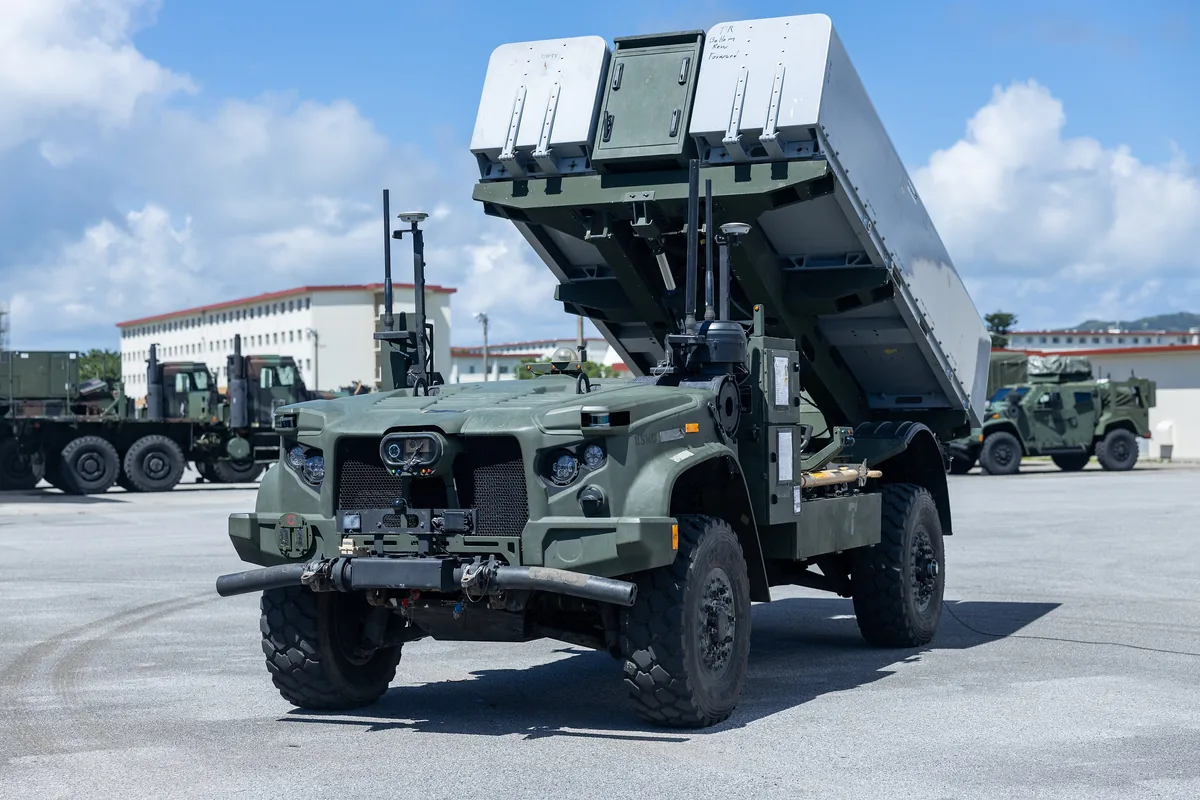
- The Navy-Marine Expeditionary Ship Interdiction System (NMESIS) is a remotely operated vehicle carrying a launcher for two Naval Strike Missiles, aimed at ships at sea and fixed targets on land (2nd Marine Division).
- The NMESIS units in public view so far have been the Pacific-based Marine Littoral Regiments in Hawaii and Okinawa. 1/10 is an East Coast unit of II Marine Expeditionary Force (II MEF).
- The 10th Marine Regiment keeps cannon artillery in another battalion. Its commander called NMESIS a complement to howitzers, not a replacement.
- The Marine Corps is building towards 18 launchers per missile battery, a level it expects to reach in fiscal year 2033 (Force Design update, October 2025).
What we know
According to a 2nd Marine Division release published on 15 October, 1/10 was selected to re-designate on 9 October 2026 in line with the Commandant’s Planning Guidance and the Force Design 2030 modernisation plan. The ceremony was held at WPT Hill Field, Camp Lejeune.
The battalion’s commanding officer, Lt Col Joseph Mozzi, set out the reason for the change. “The requirement for the Marine Corps to have a land-based capability to conduct sea denial was identified as a crucial step to facilitate the maritime component commanders to fight for sea control,” he said in the release. In the Marine Corps’ own definition, sea denial means partially or completely denying an adversary the use of the sea.
Col William Soucie, who commands the 10th Marine Regiment, said the new battalion would fire in support of forces on land and at sea. “What we will be able to do with [the NMESIS] is shoot in support of not only maneuver that’s already ashore, we will also be able to shoot in support of maneuver at sea,” he said. The regiment keeps its artillery capability in another battalion, and the Marines and sailors of 1/10 are the same people who served in it as gunners.

Background: how NMESIS reached a missile battalion
NMESIS pairs a launcher for two Naval Strike Missiles (NSM) with the Remotely Operated Ground Unit for Expeditionary (ROGUE) Fires carrier, an uncrewed version of the Joint Light Tactical Vehicle, according to the Congressional Research Service (CRS). A Marine Corps fact sheet cited by Stars and Stripes says each system includes three launch vehicles, one leader vehicle and one command and control vehicle.
The weapon grew out of Force Design 2030, the Marine Corps plan launched in March 2020 to reshape the service for naval warfare against a major power. That first plan, as summarised by CRS, called for cutting cannon artillery batteries from 21 to 5 and for a 300% increase in rocket artillery capacity. The best-known NMESIS users are the Marine Littoral Regiments of III Marine Expeditionary Force, Pacific formations meant to hold island positions within range of enemy fire. The October 2025 update adds that the same capabilities are being fielded across Marine Expeditionary Units.
NMESIS milestones at a glance
| Date | Milestone | Source |
|---|---|---|
| 2021 | NMESIS fires a Naval Strike Missile at a surface target at sea off Hawaii during Large Scale Exercise 2021 | 2nd Marine Division |
| 2023 / November 2024 | First launchers reach 3rd Marine Littoral Regiment in Hawaii. The Force Design update says six were fielded in 2023; 3rd Marine Division dates receipt to November 2024 | Force Design update; 3rd Marine Division |
| 26 April 2025 | First deployment to the Philippines, staged at Basco in the Batanes islands during Balikatan 25 | DVIDS |
| September 2025 | First deployment to Ishigaki Island, Japan, about 150 miles (240 km) east of Taiwan, for Resolute Dragon 25. No missiles fired | Stars and Stripes |
| 6 to 7 May 2026 | Balikatan 2026 maritime strike off northern Luzon: NMESIS provides simulated fires while a Japanese Type 88 missile and US Army High Mobility Artillery Rocket Systems (HIMARS) strike a target ship | US Pacific Fleet |
| 16 June 2026 | NMESIS arrives at Camp Hansen, Okinawa, for 12th Marine Littoral Regiment | 3rd Marine Division; Stars and Stripes |
| 9 October 2026 | 1/10 at Camp Lejeune re-designated as the first Medium-Range Missile Battalion | 2nd Marine Division |
How far can it reach? The published figures differ
Public figures for the Naval Strike Missile’s range are not consistent. GRYD compared the three most direct public statements. All are nominal published ranges, not proof of performance in a particular launch.
| Who says it | Published range | Approx. conversion | Source |
|---|---|---|---|
| Kongsberg (manufacturer) | More than 300 km | 162 nautical miles | Kongsberg NSM page |
| US Marine Corps (2nd Marine Division) | More than 130 nautical miles (effective range) | About 240 km | 2nd Marine Division |
| Stars and Stripes, reporting from the 12th Marine Littoral Regiment missile battery on Ishigaki (September 2025) | Maximum of 115 miles | About 185 km | Stars and Stripes |
None of the sources explains the gap. It may reflect different missile versions, flight profiles or what each source chooses to publish, but that is not confirmed.
Why it matters
The first point is geography. The NMESIS units in public view so far, 3rd Marine Littoral Regiment in Hawaii and 12th Marine Littoral Regiment on Okinawa, belong to III Marine Expeditionary Force. Their exercises have centred on the Philippines and Japan’s southwest islands near Taiwan, where Tokyo has built up its own anti-ship and air defence units. 1/10 sits in II Marine Expeditionary Force on the Atlantic coast, and the division describes it as part of the service-retained force, giving commanders “greater flexibility for employment in the event of a crisis.” The release does not say where the battalion would go. But a missile battalion on the Atlantic coast gives land-based anti-ship fires a home outside the Pacific. II MEF exercised distributed littoral warfare with Dutch, Canadian and British forces in Atlantic Alliance 25, according to the October 2025 Force Design update. Russia applies a similar idea in the Baltic, where it keeps coastal anti-ship missiles in Kaliningrad.
The second point is the shape of Marine fire support. The 2020 plan pointed to deep cuts in cannon artillery. The October 2025 update instead describes HIMARS rockets and M777A2 howitzers as complementary, and Soucie stressed that NMESIS adds to cannon artillery rather than replacing it. Converting a battalion while keeping guns in the same regiment suggests a mixed artillery force, not a pure missile force.
The third point is scale and proof. The Marine Corps says it will not reach 18 launchers per missile battery until fiscal year 2033. And in the official releases GRYD reviewed, the live-fire record is thin: one test shot off Hawaii in 2021, then simulated fires in the 2026 Balikatan maritime strike while allies fired real missiles. The battalion is a structural milestone. Its combat capability will depend on how many launchers it receives and how much live-fire training follows.
What’s uncertain
- How many launchers 1/10 has. Not publicly confirmed. The 12th Marine Littoral Regiment commander also declined to give numbers for his unit in June (Stars and Stripes).
- Which battalions convert next, and when. The division calls 1/10 “the start” of artillery modernisation but names no other units.
- Readiness. The release does not say when the battalion will be declared operational or whether it has fired a missile.
- Range. Published figures run from about 185 km to more than 300 km, as shown above.
What to watch next
- Whether 12th Marine Littoral Regiment reaches initial operational capability in 2026, as the Force Design update projects.
- Announcements of a second artillery battalion converting to missiles.
- The first exercise that takes 1/10 and NMESIS outside the Pacific, and any live Naval Strike Missile firing by the new battalion.
- The Marine Corps’ next Force Design update, for revised launcher numbers and battery timelines.
For more on how electronic warfare shapes missile operations, read our explainer on the invisible battlefield of electronic warfare.
Sources
- 2nd Marine Division (DVIDS): Marine Corps makes history as 1st Battalion, 10th Marines re-designates as first Medium Missile Battalion, 15 October 2026
- US Marine Corps: Force Design Annual Update, October 2025
- 3rd Marine Division (marines.mil): NMESIS and MADIS arrival on Okinawa, 26 June 2026
- US Pacific Fleet: Multinational forces sink decommissioned ships in Maritime Strike during Balikatan 2026, 8 May 2026
- Congressional Research Service (via EveryCRSReport): New U.S. Marine Corps Force Design Initiative: Force Design 2030, updated 7 March 2022
- Kongsberg: Naval Strike Missile (NSM) technical data
- Stars and Stripes: Marines showcase new missile systems near Taiwan during island-defense drills, 17 September 2025
- Stars and Stripes: Marine missile systems unveiled on Okinawa as US-Japan exercise concludes, 30 June 2026
- DVIDS: Balikatan 25, Marines deploy NMESIS to Basco, 26 April 2025
- Task & Purpose: Marine Corps establishes its first medium-range missile battalion, 17 October 2026