


Introduction
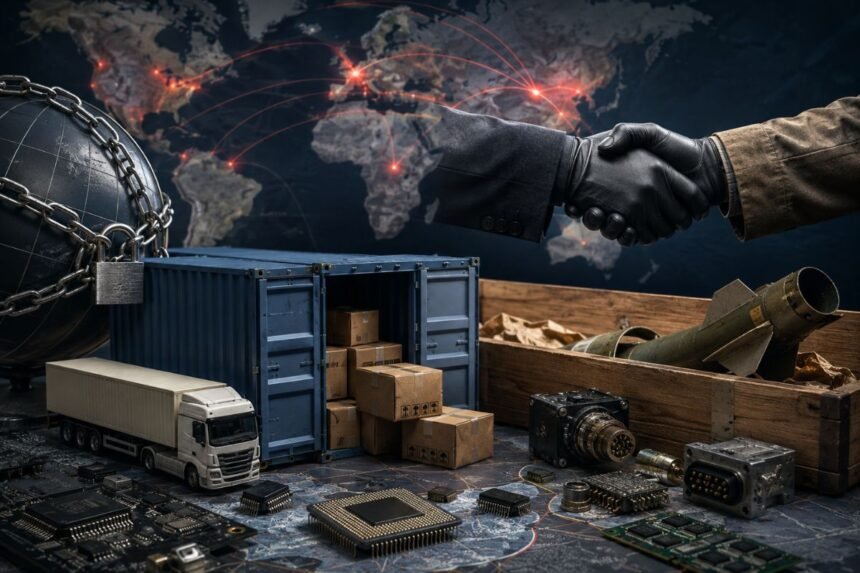
In this article you can understand how the Sanctioned countries get the advance technology as well as hardwares even having ban on trade. So let’s dive into it.
- Introduction
- The Dual use gray zone and Technical Regulatory Frameworks
- Common High Priority List (CHPL) Framework
- CHPL Tier Structure
- Operational Typologies of procurement
- 1. Transshipment and Hub Arbitrage
- 2. Front Company Infrastructure and Component Routing
- The Physical Journey of a Component
- 3. Financial Settlement
- Non-Dollar Local Currency Clearing
- Third Party Payment Agents
- Digital Assets and Crypto Settlements
- 4. Reverse Logistics and Repurchase Schemes
- 5. Physical Forensics and Network Mapping
- Conflict Armament Research (CAR) Investigations
- C4ADS Network Mapping
- Forensic Data Infrastructure and Analytical Methods
- The Investigative Detection Lifecycle
- 1. Physical Recovery and Field Disassembly
- 2. Customs Trade Data Cross-Reference
- 3. Corporate Mapping and Open Source Analysis
- 4. Judicial Enforcement Disclosures
- Key Institutions and Platforms
- Forensic Deconstruction of the Hwasong 11 Ballistic Missile
- Hardware Deconstruction and Bill of Materials
- Forensics and Supply Chain Velocity
- Supply Chain Timeline
- Institutional Oversight Shifts and the MSMT
- The Multilateral Sanctions Monitoring Team (MSMT)
- Conclusions:
The vast majority of restricted microelectronics, sensors, and structural parts used in modern precision guided munitions, unmanned aerial vehicles (UAVs), and armored fighting vehicles move through standard commercial electronics distributors.
These items are bought under the cover of routine civil trade, sent through intermediate logistics hubs, and cleared by customs agencies using unclear tariff classifications. The real nature of these supply chains usually becomes clear only after post blast physical forensics on recovered battlefield debris or through complex multi-jurisdictional trade data analysis.
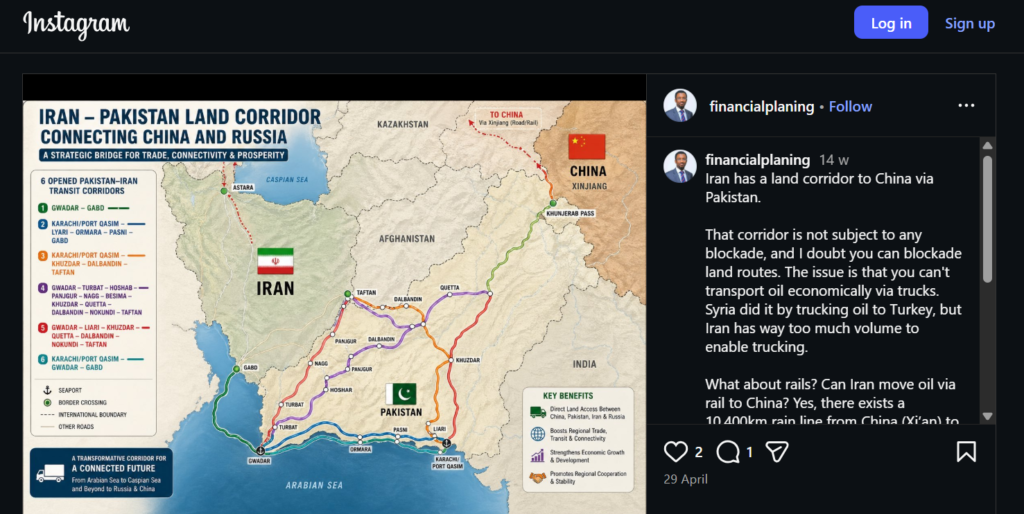
(For understanding purpose watch this: https://youtu.be/EGoYvDSnd2E?si=uOKdaCJy0jd8sRhc Source: China In Focus NTD Youtube.)
Understanding how sanctioned states maintain access to advanced technology requires examining the structural friction between commercial export controls and military procurement tactics. By exploiting the dual-use regulatory gray zone, using third-country intermediary networks, and carrying out creative logistics schemes, targeted nations systematically circumvent international trade restrictions.
The Dual use gray zone and Technical Regulatory Frameworks
The main structural weakness in international trade controls lies in the split regulation of pure military hardware versus dual-use commercial technologies. Defense items designed specifically for military end-uses are governed by strict regulatory frameworks, such as the United States Munitions List (USML) under the International Traffic in Arms Regulations (ITAR).
These items have dedicated serial numbers, restricted distribution channels, and mandatory end user verification protocols that make covert acquisition difficult.
In contrast modern precision weapons rely heavily on commercial off-the-shelf (COTS) microelectronics, digital signal processors, static converters, and field programmable gate arrays. These items sit under regulatory frameworks like the Commerce Control List (CCL) under the Export Administration Regulations (EAR) or fall under unlisted commercial designations such as EAR99.
Because these dual-use components are produced by the millions for civilian applications ranging from automotive engine control units and industrial automation to consumer telecom infrastructure they flow through a complex global distributor network that lacks the rigorous compliance infrastructure of the defense sector.
Common High Priority List (CHPL) Framework
To standardize regulatory enforcement across jurisdictions, the Group of Seven (G7), alongside the European Union, the United Kingdom, and Japan, established the Common High Priority List (CHPL). The CHPL categorizes 50 critical items using six digit Harmonized System (HS) tariff codes that Russia and its partners actively seek for military production.
Divided across four main tiers, the CHPL provides a targeted tracking mechanism for customs authorities and compliance screeners.(The chart include some technical terms which are basically used for the shipment purpose. HS means Harmonized System this includes electronic components.)
CHPL Tier Structure
| CHPL Tier | HS Code Classification | Representative Component Types | Military & Battlefield Application |
|---|---|---|---|
| Tier 1: High-Priority Microelectronics | 8542.31, 8542.32, 8542.33 | Electronic Integrated Circuits: Processors, Controllers, Memories, Amplifiers | Main processing units, guidance computing, and signal processing in cruise missiles and UAVs |
| Tier 2: Wireless & Passive Electronics | 8517.62, 8526.91, 8532.21, 8532.24 | Data Transmission Machines, Radio Navigation Aids, Tantalum & Ceramic Capacitors | Encrypted communications, satellite navigation receivers, power stabilization |
| Tier 3.A: Discrete Electronic Components | 8504.40, 8525.89, 8529.10, 8541.10 | Static Converters, Digital Cameras, Antennas, Diodes | Optical targeting systems, power conversion for onboard electronics, RF transceivers |
| Tier 3.B: Mechanical & Optical Components | 8482.10, 8807.30, 9013.10, 9014.20 | Ball Bearings, Aircraft Parts, Telescopic Sights, Aeronautical Instruments | Flight control surfaces, turret stabilization, thermal and optical sighting assemblies |
| Tier 4.A: Electronics Manufacturing Equipment | 8486.40, 8534.00, 8543.20 | Semiconductor Assembly Apparatus, Printed Circuits, Signal Generators | Domestic fabrication, repair, and testing of printed circuit boards and electronic modules |
| Tier 4.B: Advanced Machining Tools | 8457.10, 8458.11, 8459.61, 8466.93 | CNC Machining Centers, Horizontal CNC Lathes, CNC Milling Machines | Precision milling of missile airframes, engine turbines, artillery barrels, and armor plating |
Operational Typologies of procurement
Analyzing documented enforcement actions, customs data, and field teardowns reveals that virtually all illicit component procurement operations fit five primary operational typologies.
1. Transshipment and Hub Arbitrage
Direct exports of dual-use technology from coalition origin countries to sanctioned destinations have effectively stopped under comprehensive export bans. To bypass these blocks, procurement networks route shipments through intermediate third country jurisdictions that maintain open commercial ties with targeted nations.
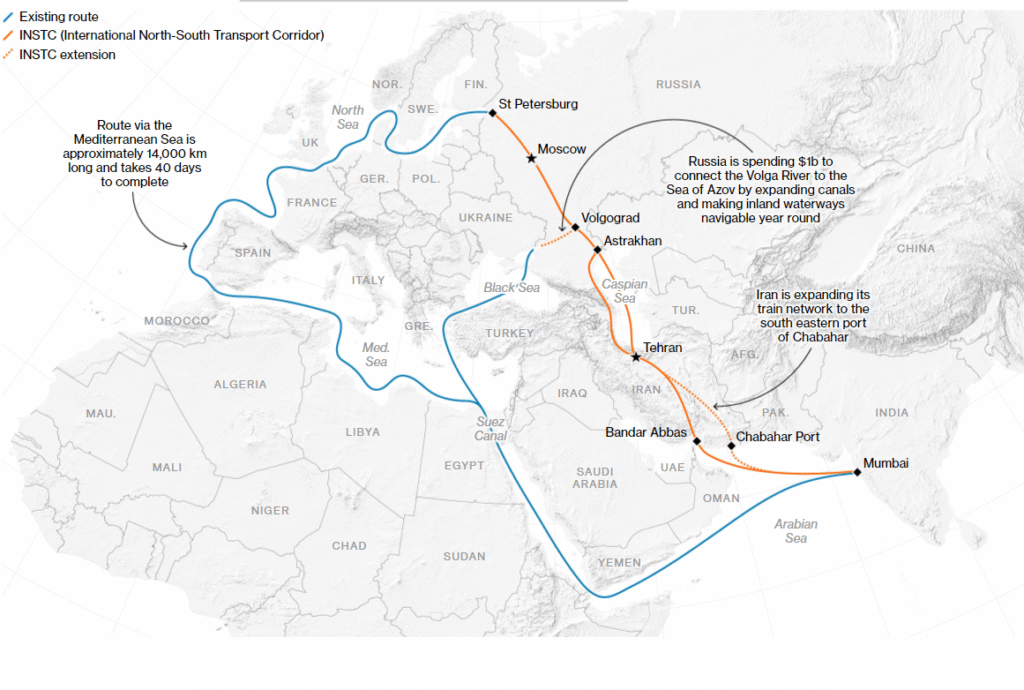
Transshipment relies on regional trade nodes across Eurasia and the Middle East. Freight forwarders receive goods in commercial free zones such as the United Arab Emirates or Turkey and redocument the cargo manifests before forwarding them to final destinations.
For example, corporate entities such as UAE-based NIT Group FZE and Turkey based KOC Gemicilik were identified in federal enforcement disclosures for shipping hundreds of consignments containing Tier 1 through Tier 4 CHPL components to Russian defense linked buyers.
This hub arbitrage introduces significant cost markups. Quantitative trade tracking indicates that sanctioned buyers pay a substantial price premium when sourcing goods via third-country intermediaries, with Russian procurement networks facing markups reaching roughly 300% on specific Chinese-sourced microelectronics compared to global market prices.
Key transshipment hubs identified by the Bureau of Industry and Security (BIS) include:
- Armenia, Brazil, China, Georgia, India, Israel, Kazakhstan, Kyrgyzstan, Mexico, Nicaragua, Serbia, Singapore, South Africa, Taiwan, Tajikistan, Turkey, the UAE, and Uzbekistan.
2. Front Company Infrastructure and Component Routing
To prevent Western manufacturers and tier one distributors from identifying restricted end-users, procurement managers deploy layers of shell and shelf companies managed by professional corporate-formation agents. These entities obscure beneficial ownership, use generic commercial addresses, and present plausible civilian end-use declarations, such as civil telecommunications, automotive repair, or consumer appliance manufacturing.
A detailed example of this typology is revealed in U.S. Department of Justice indictments involving Nikolay Goltsev, Salimdzhon Nasriddinov, and Kristina Puzyreva. Operating out of Brooklyn, New York, the network established front entities including SH Brothers Group Inc. and SN Electronics Inc. to procure over $7 million in military grade and dual use microelectronics.
The Physical Journey of a Component
The physical journey of a single component illustrates how these front companies operate in practice:
- Initial Order: A high-specification dual-use integrated circuit chip such as a programmable logic controller categorized under HS Code 8542.31 would be ordered by SH Brothers Group Inc. from an authorized U.S. commercial electronics distributor.
- False End Use Declaration: The buyers claimed the integrated circuits were destined for domestic commercial manufacturing or civil telecom infrastructure.
- Domestic Collection: Upon delivery to a Brooklyn location, the components were repackaged and prepared for international shipment.
- Intermediate Routing: Components were shipped to intermediate freight-forwarding addresses in Türkiye, Hong Kong, India, China, or the UAE, using export documentation that omitted any Russian destination.
- Final Transshipment: From these intermediate hubs, local corporate affiliates, such as Suntronic F.Z.E. in the UAE, re consigned the electronics to state linked Russian defense suppliers.
- Military Integration: The microcontrollers were ultimately integrated into signals intelligence and guided missile systems
3. Financial Settlement
Sanctions targeting sovereign banking sectors, including the removal of major institutions from the SWIFT messaging network and secondary sanctions on commercial banks, have forced procurement networks to abandon standard US dollar (USD) and Euro (EUR) clearing channels.
Financial workarounds rely on a combination of alternative settlement mechanisms:
Non-Dollar Local Currency Clearing
Shifting trade settlement to local currency pairs, such as the Russian Rouble (RUB) and Chinese Yuan (RMB), processed through non-sanctioned regional banks or specialized financial institutions operating outside Western clearing jurisdiction.
Third Party Payment Agents
Using corporate service providers and trade finance houses in third countries to settle invoices via nested accounts, preventing primary correspondent banks from identifying the ultimate transacting parties.
Digital Assets and Crypto Settlements
Employing stable coins and distributed ledger networks to move capital internationally across borderless networks, completely bypassing the compliance checkpoints embedded in traditional banking systems.
A January 2025 amendment to drone contracts reportedly stated that payments would be made “to an account provided by MODAFL in the UAE or Turkey,” indicating that Iranian defense linked entities were using financial channels in both countries to facilitate transactions tied to weapons deals.
4. Reverse Logistics and Repurchase Schemes
When direct procurement and third-country transshipment face severe choke points, state actors turn to reverse logistics repurchasing military components previously exported to foreign armed forces. Rather than attempting to source newly manufactured Western microelectronics, targeted defense enterprises buy back foreign-held stocks of their own exported systems.
Customs clearance records sourced from trade platforms reveal that Russian defense manufacturers executed systematic buybacks of military hardware previously sold to India and Myanmar.
Documented buyback consignments include:
- Night vision assemblies and missile guidance components.
- High precision Sosna U tank gunner sights which rely heavily on foreign thermal imaging sensors.
- Thousands of imported optical and telescopic gun sights.
These components were re-imported directly into domestic defense plants to replace damaged hardware or equip newly manufactured armored vehicles, bypassing Western trade controls entirely.
5. Physical Forensics and Network Mapping
The ultimate verification of illicit supply chains occurs through the physical dismantling and reverse engineering of recovered weapons systems. Field inspections of downed cruise missiles, reconnaissance drones, and loitering munitions systematically yield concrete bills of materials, exposing specific part numbers, date codes, and manufacturing locations.
Conflict Armament Research (CAR) Investigations
Investigations conducted by Conflict Armament Research (CAR) on Iranian designed Shahed-136 (Russian designation Geran2) loitering munitions recovered in Ukraine mapped the internal component architecture.
Physical teardowns identified unlisted defense suppliers, such as:
- Sarmad Electronic Sepahan as a primary flight control component fabricator.
- One Parvaz Mado Nafar as the engine manufacturer.
Before this not single one find out it.
C4ADS Network Mapping
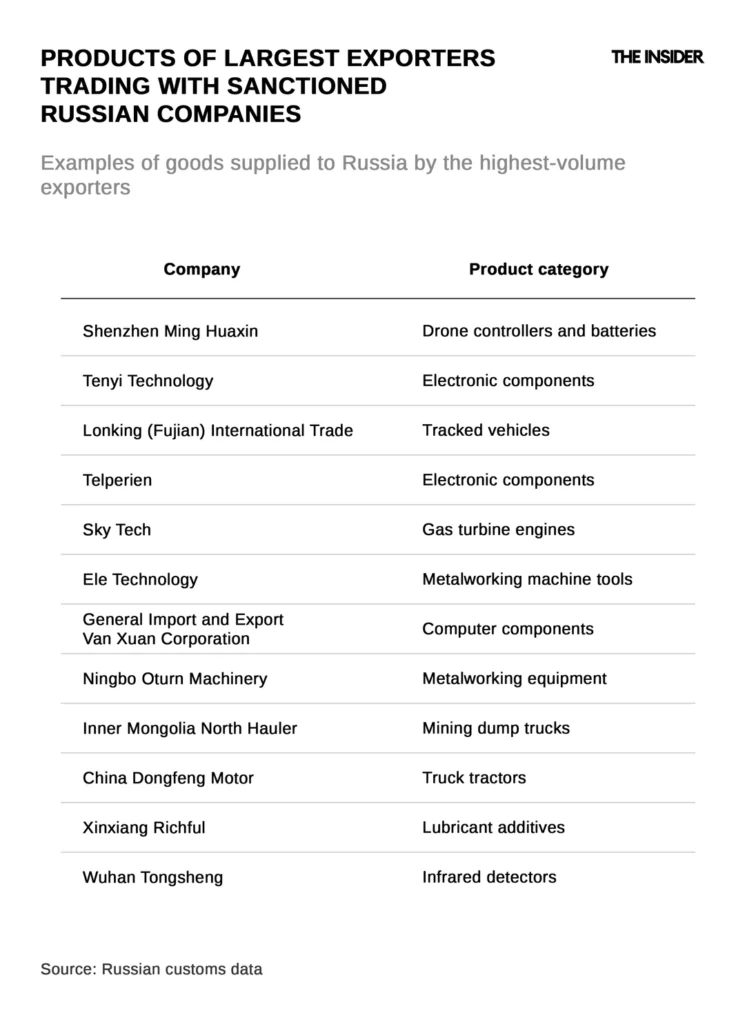
Similarly, network-mapping investigations by C4ADS using corporate registry data, maritime trade manifests, and satellite tracking revealed extensive procurement networks operating through Belarus.
Their investigation identified 58 corporate entities that supplied over $1.2 billion in goods to Russian arms manufacturers following the 2022 invasion. There were half of these supplying entities had never been formally designated under Western sanctions regimes, underscoring the gap between active procurement hubs and public sanctions lists.
Forensic Data Infrastructure and Analytical Methods
Detecting illicit trade networks requires cross referencing multi sourced datasets, combining physical hardware forensics, open source intelligence (OSINT), granular customs manifest tracking, and enforcement disclosures.
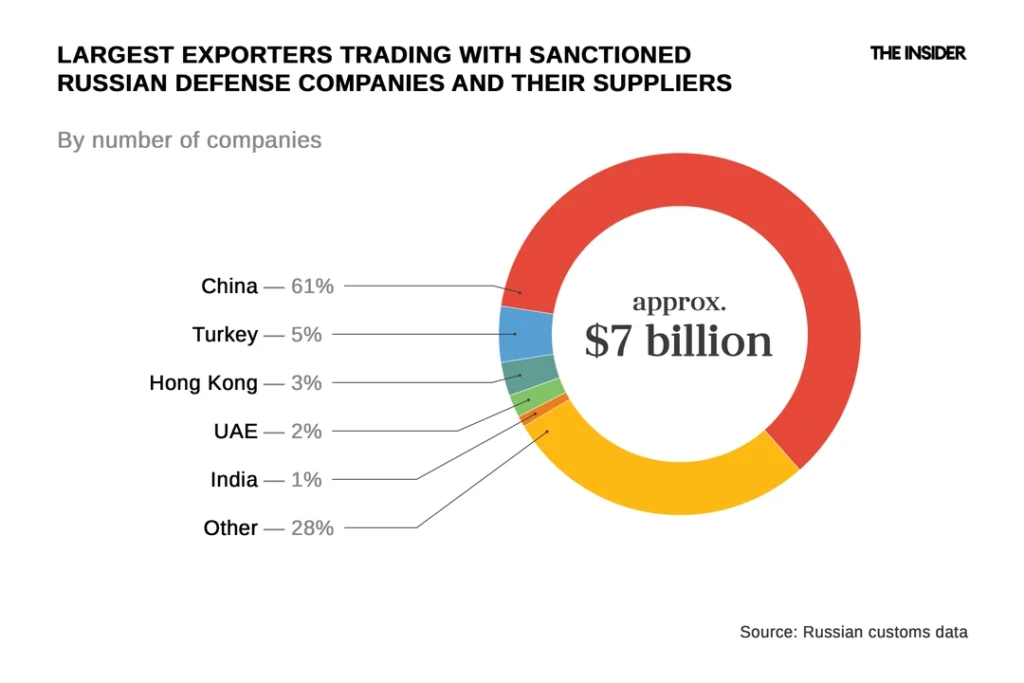
The Investigative Detection Lifecycle
The investigative cycle follows a structured detection lifecycle:
1. Physical Recovery and Field Disassembly
Field recovery and disassembly of debris from downed weapons systems to extract serial numbers, part markings, and factory date codes.
2. Customs Trade Data Cross-Reference
Cross-reference hardware details against customs trade data, such as UN Comtrade records, identifying anomalous export spikes, mis declared HS tariff codes, and unusual price premiums in transshipment hubs.
3. Corporate Mapping and Open Source Analysis
Open-source corporate mapping tools, including the Trade Integrity Project (TIP), link transshipment entities to corporate registries and maritime shipping manifests.
4. Judicial Enforcement Disclosures
Judicial enforcement disclosures such as federal indictments and Department of Commerce denial orders uncover closed procurement routes and confirm the illicit networks’ operational methods.
Key Institutions and Platforms
| Institution / Platform | Primary Methodology | Key Analytical Datasets | Operational Insight & Regulatory Impact |
|---|---|---|---|
| Conflict Armament Research (CAR) | Physical battlefield recovery, hardware teardowns, serial number tracing | Component-level serial numbers, factory date codes, circuit board topography | Identifies specific component part numbers and unflagged origin manufacturers directly from recovered weapons |
| KSE Institute | Macroeconomic and trade data analytics (Russian CHP Imports Tracker) | UN Comtrade, Chinese Customs, Taiwanese Customs, mirror trade statistics | Quantifies shifts in global trade routes, tracks 75% Chinese import reliance, measures 300% price premiums |
| C4ADS | Network mapping, corporate registry analysis, cross-border satellite and maritime tracking | Corporate filings, bill of lading data, AIS vessel tracking, flight manifests | Exposed 58 Belarusian firms supplying over $1.2B in defense goods to Russia, showing nearly half were unsanctioned |
| Trade Integrity Project (TIP) | Automated cross-matching of corporate entities with CHPL export transactions | Open Source Centre (OSC) proprietary trade intelligence, global customs feeds | Public database of firms exporting CHPL goods to Russia; explicitly recommended by US BIS for corporate screening |
| DOJ / BIS Enforcement Filings | Judicial subpoenas, electronic surveillance, financial intelligence, customs intercepts | Federal criminal indictments, BIS orders denying export privileges, plea agreements | Unveils specific procurement routes, straw buyer identities, shell entity structures, and exact transshipment hubs |
The integration of these analytical platforms allows compliance officers and intelligence analysts to move beyond static, entity-based screening lists. By using databases like the Trade Integrity Project, organizations can evaluate transaction behaviors and identify red flags before goods cross international borders.
Forensic Deconstruction of the Hwasong 11 Ballistic Missile
The operational reality of modern covert procurement is illustrated by the forensic deconstruction of a North Korean Hwasong 11 series short range ballistic missile (SRBM) designated by Western intelligence as the KN-23 or KN-24 recovered following an attack on Kyiv and Kharkiv, Ukraine.
Hardware Deconstruction and Bill of Materials
In early 2024, field investigators from Conflict Armament Research conducted a forensic autopsy of the propulsion, navigation, and guidance assemblies of a Hwasong-11 missile recovered in Kharkiv.
The physical inspection revealed an extensive reliance on foreign-sourced technology:
- Component Count: Investigators documented over 290 non domestic electronic components integrated into the missile’s guidance and control systems.
- Corporate Traceability: The foreign components were traced to 26 distinct commercial brands headquartered across eight sovereign jurisdictions, including the United States, Germany, Japan, the Netherlands, Switzerland, Singapore, Taiwan, and China.
- Jurisdictional Breakdown: Approximately 75.5% of the documented electronic components were linked to companies incorporated in the United States, 11.9% to entities in Germany, and 3.1% to firms in Japan.
The overwhelming majority of these parts were standard commercial microcontrollers, logic gates, signal converters, and passive capacitors produced for civil industrial markets rather than military grade weapons systems.
Forensics and Supply Chain Velocity
Physical forensics provided definitive proof regarding the velocity of North Korea’s illicit supply chains. Field inspection of internal components specifically jet vane actuators responsible for directing thrust vectoring, as well as internal cable raceway harnesses revealed explicit manufacturing date codes.
Supply Chain Timeline
| Supply Chain Phase | Timeframe & Markings | Operational Details & Methodologies |
|---|---|---|
| Semiconductor Fabrication | 2021 – 2023 | Western manufacturers produce commercial microcontrollers, capacitors, and signal converters |
| Intermediary Transshipment | 2022 – 2023 | Commercial distributors ship components through brokers in East Asian and Eurasian commercial hubs |
| Factory Assembly in Pyongyang | Juche 112 (2023) / Juche 113 (2024) | Components are integrated into SRBM guidance units; actuators stamped with ‘112’ and ‘113’ production codes |
| Munitions Transfer & Deployment | Late 2023 – Mid 2024 | Finished Hwasong-11 missiles are shipped across borders to active operational sectors |
| Recovery & Physical Forensics | January – August 2024 | Downed missile remnants recovered in Kharkiv and Kyiv undergo post-blast physical disassembly |
Investigators observed handwritten and stamped factory production codes corresponding to the Juche calendar the official calendar system used in North Korea. Components marked with the designation “112” corresponded to Juche year 112 (2023), while subsequent missile debris recovered in Kyiv Oblast in August 2024 bore jet vane actuators stamped with “113,” indicating production in Juche year 113 (2024).
This temporal evidence demonstrated that Western microelectronics were acquired, routed through third-country brokers, delivered to factories in North Korea, integrated into newly assembled ballistic missiles, transferred across borders, and launched against target zones within a span of less than 12 to 18 months.
Institutional Oversight Shifts and the MSMT
The forensic analysis of the Hwasong-11 missile triggered a major institutional conflict within international security bodies. For fifteen years, the United Nations Panel of Experts established pursuant to UNSC Resolution 1874 had served as the primary international body tasked with documenting and reporting North Korean sanctions evasion and illicit arms transfers.
The Multilateral Sanctions Monitoring Team (MSMT)
To address the oversight void created by the dissolution of the UN Panel, a coalition of eleven nations including the United States, Japan, South Korea, the United Kingdom, France, Germany, Italy, the Netherlands, Canada, Australia, and New Zealand established a replacement monitoring framework: the Multilateral Sanctions Monitoring Team (MSMT).
MSMT Member States:
- Australia, Canada, France, Germany, Italy, Japan, the Kingdom of the Netherlands, New Zealand, the Republic of Korea, the United Kingdom of Great Britain and Northern Ireland, and the United States.
Conclusions:
The mechanics of covert military procurement show that modern state sponsored trade evasion is a decentralized, market driven phenomenon. Targeted nations do not need to build end to end domestic manufacturing capabilities for every microelectronic component.
There is only one thing constant and that is the Economy of rich componies. Any war or conflict for the componies especially western companies is the opportunity to make huge profit whether by selling microchips or any small cheap rubber tube. There is no doubt this will also happen in future because the Seller wants to sell and Buyer wants to buy anyway.