

Introduction:
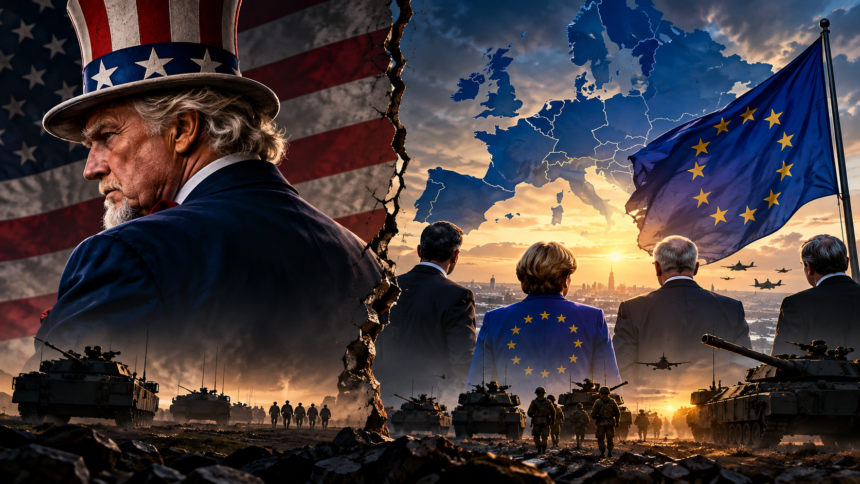
Europe can become more self reliant, but it cannot yet sustain a major, high intensity war against a peer adversary without direct US military support. Its main weaknesses are not only troop numbers. They also include intelligence, space systems, logistics, air defence, ammunition, command networks, and industrial capacity.
- Introduction:
- Europe’s Post Cold War Security Problem:
- Europe’s Strategic Enablers Gap:
- Intelligence, Surveillance, and Reconnaissance:
- Space Dependence:
- Airlift, Refuelling, and Command Systems:
- Dependence on US Technology:
- The F 35 Question:
- Europe’s Fragmented Defence Industry:
- Europe’s Main Military Powers:
- The United Kingdom:
- France:
- Germany:
- Also Read, The World Is Not Dividing Into Two Blocs. It Is Dividing Into Networks.
- Regional Defence Patterns:
- The Nordic Countries:
- Ireland:
- Lessons from the Ukraine War:
- NATO and Article 5:
- Russian Claims About NATO Readiness:
- Why EU Article 42.7 Is Not Enough:
- The Cost of Strategic Autonomy:
- EU Defence Funding:
- Partnerships Beyond America:
- What Europe Must Do Next:
- Conclusion:
For more than 70 years, European security has depended heavily on US military power and NATO’s integrated command system. After the Cold War, many European states reduced heavy forces and defence production because they expected the United States to remain the main security provider.
Russia’s full scale invasion of Ukraine exposed the risks of this model. Europe now faces a harder security environment shaped by conventional war, cyberattacks, sabotage, missile threats, hybrid warfare, and pressure on critical infrastructure.
Europe has strong military powers, advanced defence companies, and growing political support for higher defence spending. France has an independent nuclear force. The United Kingdom has a powerful submarine based deterrent. Germany is rebuilding the Bundeswehr, while Poland and the Nordic states are expanding their forces.
However, Europe still relies on the United States for several strategic enablers. These include ISR, space based intelligence, satellite communications, strategic airlift, aerial refuelling, precision weapons, missile warning, logistics, and NATO command support.
The answer is therefore clear: Europe can eventually survive without America, but it cannot safely defend itself alone today. Strategic autonomy would require many years of higher spending, industrial expansion, standardisation, recruitment, and political coordination.
Europe’s Post Cold War Security Problem:
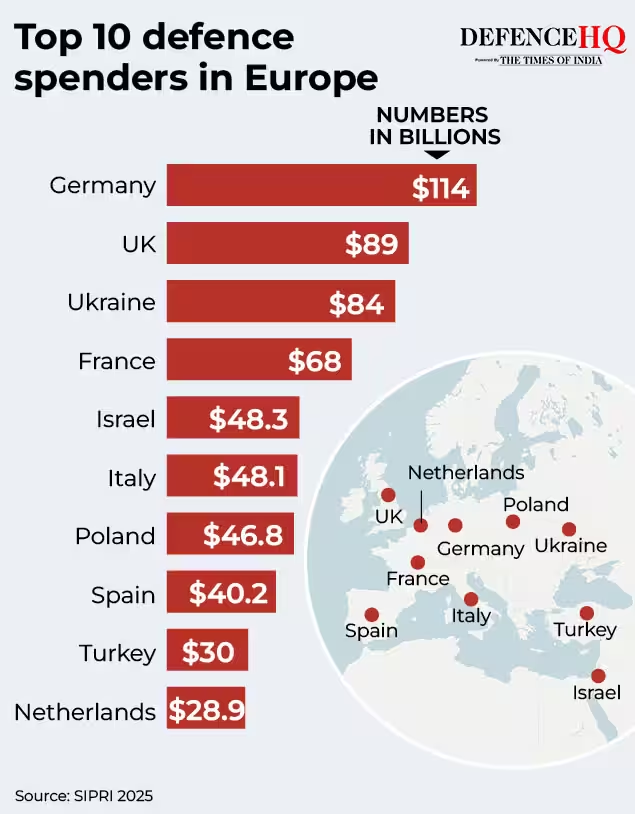
Europe reduced its military capacity after the Cold War. Many countries cut troop numbers, closed defence plants, reduced ammunition stocks, and retired heavy equipment. These choices were based on the belief that a large war in Europe was unlikely and that the United States would remain the main provider of security.
That assumption is now under pressure. Russia’s war in Ukraine has returned large scale land warfare to Europe. The conflict uses artillery, drones, missiles, electronic warfare, cyber operations, and long range strikes. At the same time, crises in the Middle East and growing Indo-Pacific tensions compete for US attention and military resources.
US demands for greater European burden sharing have also changed the political debate. The US security guarantee remains central to NATO, but European governments can no longer assume that American support will be unlimited in every crisis.
Europe’s Strategic Enablers Gap:
A modern military needs more than soldiers, tanks, and fighter aircraft. It needs the systems that find targets, move forces, protect networks, and sustain operations. These systems are known as strategic enablers.
Europe’s largest gaps are in:
- Intelligence, surveillance, and reconnaissance (ISR).
- Space based early warning, PNT, satellite communications, and intelligence.
- Strategic and tactical airlift.
- Aerial refuelling and airborne command and control.
- Precision guided munitions and missile defence interceptors.
- Integrated logistics, command systems, and battlefield networks.
- Large ammunition reserves and wartime industrial capacity.
Intelligence, Surveillance, and Reconnaissance:
ISR allows a military to find, identify, track, and target enemy forces across land, sea, air, space, and cyberspace. US ISR helped reveal Russian preparations before the invasion of Ukraine. It also supported Ukraine with intelligence and targeting information during the war.
Europe has capable national systems, but they are limited compared with US capacity. The United Kingdom operates three Boeing RC135 Rivet Joint aircraft, while the US Air Force operates 17. NATO also operates RQ4D Phoenix unmanned aircraft based on US technology.
Europe does not have a direct equivalent to every US low observable intelligence platform. This limits its ability to collect information inside heavily defended airspace without American support.
Space Dependence:
Military operations depend on space based systems for positioning, navigation, timing, satellite communications, missile warning, and intelligence. European states have important space programmes, including Galileo and national military satellites. Yet they still lack the full range of US military space capabilities.
Some estimates suggest that Europe would need at least $10 billion for a basic level of burden sharing in space. Full independence in military space operations could cost at least $25 billion and may not be available before 2040.
This means that European strategic autonomy would remain incomplete for many years, even if governments increase spending quickly.
Airlift, Refuelling, and Command Systems:
Europe has too little strategic airlift for a long, multi front war. The United Kingdom operates eight C17 Globemaster aircraft, while three more are available through a NATO consortium. European countries also operate A400M aircraft, but these cannot fully replace the larger US airlift network.
Europe has further shortages in aerial refuelling aircraft and airborne command and control systems. These weaknesses reduce fighter range, limit deployment speed, and make it harder to coordinate forces across several fronts.
The 2021 Kabul evacuation demonstrated this problem. European governments relied heavily on US airlift, intelligence, and command support to evacuate their citizens.
Dependence on US Technology:
Europe’s dependence on US defence technology increased after the Ukraine war. Bruegel’s Foreign Military Sales dataset shows that US Foreign Military Sales to European Union countries rose by 89% between 2021 and 2022. In real terms, sales remained 48% above the 2014 to 2021 average.
The European Defence Industrial Strategy set a goal for EU members to buy at least 50% of their defence equipment from within the EU by 2030. Yet about 78% of EU defence purchases between February 2022 and June 2023 came from outside the bloc. The United States received most of these contracts.
This dependence is strongest in advanced air defence, precision guided munitions, and fifth-generation fighter aircraft.
The F 35 Question:
The F 35 Lightning II is a major example of Europe’s defence relationship with the United States. The United Kingdom, Italy, Norway, Denmark, Germany, Finland, and other European countries operate or plan to operate the aircraft.
The F 35 provides stealth, sensor fusion, and networked combat capability. It also connects European air forces to US controlled software, mission data systems, spare parts networks, and supply chains.
The aircraft uses the Autonomic Logistics Information System and its successor, the Operational Data Integrated Network. There is no widely accepted evidence of a physical “kill switch” that could instantly disable European aircraft. However, a long-term halt in software updates, spare parts, secure data, and technical support could gradually reduce fleet availability.
Europe’s Fragmented Defence Industry:
Europe’s defence industry is advanced but divided. Governments often protect national companies, jobs, and procurement programmes. This creates too many equipment types and prevents large scale production.
European armed forces operate about 29 types of destroyers, 17 types of main battle tanks, and 20 types of fighter aircraft. The United States operates four main types of destroyers, one main type of main battle tank, and six types of fighter aircraft.
Fragmentation raises research and development costs. It also complicates training, maintenance, spare-parts supply, communications, and ammunition resupply during war.
Projects such as the Franco German Spanish Future Combat Air System have faced disputes over industrial leadership, intellectual property, and workshare. Competition between Dassault Aviation and Airbus shows how national interests can slow joint European programmes.
Europe’s Main Military Powers:
The United Kingdom, France, and Germany are Europe’s most important military powers. None currently has the manpower, readiness, ammunition, equipment, and industrial depth required for a long conventional war against a peer adversary without US support.
The United Kingdom:
The United Kingdom has one of Europe’s strongest expeditionary forces. However, years of defence cuts reduced the size of its conventional forces and created readiness pressures.
The British nuclear deterrent is based on four Vanguard-class nuclear-powered ballistic missile submarines carrying Trident II D5 missiles. The United Kingdom controls the decision to use the deterrent and produces its own nuclear warheads at the Atomic Weapons Establishment.
However, the system remains closely linked to US infrastructure. The UK draws missiles from a shared pool connected to the US Navy, and missiles are serviced at Naval Submarine Base Kings Bay in Georgia. Navigation, fire control, maintenance, and modernisation also involve close US links.
The UK can act independently in limited operations. It cannot yet replace the US intelligence, logistics, space, and command network during a major continental war.
France:
France is Europe’s strongest advocate of strategic autonomy. It has an independent nuclear force, the Force de Frappe, with about 290 deployed warheads carried by submarine launched ballistic missiles and air-launched cruise missiles.
France can conduct expeditionary operations with a high degree of independence. Its military experience in the Sahel shows this strength. Yet the French armed forces lack the mass and industrial depth required for a prolonged high intensity war in Europe.
France has roughly 200 Leclerc main battle tanks and originally held about 70 CAESAR self propelled howitzers. Transfers to Ukraine have placed additional pressure on French stocks. Defence companies also need time and investment to move from peacetime output to sustained wartime production.
France can lead limited European operations. It cannot alone replace the US logistical network, industrial capacity, or large ammunition reserves.
Germany:
Germany has Europe’s largest economy but underfunded its armed forces for many years. After Russia’s invasion of Ukraine, Chancellor Olaf Scholz announced the Zeitenwende and created a €100 billion special fund to rebuild the Bundeswehr.
Germany is still not ready for immediate high intensity combat. Its forces face shortages in equipment, ammunition, readiness, and personnel. The country has also purchased major systems from outside Europe.
The European Sky Shield Initiative shows this tension. Germany plans to use US Patriot systems for long range defence, Israeli US Arrow 3 systems for exo-atmospheric ballistic missile interception, and Germany’s IRIS T for shorter range defence.
France, Italy, and Spain have not joined ESSI. France prefers European systems such as the Franco Italian SAMP/T NG, while Germany prioritises fast access to proven systems. This disagreement reflects the wider tension between European industrial autonomy and rapid capability improvement.
Also Read, The World Is Not Dividing Into Two Blocs. It Is Dividing Into Networks.
Regional Defence Patterns:
The Nordic Countries:
Sweden and Finland joined NATO after Russia’s invasion of Ukraine changed Northern Europe’s security environment. Sweden, Finland, Denmark, and Norway also cooperate through Nordic Defence Cooperation.
The Nordic states have capable forces designed for territorial defence in difficult climates. Defence spending in Scandinavia rose by 126% after 2022, while spending in the Baltic states increased by 134%.
These countries are stronger together, but they remain connected to US-led NATO systems. Their use of the F 35 and dependence on US intelligence show that regional defence cooperation is not the same as full strategic independence.
Ireland:
Ireland demonstrates the risks of low defence spending and military neutrality. It is not a NATO member and spends about 0.2% of GDP on defence.
For many years Ireland lacked a complete military radar network and combat aircraft capable of intercepting aircraft, drones, or strategic bombers near its airspace. It has relied on arrangements with the United Kingdom to respond to some air threats.
In 2026, Ireland signed an agreement with France’s Thales to acquire long range military radars. Full operation is not expected until 2028. Ireland is also considering a €2.5 billion plan to buy a squadron of fighter aircraft.
Lessons from the Ukraine War:
The Russia Ukraine war is the clearest test of European military capacity. It is a war of attrition involving artillery, drones, missiles, electronic warfare, cyber operations, and heavy losses of people and equipment.
European defence industries have struggled to meet Ukraine’s needs. Rheinmetall has planned to produce between 1.1 million and 1.5 million 155mm artillery shells each year by 2027. This expansion will take time and depends on supply chains, skilled workers, financing, and long term contracts.
Russia has moved closer to a war economy. By 2024, some estimates suggested that Russia was producing or rebuilding about 1,550 tanks and 5,700 armoured vehicles each year, as well as large numbers of artillery systems and loitering munitions.
European support for Ukraine has been substantial. Early estimates placed European aid at about €62 billion and US aid at about €64 billion. Yet Europe’s support has depended on US stockpiles, satellite intelligence, logistics, and military technology.
The war shows that Europe could face shortages of precision munitions, air defence interceptors, spare parts, and heavy equipment within a short period if it had to fight a major war without the United States.
NATO and Article 5:
NATO remains the main foundation of European security. Article 5 treats an armed attack against one member as an attack against all members. However, NATO’s deterrence still depends heavily on US military power, nuclear forces, intelligence, space support, strategic transport, and planning.
The Supreme Allied Commander Europe has traditionally been an American general. The United States also provides much of the alliance’s extended nuclear deterrence and strategic command capacity.
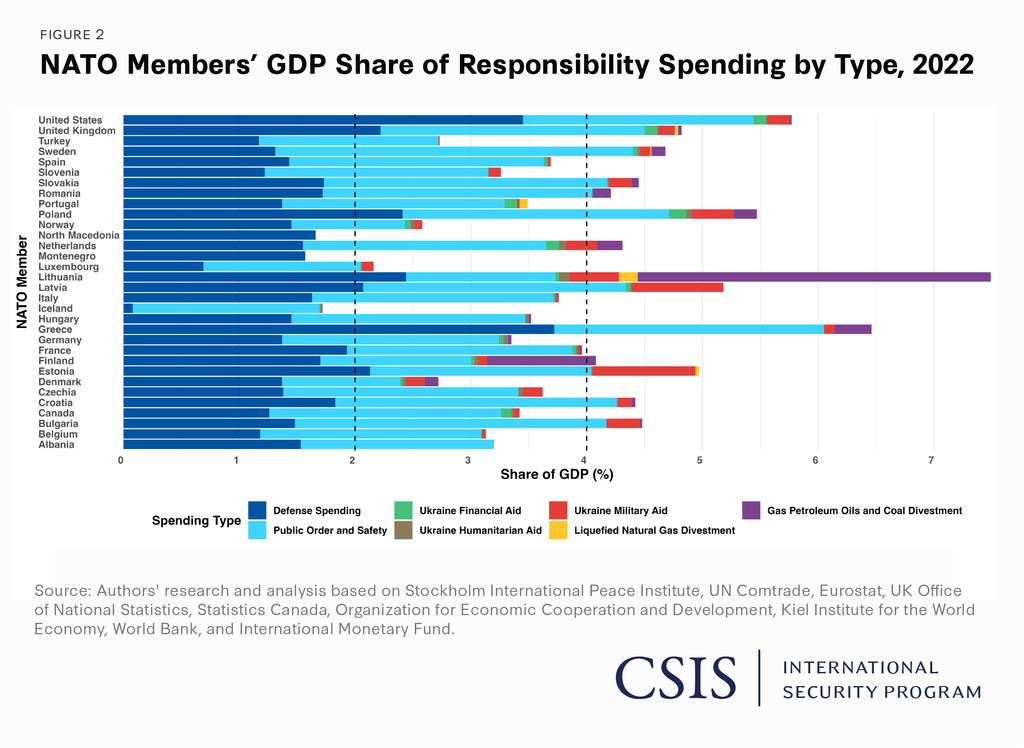
Some analysts argue that Europe would need a European SACEUR, stronger European control over NATO planning, and defence spending of 3% to 3.5% of GDP by 2030 to become a true coleader within the alliance. Reaching these targets would be politically difficult.
Russian Claims About NATO Readiness:
Russian state media and strategic analysts often highlight NATO’s readiness problems. NATO has moved from the smaller NATO Response Force towards the 40,000 strong Allied Reaction Force and has discussed deploying up to 300,000 troops in different stages.
Russian analysts argue that Europe would need between 35 and 50 additional combat brigades to meet these plans. Their claims may serve political purposes, but they also point to real problems involving recruitment, ammunition stocks, deployment speed, and political resistance to conscription.
Why EU Article 42.7 Is Not Enough:
Article 42.7 of the Treaty on European Union requires EU members to provide aid and assistance to a member state that is attacked. It is a political commitment, but it does not create a NATO style military command structure.
The EU has no permanent force or integrated defence plan capable of quickly stopping a major attack by a nuclear armed power. France invoked Article 42.7 after the 2015 terrorist attacks in Paris. The response focused mainly on intelligence cooperation and support for French operations.
Article 42.7 can strengthen European solidarity. It cannot quickly replace NATO as Europe’s main security system.
The Cost of Strategic Autonomy:
If the United States withdrew from NATO or moved most of its attention to the Indo Pacific, Europe would face a major military and financial burden.
Some estimates suggest that Europe would need about 300,000 additional trained combat personnel to deter Russia without US forces. It would also need an immediate and continuing defence spending increase of more than €250 billion each year.
A target of 3.5% of GDP for core defence and another 1.5% for infrastructure and resilience could require at least €1 trillion in additional funding over the next decade.
| European autonomy requirement | Estimated scope |
|---|---|
| Additional personnel needed to deter Russia | About 300,000 troops |
| Immediate annual spending increase | More than €250 billion |
| Additional funding towards a 3.5% defence target by 2035 | About €1 trillion |
| Space-based early warning, ISR, and PNT | At least $25 billion, with capability after 2040 |
These figures are estimates, not fixed requirements. The final cost would depend on the level of Russian threat, the degree of US withdrawal, European procurement choices, and the role of nuclear deterrence.
EU Defence Funding:
The European Union has created several programmes to increase defence production and joint procurement:
- The European Defence Fund provides an €8 billion budget for 2021 to 2027 to support joint defence research and development.
- EDIRPA provides €310 million to encourage common procurement.
- The European Peace Facility is an off budget fund worth more than €17 billion and has supported military assistance to Ukraine.
- Security Action for Europe offers up to €150 billion in soft loans for joint procurement.
These programmes are useful, but they remain small compared with the cost of replacing US capabilities. By mid 2025, five countries Poland, Romania, France, Italy, and Belgium accounted for about 76% of €130.16 billion in approved SAFE loan allocations. Poland alone received about 34%, or €43.73 billion, for its military buildup.
Direct EU grant funding under the European Defence Industry Programme has also been limited. About €325 million in initial funding is small compared with the stated ambition of €190 billion.
Europe is therefore not yet rearming through one united defence budget. Governments are using national budgets, loans, and separate procurement plans. A larger investment programme, possibly comparable in scale to the NextGenerationEU recovery fund, may be needed to build sufficient industrial capacity.
Partnerships Beyond America:
European countries are exploring defence partnerships with India and other powers. These relationships could diversify supply chains and support cooperation in rockets, ammunition, counter drone technology, and autonomous underwater systems.
John Cockerill Defense has supported India’s Project Zorawar, which is developing light tanks for high altitude operations against the People’s Liberation Army. Partnerships involving Larsen & Toubro and Exail also focus on autonomous underwater vehicles for mine clearance.
These projects cannot replace US capabilities in the near term. They can, however, help Europe build a wider technology and industrial network in a more competitive international system.
What Europe Must Do Next:
Europe can improve its ability to defend itself by taking several connected steps:
- Increase defence spending and protect long term budgets from political reversal.
- Expand production of artillery shells, precision munitions, missiles, drones, spare parts, and air defence interceptors.
- Build independent or shared European ISR, satellite communications, missile warning, and PNT systems.
- Improve strategic airlift, aerial refuelling, military transport, and airborne command and control.
- Standardise equipment and reduce the number of platforms, ammunition types, and support systems.
- Improve recruitment, retention, reserves, mobilisation, and military training.
- Strengthen European command arrangements while preserving NATO interoperability.
- Develop a clearer relationship between conventional defence, missile defence, and nuclear deterrence.
- Use partnerships with India and other countries to diversify supply chains without creating new dependencies.
- Combine political will with industrial planning so that defence budgets create usable combat power.
Conclusion:
It is very hard for Europe currently fight and sustain a major, high intensity conventional war against Russia without direct US military, intelligence, logistical, and industrial support. Its weakness is not a lack of advanced weapons alone. It is the shortage of the strategic enablers, stocks, command systems, and industrial depth needed for a long war.
The United Kingdom has strong expeditionary forces and a nuclear deterrent, but its nuclear and conventional systems remain closely linked to the United States. France has the most independent strategic posture, but it lacks the mass needed for a prolonged continental war. Germany has the economic power to rebuild, but its armed forces still face major readiness and equipment gaps.
Europe can survive without America in the long term, but not safely today. Strategic autonomy would require sustained spending, larger forces, greater industrial capacity, common procurement, stronger space systems, and difficult political choices.
The most accurate answer is therefore simple: Europe is not helpless, but it is not yet strategically independent. It can become more self eliant, yet the process would take many years and hundreds of billions of euros in sustained investment.