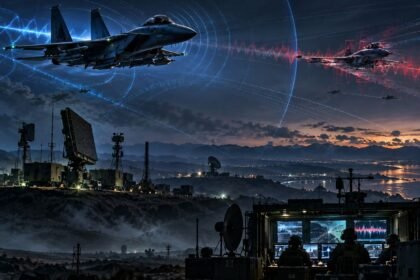


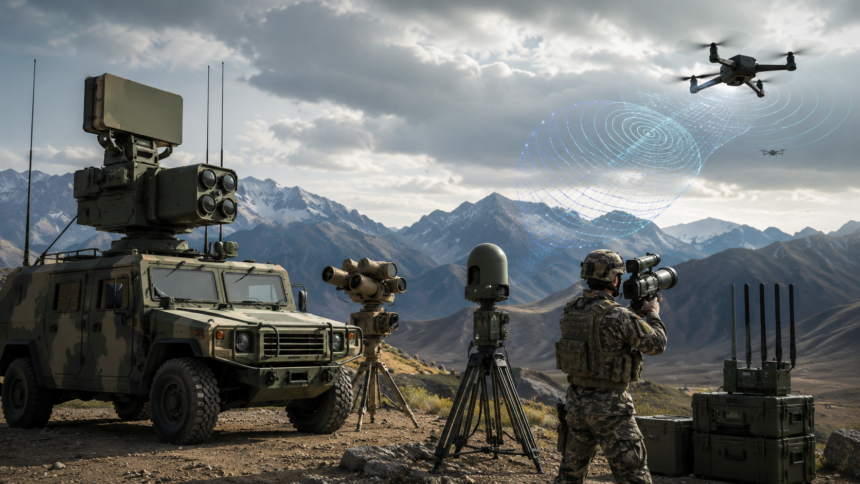
The Battlefield Is Shifting From Aircrafts to Drones
For years, drones needed a human somewhere in the usage, flying them, watching a feed, and making the call. That era is ending fast. Today’s most advanced unmanned systems increasingly rely on machine learning optical recognition paired with inertial navigation, which basically means they can find their way to a target without ever touching GPS.
- The Battlefield Is Shifting From Aircrafts to Drones
- Why Counter-Drone Systems Aren’t Optional Anymore
- How Counter-Drone Technology Has Evolved Over Time
- The Cheap, Clever Fixes Coming Out of the Battlefield
- Winning the Real-Time Fight: Detect, Track, Identify, Destroy
- How Different Countries Are Tackling the Drone Problem
- United States: Expensive Firepower, Uncomfortable Lessons
- Russia: Mass-Produced and Battlefield-Tested
- India: Betting Big on a Sovereign AI Shield
- China: Out-Massing the Threat
- France: Precision and Modularity for NATO
- Israel: Turning the Cost Equation Upside Down
- Iran: Doing More With Less
- Conclusion
Most of the electronic warfare tools built over the last decade were designed to jam GPS signals or hijack radio frequencies. Take those signals out of the equation, and a lot of expensive jamming equipment suddenly becomes far less useful.
Fiber-optic FPV drones make the problem worse. Since they fly on a physical tether instead of a radio link, there’s no broadcast signal to intercept in the first place. No signal, no jamming.
So, where’s this heading? By the late 2020s, most analysts expect the real “brains” of drone warfare to live in software, not hardware. Instead of a single operator flying a single aircraft, AI systems will likely coordinate entire fleets at once, managing targets, deconflicting airspace, and reacting in fractions of a second. Whoever masters that orchestration layer first will hold a serious tactical edge.
Why Counter-Drone Systems Aren’t Optional Anymore
Here’s the uncomfortable truth: drone warfare has quietly flipped the economics of defense on its head.
An Iranian Shahed 136 attack drone costs somewhere between $20,000 and $50,000 to build. Meanwhile, shooting one down with a Patriot missile costs roughly $4 million. A THAAD interceptor runs even higher, up to $15 million per shot. When dozens or hundreds of drones show up at once, that math becomes unsustainable almost immediately.
We saw exactly this play out during the opening days of the 2026 Iran War. Coalition forces reportedly used more than 1,000 Patriot interceptors in just ten days, responding to a combined wave of over 2,000 drones and 500 ballistic missiles. Given that the U.S. defense-industrial base produces around 600 Patriot Advanced Capability-3 (PAC-3) missiles a year, that burn rate simply isn’t something the system can keep up with long term.
This is the logic behind Iran’s approach: send cheap drones in large mixed salvos, force the other side to spend expensive interceptors, and eventually expose gaps in critical infrastructure like power grids, ports, and command centers.
The takeaway for militaries everywhere is straightforward. Expensive assets need cheap, localized layers of protection in front of them. Without directed energy weapons, AI guided interceptor drones, and cyber takeover tools sitting in that outer layer, high-cost systems get burned through fast, and infrastructure becomes dangerously exposed.
How Counter-Drone Technology Has Evolved Over Time
It helps to see this as a timeline rather than a single leap forward.
| Era | Dominant Drone Threat | Counter-Drone Response | Leading Countries |
|---|---|---|---|
| 2010–2017 | Commercial quadcopters, early surveillance drones | Handheld RF jammers, basic optical/acoustic sensors | US, Russia, Israel |
| 2018–2022 | Kamikaze loitering munitions, early swarm testing | GPS spoofing, 3D radar, portable EW, net guns | Russia, France, China, Turkey |
| 2023–2024 | Mass swarms, FPV kamikazes, Shahed-style attacks | Airburst cannons, jet-powered interceptors, early lasers | US, France, China, Israel, India |
| 2025–2026+ | Autonomous swarms, fiber-optic FPVs, GPS-independent drones | AI sensor fusion, directed-energy weapons, cyber-takeover networks | Israel, India, Russia, Iran |
Every time offensive drones got smarter or cheaper, defensive systems had to catch up, moving from a human manually pulling a trigger toward AI making split-second calls with a human simply supervising.
The Cheap, Clever Fixes Coming Out of the Battlefield
Not every solution here involves a laser cannon. Some of the most interesting innovations are almost embarrassingly low tech, and that’s exactly why they work.
Russia’s Pistol-Sized Drone Killer
Russia’s “Yolka” interceptor (the name translates to “fir tree”) looks almost like a toy. It weighs between 1 and 3 kilograms, fires from a handheld pistol-style launcher, and costs roughly $500 per unit. Once fired, it flies completely on its own, using a combined thermal-and-optical seeker to chase down FPV drones at up to 250 km/h.
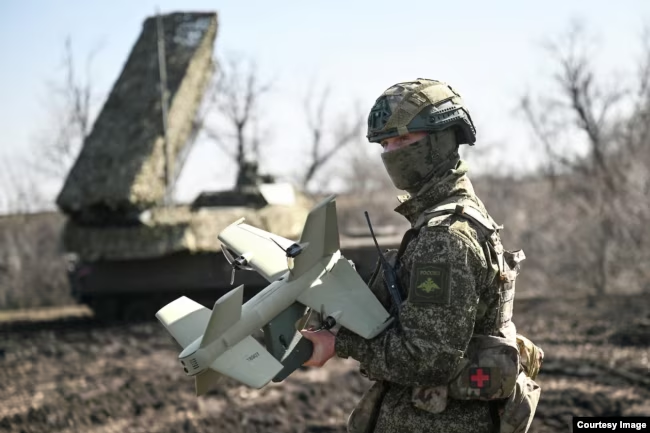
There’s no explosive warhead involved. It simply rams the target using a reinforced, spiked nose, physically destroying the drone’s airframe on impact. Because it doesn’t need a communication link back to the operator after launch, it’s essentially immune to jamming.
Russia’s Rostec also introduced the “Mnogotochie” cartridge, a 12-gauge round adapted for AK rifles that splits into three sub-projectiles mid-air. That alone reportedly boosts hit probability against erratic FPV drones by up to 2.5 times.
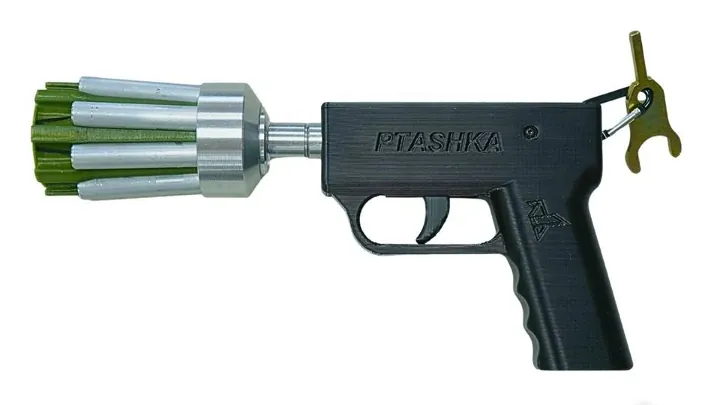
And then there’s the humble net gun. Ukraine’s Ptashka pistol fires an expanding 3.5 meter mesh for less than $200 a unit, tangling up rotors on slow-hovering “waiter” drones. It’s not glamorous, but it works, and it’s cheap enough to hand out widely.
Winning the Real-Time Fight: Detect, Track, Identify, Destroy
Every modern counter-drone system follows some version of the same four-step process, often shortened to DTIM: Detection, Tracking, Identification, and Mitigation.
Detection is harder than it sounds. Small drones barely register on radar, fly low, and blend into ground clutter. That’s why militaries increasingly rely on MIMO radar, systems that use multiple antennas transmitting independent signals at once for much sharper resolution. These radars are tuned to catch “micro-Doppler signatures,” the tiny frequency shifts created by spinning rotor blades, which helps tell a hostile quadcopter apart from a flock of birds.
Once something’s flagged, sensor fusion takes over, blending RF scanners, acoustic sensors, and infrared cameras so AI can classify the threat and calculate an intercept path within milliseconds.
The final step, mitigation, is where things get interesting. Rather than reflexively launching an expensive missile at every threat, AI systems are increasingly built to pick the cheapest effective option: a $3 laser burst, a quiet cyber-takeover, or a $500 kinetic interceptor instead of a multi-million-dollar missile. That’s the real goal behind modern counter-drone technology, matching the cost of the response to the cost of the threat.
How Different Countries Are Tackling the Drone Problem
Every major military power has taken its own path here, shaped by geography, budget, and the specific threats they’re facing.
United States: Expensive Firepower, Uncomfortable Lessons
The U.S. has leaned heavily on integrated, mobile systems like M-LIDS and MADIS, both built on armored vehicles and packed with radar, jammers, and 30mm autocannons. Raytheon’s Coyote interceptor has also evolved into a jet-powered missile (Block 2) capable of 555 km/h and a useful re-attack feature if it misses on the first pass.
But the 2026 Iran War exposed a real weakness: even with advanced microwave and laser tech in the arsenal, the U.S. burned through interceptors far faster than it could replace them. That’s pushed analysts to argue for a “counter-drone-as-a-service” model, leaning on partnerships with Gulf states and Ukraine to get cheaper layered defenses into the field faster.
Russia: Mass-Produced and Battlefield-Tested
Russia’s approach is blunt but practical: cheap, portable gear that frontline troops can actually use. Firearm-shaped jammers like the Pishchal, alongside the Yolka interceptor and Mnogotochie shotgun rounds, reflect a doctrine built around volume rather than sophistication. Dual-mounted PKT machine guns even serve as last-resort, close-in defense against low-flying FPVs.
India: Betting Big on a Sovereign AI Shield
India’s ‘Indrajaal’ system stands out because it’s homegrown, an AI-powered mesh network built entirely on domestic IP, running through a command core called SkyOS. It comes in a wide range of flavors: the Trooper and Repulsor for covert manpack operations; the Ranger and Combat variants for mobile convoy and armored-vehicle protection; the Urban and Infra versions for cities and power plants; and the Border and Maritime nodes guarding frontiers and ports. The Zombee, a 2.8 kg autonomous interceptor drone, rounds things out as the hard-kill option of last resort.
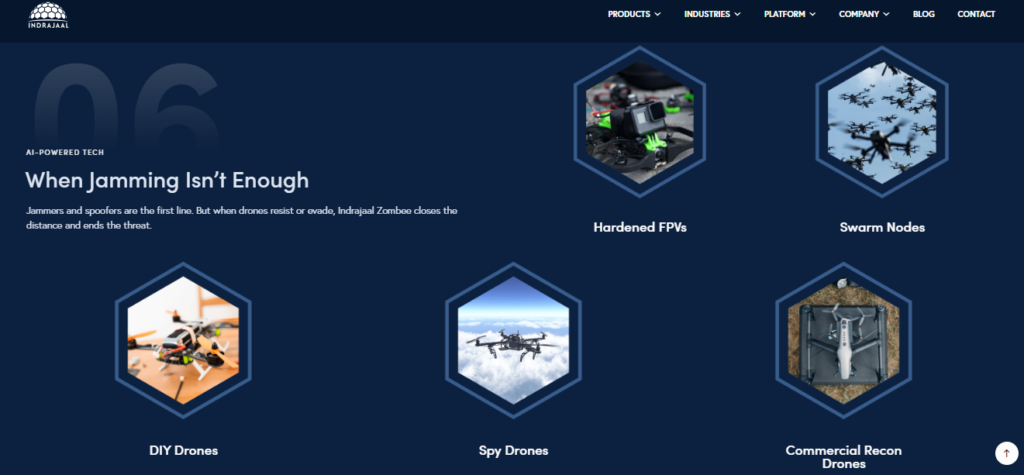
Alongside this, DRDO’s D4 system and the broader “Sudarshan Chakra” air defense umbrella tie together jamming, lasers, and missile systems into one national shield.
China: Out-Massing the Threat
China’s FK-3000 vehicle is essentially a mobile missile magazine on wheels, capable of carrying up to 96 quad-packed micro-missiles and intercepting targets within four to six seconds. Pair that with the Silent Hunter laser, a combat-proven 30–100 kW system already used against Houthi drones in the Gulf, and you get a picture of China’s doctrine: overwhelming density paired with near-unlimited laser ammunition.
France: Precision and Modularity for NATO
France’s Sky Warden system acts as a command layer tying together everything from the Mistral 3 missile down to simple net launchers. The RAPIDFire 40mm cannon, meanwhile, uses airburst tungsten rounds to shred drones without relying on jamming at all. France also proved its systems work in the real world, protecting the 2024 Paris Olympics with the HELMA-P laser and securing NATO headquarters in Brussels with the AI-driven Boreades system.
Israel: Turning the Cost Equation Upside Down
Israel’s Iron Beam laser, officially “Magen Or,” might be the single clearest example of solving the cost-asymmetry problem outright. Where an Iron Dome missile costs around $50,000 per shot, Iron Beam brings that down to $2–5 in electricity. Deployed ahead of schedule in December 2025, it can burn through drones and rockets at ranges up to 10 kilometers. Smaller variants like the 10 kW “Lite Beam” and the vehicle-mounted “Iron Wasp” extend that same logic down to the tactical level.
Iran: Doing More With Less
Iran isn’t chasing parity with Western militaries; it’s optimizing for endurance and cost. The Majid air defense system uses passive infrared sensors instead of active radar, meaning it gives off no RF signature and can operate in near-total silence. It’s reportedly proven effective enough to down a U.S. MQ-9 Reaper and has even been credited with damaging an F-35 by exploiting its heat signature. Iran has also repurposed its Karrar target drone into a jet-powered interceptor, armed with Majid air-to-air missiles, giving it a far cheaper alternative to scrambling manned fighters.
Conclusion
Drone warfare has permanently shifted the calculus of modern conflict, and counter-drone technology is now the deciding factor in who can actually afford to keep fighting. The countries pulling ahead aren’t necessarily the ones with the flashiest fighter jets. They’re the ones building AI driven, sensor-fused, cost-matched defenses that can outlast a saturation attack rather than just survive the first wave.
The more important thing is the ”technology”. It decides the probability of winning. That’s why it is necessary to build the most advanced tech.