

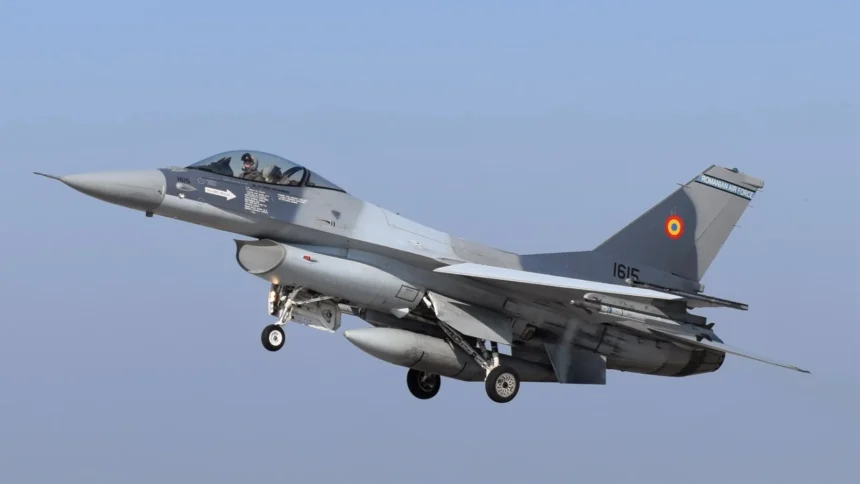
Two Romanian Air Force F-16s shot down two jet-powered Geran-family attack drones over Romania’s Black Sea territorial waters near Sulina on 17 October 2026, Romania’s Ministry of National Defence said. Bucharest has called a dedicated NATO meeting on Black Sea defence for 20 October, after a week of drone strikes on merchant ships.
Key takeaways
- The F-16s scrambled from the 86th Air Base at Borcea at 17:43 local time and downed the drones at 18:01 and 18:05 (Romanian Ministry of National Defence).
- The ministry later identified both as jet-propelled attack drones from the Russian Geran family. It did not name a launch site or the drones’ target (ministry update, in Romanian).
- Romania’s foreign minister, Oana Țoiu, said a dedicated North Atlantic Council meeting on Black Sea defence and deterrence will be held on Tuesday 20 October at Romania’s initiative (Țoiu on X).
- The shootdowns follow a run of drone strikes on merchant ships off Romania and Bulgaria, including a tanker fire off Sulina on 15 October that left seven crew missing (BBC).
- Bulgaria has formally asked NATO for combat aircraft and counter-drone systems. A NATO official said ambassadors would discuss the request this week (Reuters via Defense News).
What we know
According to the Ministry of National Defence (press release No. 213), radar picked up a group of aerial targets about 120 km east of Snake Island, heading south-west, on the evening of Saturday 17 October. Two F-16s on Air Policing duty took off from Borcea at 17:43 local time (20:13 IST). The first target entered Romanian airspace at 17:59 and was shot down at 18:01. The second entered at 18:01 and was shot down at 18:05. Both fell over Romania’s territorial waters.
In a later update, the ministry said the targets were attack drones of the Geran family with jet propulsion, downed south-east and east of Sulina, the small port at the mouth of the Danube’s Sulina branch. Foreign Minister Oana Țoiu gave the distances as about 25 km south-east and 20 km east of Sulina. “The Black Sea will be safe again,” she wrote, adding that Romania had briefed its allies and EU partners.
The same update says that in the week before the shootdown, Romanian radar tracked drones flying in Ukrainian airspace near the border on eight separate occasions, and in four of them drones briefly crossed into Romanian airspace (GRYD translation). The ministry did not say who launched Saturday’s drones.
Background: a week of strikes on Black Sea shipping
The western Black Sea is a key route for Ukraine’s grain and cargo trade, and the Sulina Canal links the Danube to the sea. On 13 October, drones struck two merchant ships off Bulgaria. One, the Guinea-Bissau-flagged Dignity, sank, leaving 11 crew missing, and Bulgaria summoned Russia’s ambassador, the BBC reported. All 15 crew of the second ship, the Maltese-flagged Chelsea 3, were rescued, AP reported.
Off Romania, the Comoros-flagged tanker Yara J was hit late on 14 October and its crew put out the fire. Early on 15 October, the San Marino-flagged Wine Trader reported a fire in its superstructure about 13 nautical miles south-east of Sulina. Five of its 12 crew were rescued and seven were still missing, the Romanian Naval Authority said via AGERPRES. President Nicușor Dan confirmed both tankers had been struck by drones.
Moscow says it targets ships carrying weapons and dual-use cargo to Ukrainian ports, while Kyiv and European governments say civilian cargo ships are being hit, according to the BBC. A NATO military source told Reuters the two tankers were hit by Russian drones (Reuters via Devdiscourse).
Black Sea drone incidents at a glance
October 2026; local times (UTC+3).
| Date | What happened | Source |
|---|---|---|
| 13 Oct | Drones hit two merchant ships off Bulgaria; cargo ship Dignity sinks with 11 crew missing | BBC |
| 14 Oct, 20:04 | Two aerial targets enter Romanian airspace; Spanish F-18s on NATO Enhanced Air Policing scramble from Mihail Kogălniceanu | Romanian MoD |
| 14 Oct, late | Tanker Yara J hit by a drone off Romania; crew safe | BBC |
| 15 Oct, about 07:00 | Wine Trader on fire 13 nm south-east of Sulina; 7 of 12 crew missing | Romanian Naval Authority via AGERPRES |
| 15 Oct | NATO Secretary General Mark Rutte meets Bulgaria’s PM and Romania’s President on Black Sea security | Rutte on X |
| 16 Oct | Bulgaria formally asks NATO for combat aircraft and counter-drone systems | Reuters via Defense News |
| 17 Oct, 18:01 and 18:05 | Romanian F-16s shoot down two jet Geran-family drones off Sulina | Romanian MoD |
| 20 Oct (planned) | Dedicated North Atlantic Council meeting on Black Sea defence and deterrence | Romanian Foreign Minister |
Romania’s drone incident count since 2022
The Romanian Ministry of National Defence publishes a running tally on its English homepage (data updated 17 October 2026). The ministry notes that categories are not cumulative: one incident can appear in more than one column.
| Year | Attacks near the border | Aircraft scrambled | Unauthorised entries | Drones shot down |
|---|---|---|---|---|
| 2022 | 1 | 0 | 1 | 0 |
| 2023 | 12 | 2 | 2 | 0 |
| 2024 | 26 | 12 | 7 | 0 |
| 2025 | 28 | 21 | 9 | 0 |
| 2026 (to 17 Oct) | 97 | 77 | 35 | 6 |
Source: Romanian Ministry of National Defence, “Drone and sea mine incidents”.
Why the Black Sea drones matter for NATO
The numbers show how fast the problem has grown. On the ministry’s own figures, 2026 so far has more than three times as many attacks near the border as 2025, and all six drones Romania has shot down since the war began were downed this year. Romania only started shooting such drones down in 2026, Reuters noted. In July, after its forces shot down three drones between 24 and 26 July, the foreign ministry summoned Russia’s ambassador, AGERPRES reported.
Saturday’s intercepts came about two and four minutes after each drone entered Romanian airspace, on the ministry’s published times. That is a fast air-policing response, but it also shows the limit of the current model. Air policing protects national airspace. Most of the ship attacks off Romania and Bulgaria happened outside NATO territorial waters, Reuters reported, in the two countries’ exclusive economic zones, where a coastal state has economic rights but not full sovereignty. Neither Bulgaria’s public request nor NATO’s statements so far say how merchant ships out there would be protected.
Jet-powered drones add pressure. Ukrainian intelligence services consider Russia’s jet-powered Geran a copy of Iran’s Shahed-238, Semnal reported. A faster drone shortens the window between radar detection and impact. GRYD’s reading, an inference rather than an official assessment, is that this pushes allies towards layered defences at sea and along the coast, not just fighter scrambles. NATO’s Secretary General has already pointed in that direction: “NATO has strengthened our posture along the eastern flank including with increasing counter-drone capabilities,” Rutte wrote on 15 October.
Geography also limits the options. Days after Russia’s full-scale invasion in February 2022, Turkey invoked Article 19 of the 1936 Montreux Convention, which restricts the passage of warships of states at war through the Turkish Straits (DW). Carnegie research published in July 2026 describes informal 2022 understandings under which NATO countries outside the Black Sea agreed not to send warships through the straits. In practice, any extra allied naval presence would lean heavily on the three littoral allies, Romania, Bulgaria and Turkey. Bulgarian Defence Minister Dimitar Stoyanov has said he plans to meet his Romanian and Turkish counterparts to coordinate.
What’s uncertain
- Who launched Saturday’s drones and what they were aiming at. Romania’s ministry has not said.
- Whether the 20 October meeting is a formal Article 4 consultation. Romania’s foreign minister described it as a dedicated North Atlantic Council meeting; she did not use the term Article 4.
- What, if anything, NATO will send. Stoyanov said Bulgaria’s letters urged NATO to strengthen its capabilities, “which also means deploying additional forces on our territory”, adding: “We are awaiting their decision.”
- The fate of the missing sailors from the Dignity and the Wine Trader, as of 18 October.
What to watch next
- The outcome of the North Atlantic Council meeting on Tuesday 20 October.
- NATO ambassadors’ decision on Bulgaria’s request for aircraft and counter-drone systems.
- Bulgaria’s planned entry into a NATO counter-drone initiative, which Stoyanov told parliament he expected by 30 October at a cost of €220,000 a year (The Sofia Globe).
- Romanian and Bulgarian steps towards an EU Maritime Security Hub in the Black Sea, which Țoiu said both countries are working to speed up.
Related: NATO’s ‘block, blunt, break’ theory of victory, how anti-drone technology is evolving, electronic warfare explained and why Kaliningrad matters for NATO.
Sources
- Romanian Ministry of National Defence, Press Release No. 213, 17 October 2026
- Romanian Ministry of National Defence, Informație de presă, UPDATE No. 337, 17 October 2026 (Romanian)
- Romanian Ministry of National Defence, Press Information No. 211, 15 October 2026
- Romanian Ministry of National Defence, Drone and sea mine incidents (data updated 17 October 2026)
- Oana Țoiu, Romanian Foreign Minister, post on X, 17 October 2026
- Mark Rutte, NATO Secretary General, post on X, 15 October 2026
- Reuters via Defense News, Bulgaria seeks NATO anti-drone systems, 16 October 2026
- BBC, Seven crew missing after drone attack leaves tanker ablaze off Romania’s coast, 15 October 2026
- AGERPRES, Five crew members from Wine Trader rescued, seven others remain missing, 15 October 2026
- AP, Drone attacks in Black Sea off Bulgaria sink 1 vessel, 13 October 2026
- Reuters via Devdiscourse, Romanian F-16 fighter jets shoot down two drones, 17 October 2026
- The Sofia Globe, Bulgaria expects to join NATO counter-drone initiative by 30 October, 14 October 2026
- AGERPRES, Foreign Ministry presents Russian ambassador with drone debris, 27 July 2026
- Semnal, Dronele doborâte lângă Sulina erau Geran cu reacție, 17 October 2026 (Romanian)
- DW, Why a 90-year-old treaty limits NATO in the Black Sea
- Carnegie Endowment for International Peace, Managing Montreux: Turkey and the Russia-Ukraine War in the Black Sea, July 2026