


GRYD Weapons Watch
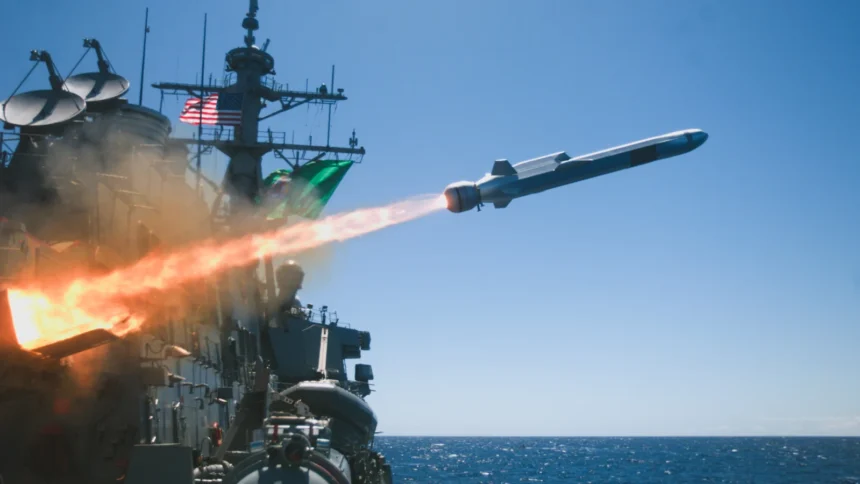
Kongsberg has fired a Naval Strike Missile (NSM) test round from a standard 20-foot shipping container in Norway, the first public demonstration of its new NSM Mission Module. The Norwegian firm says the launcher can work from ships, trucks or the ground without modification, which could make anti-ship missiles far easier to hide and spread out.
Key takeaways
- Kongsberg test-fired an NSM Ballistic Test Vehicle from a container-based unit that holds up to four missiles. The company announced it on 22 October, Baird Maritime reports.
- Janes reports the firing took place on 1 October at an undisclosed military test range, using a four-pack launcher inside the container.
- The test checked safety, handling and loading, and how the unit copes with pressure and blast at launch. It was not a live-warhead shot at a target.
- Kongsberg is pitching the module for long coastlines and large distances, and has told Janes that Australia may be interested in a land-based option.
What we know
In a company story titled “Missile in a box”, Kongsberg said that in the autumn of 2026 it “successfully conducted a test firing of an NSM Ballistic Test Vehicle from a standard 20-foot container”. The firing took place in Norway, from a container-based unit holding up to four missiles. Kongsberg calls the product the NSM Mission Module.
The company said the aim was “to verify safety aspects, logistical parameters related to handling and loading, as well as the system’s ability to manage pressure and blast effects during launch”. In other words, this was a test of the box, not of the missile’s ability to find and hit a ship.
More detail came from Ståle Mortensson, a Kongsberg vice president for business development and strategy, who spoke to Janes at the Land Forces exhibition in Perth, Australia, on 8 October. He said the firing happened on 1 October at an undisclosed military test range and used a four-pack launcher in the 20-foot container. The test round had the same size and weight as a live NSM but no live warhead. Before launch, the roof section of the modified container opens to give the multi-canister launcher a path to fire.
Kongsberg says the container “can be deployed, without modifications, from ships, trucks or directly from the ground”, and that it fits into existing logistics and transport networks. Baird Maritime reported that the company made the announcement on Thursday 22 October, the same week it won a NOK400 million (about $42 million) contract for more missiles for Denmark.
Background
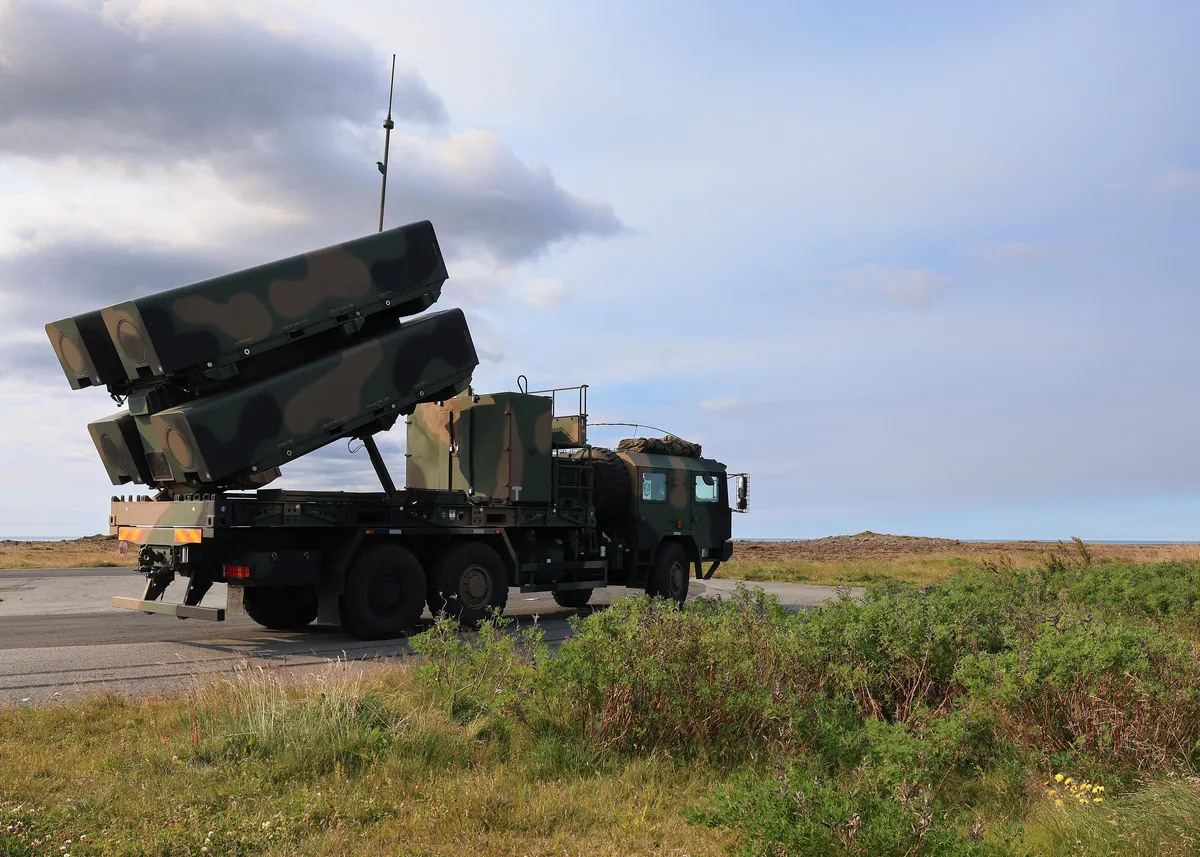
The NSM is a Norwegian anti-ship and land-attack cruise missile, and Kongsberg says it now has more than 15 user countries. It already flies from frigates, corvettes and truck launchers. Poland’s Naval Missile Unit drives its launchers on trucks, and in August 2024 it deployed one to Iceland for the NATO-linked exercise Northern Viking 24, which the U.S. Navy said was about the defence of Iceland and sea lanes in the Greenland-Iceland-United Kingdom (GIUK) gap.
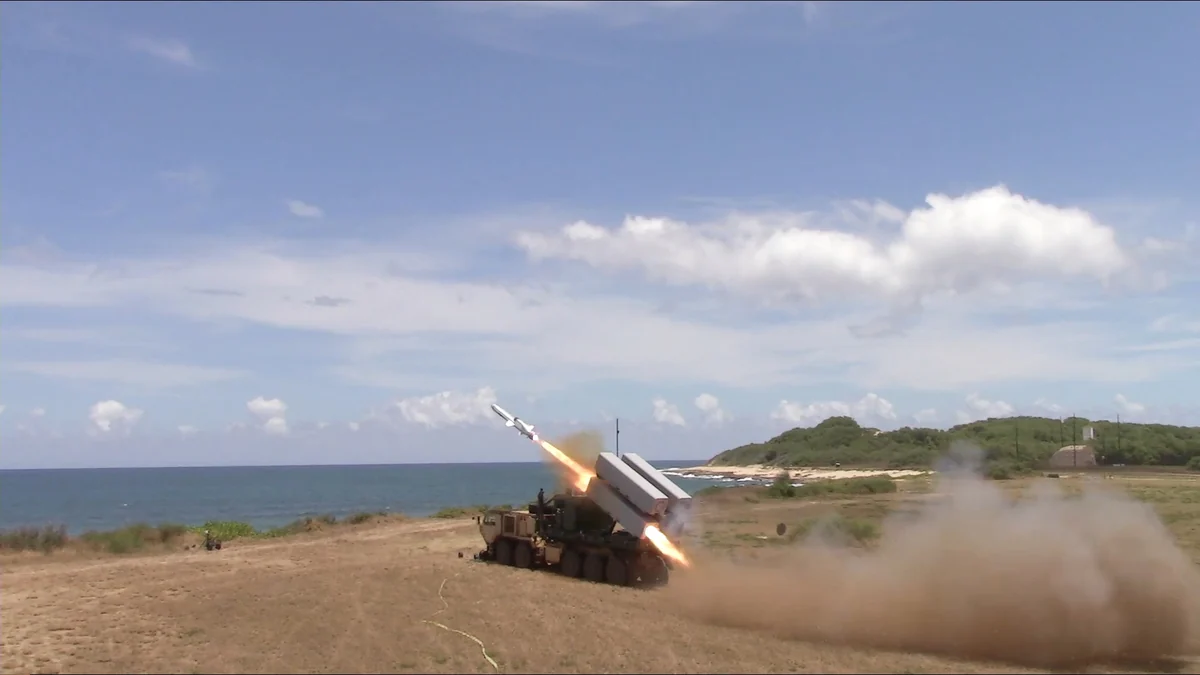
The idea of firing the NSM from something other than a purpose-built vehicle is not new. During the Rim of the Pacific (RIMPAC) exercise off Hawaii in 2018, the U.S. Army fired an NSM from a flat-rack launcher on a Palletized Load System truck and hit a decommissioned ship 63 miles north of Kauai. The US Marine Corps has since built its Navy-Marine Expeditionary Ship Interdiction System (NMESIS) around a remotely operated vehicle with two NSMs, and in October it stood up its first NMESIS missile battalion.
In Europe, Kongsberg reported that Norway, the United Kingdom and Poland fired NSMs together during Exercise Ægir 25 in northern waters, including the first live NSM firing from a Royal Navy warship, HMS Somerset. For more on the wider family of strike weapons, see the GRYD missiles hub.
NSM Mission Module at a glance
| Item | Detail | Source |
|---|---|---|
| Product | NSM Mission Module, a containerised NSM launcher | Kongsberg |
| Container | Standard 20-foot shipping container with an opening roof section | Kongsberg; Janes |
| Capacity | Up to four missiles (four-pack launcher) | Kongsberg; Janes |
| Test date and place | 1 October 2026, undisclosed military test range in Norway | Janes; Kongsberg |
| Test round | Ballistic Test Vehicle, same size and weight as a live NSM, no live warhead | Janes |
| Test aims | Safety, handling and loading, pressure and blast effects | Kongsberg |
| Launch options | Ships, trucks or the ground, without modification | Kongsberg |
| Announced | Thursday 22 October 2026 | Baird Maritime |
| NSM user countries | More than 15 | Kongsberg |
Why it matters
The headline is not a new missile. It is a new way to hide and move an existing one. A truck launcher looks like a military vehicle, and a warship can be tracked. A 20-foot container is the basic unit of world trade, and it can travel by road, rail or sea through the same networks as commercial freight. That is the heart of Kongsberg’s pitch: the company says containers can be “pre-positioned and deployed discreetly” and spread across larger areas.
That matters because anti-ship warfare is increasingly about making an enemy guess where the threat is. Mortensson put it plainly: “There is growing interest in concepts that enable capabilities to be distributed and repositioned across large geographic areas, with a containerized solution representing one possible approach.” For countries with long coasts, such as Norway, or with huge distances to cover, such as Australia, a launcher that can be dropped on a quay, a ship deck or a remote island without a special vehicle could stretch a small missile stock much further. The same logic sits behind the US Marines’ NMESIS and the island-based missile deployments GRYD covered during Keen Sword 27.
There is a NATO angle too. The alliance’s northern flank, from the Norwegian coast to the GIUK gap and the Baltic, is full of narrow seas where a few well-hidden anti-ship batteries could slow an opponent. Mortensson also told Janes the box could support land strike missions, since the NSM can hit targets ashore. That fits the alliance’s focus on holding an attacker at risk early, which GRYD explored in NATO’s “block, blunt, break” plan.
For Kongsberg, it is also a sales story. The firm told Janes: “We are looking at the market and hoping to sell internationally.” A launcher that can ride on almost anything widens the customer base beyond navies with suitable ships.
What’s uncertain
- How far it went. Neither Kongsberg nor Janes gave a flight distance or said whether the test round was guided to a target. The test focused on launch safety and handling.
- Targeting. A missile in a box still needs radar, data links and a fire control system to find ships. Kongsberg’s story does not explain how the module would get targeting data.
- Customers and cost. No buyer, price or in-service date has been announced. Australia’s interest was described by Mortensson as possible, not confirmed.
- Disguise. Kongsberg’s material does not say how containerised launchers would be marked or kept apart from civilian freight, a question buyers and planners would have to settle.
What to watch next
- A guided live firing against a sea target from the container, which would be the real proof of the concept.
- Any order from Norway, Poland, Denmark, Australia or another of the NSM’s existing users.
- Whether Kongsberg shows the module at future defence exhibitions alongside its StrikeMaster vehicle, which fired an NSM test munition in October 2025, according to Baird Maritime.
- Similar moves by other missile makers to put launchers in standard containers. For context on Baltic pressure points, see GRYD’s explainer on Kaliningrad and NATO.
Sources and further reading
- Kongsberg, Missile in a box: the NSM evolution continues (October 2026)
- Janes, Kongsberg test fires Naval Strike Missile from shipping container (15 October 2026)
- Baird Maritime, Kongsberg test-fires naval strike missile from 20-foot container in Norway (22 October 2026)
- U.S. Army, First land-based missile launch performed at RIMPAC exercise (2018)
- Kongsberg, Allies validate NSM performance in Arctic exercise (October 2025)
- DVIDS, Northern Viking 2024, U.S. Navy image 240826-N-DE439-1002 (26 August 2024)