


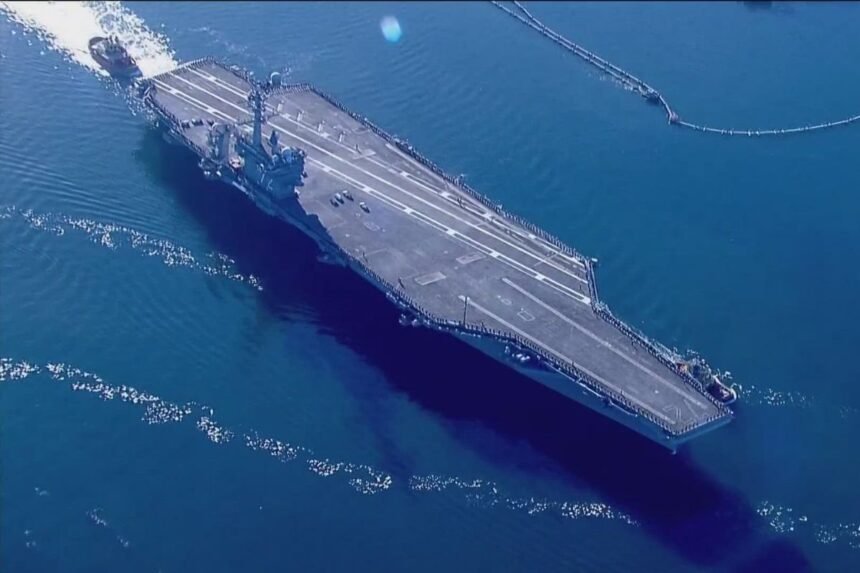
An aircraft carrier is built to stay at sea. Its nuclear reactor can provide propulsion for years. Its aircraft can be launched repeatedly. Its carrier strike group can operate thousands of kilometres from the United States. But there is one part of the ship that cannot simply be refuelled or replaced:
The People.
That reality is now at the centre of growing concern surrounding the USS Abraham Lincoln, which has remained deployed for an unusually long period as the United States continues military operations connected to the Iran conflict.
The carrier left San Diego on November 21, 2025, originally for an Indo-Pacific deployment, before being redirected to the Middle East as tensions with Iran escalated.
Months later, the deployment is still continuing.
And according to an investigation published by Military Times on August 11, 2026, several sailors aboard the Abraham Lincoln have reportedly attempted to go overboard during the extended deployment. The report was based largely on interviews with family members of sailors, including the wife of one sailor who allegedly attempted to jump from the carrier and was subsequently placed on medical hold.
The disturbing allegations point towards a problem that is rarely visible when discussing naval warfare:
A warship can have enormous endurance. Its crew cannot.
The machine can keep going. The human body has limits.
The Abraham Lincoln is one of the world’s most powerful warships. It carries thousands of sailors and Marines, along with an embarked air wing and the sophisticated systems required to operate a modern carrier strike group.
From a strategic perspective, keeping such a ship deployed makes sense. A carrier provides the United States with a mobile airbase that can be moved rapidly into a crisis zone without depending on a host nation’s airfields. But maintaining that capability comes with a human cost.
A sailor does not experience deployment as a line on a Pentagon map. For the person aboard the ship, deployment means months of watches, maintenance, flight operations, drills and cramped living conditions while remaining thousands of kilometres away from family.
And when the expected return date keeps moving further away, psychological pressure can build.
When “extended deployment” becomes something else
Military deployments are planned around certain assumptions. Sailors know roughly when they are leaving. Families know approximately when they will return. The crew prepares mentally for a defined period away from home. But geopolitical crises do not respect those schedules.
The Abraham Lincoln was sent towards the Middle East after initially being assigned to the Indo-Pacific. It arrived in the US Central Command area in January 2026 and subsequently became part of US operations against Iran. The longer it remained forward, the more unusual the deployment became.
And that is where the difference between operational endurance and human endurance becomes important. A nuclear-powered carrier can remain technically capable of operating. Its sailors still need sleep. They still need time away from the ship. They still need communication with their families. And they still need to believe that eventually, they are going home.
The problems that don’t appear on a battlefield map
The Military Times report also described concerns raised by families over conditions aboard the carrier, including allegations involving sanitation, showers, toilets, laundry and food. These details may appear secondary compared with missiles and combat aircraft. They are not. In a confined environment where thousands of people live and work for months, ordinary inconveniences can become significant sources of frustration when combined with exhaustion and uncertainty.
The Navy has previously pushed back against claims of food shortages aboard deployed vessels, saying logistics records showed adequate food supplies aboard the Lincoln and other ships. That distinction matters. Not every allegation made by family members is necessarily an independently verified fact.
But the fact that families are raising these concerns at all and that Military Times investigated them shows that the human side of the deployment deserves attention.
The invisible battlefield
Military power is normally measured in visible things.
How many aircraft? How many missiles? How many ships? How many sorties?
But there is another metric that is much harder to quantify:
How many people are still mentally and physically ready to keep doing the job?
A sailor can look perfectly normal while carrying severe emotional strain.
There may be no visible injury. No damaged aircraft. No alarm on the ship’s combat systems. Yet the individual may be struggling. That is what makes reports of sailors attempting to go overboard particularly serious. They do not automatically mean the entire crew is in crisis. Nor do they prove that conditions aboard the carrier are universally intolerable. But they do demonstrate something militaries sometimes find uncomfortable to acknowledge:
training does not eliminate human limits.
The hidden price of keeping a carrier forward
There is also a strategic dimension to the story. Aircraft carriers are among the United States’ most valuable military assets, but they are not unlimited. Every carrier requires periods of maintenance. Crews need recovery and training cycles. Families need stability. The Navy must rotate forces without exhausting the people who operate them. The longer one carrier remains deployed, the greater the pressure on that wider system.
The US Navy has already experienced extraordinarily long deployments in recent years. In fact, the USS Gerald R. Ford returned in May 2026 after an 11-month deployment, surpassing the post-Vietnam War record for carrier deployment length. That suggests this is not merely a one-off problem. It raises a much broader question about the sustainability of America’s carrier-centric global presence.
A carrier is more than steel
It is easy to look at an aircraft carrier and see a machine.
A nuclear reactor. A flight deck. Catapults. Fighters. Missiles. Radar.
But inside that machine are thousands of people. Someone launches the aircraft. Someone services it. Someone maintains the arresting gear. Someone monitors the reactor. Someone stands watch at 3 a.m. Someone is answering a phone call from home. And someone may simply be counting the days until they can walk off the ship. That human element is easy to forget when discussing military power. But it may be the most important element of all.
The real limit of a supercarrier
The story emerging from the Abraham Lincoln is therefore not simply about a troubled deployment.
It is about the fundamental contradiction of modern military power. Technology allows nations to keep warships operating farther away for longer than ever before. But technological endurance does not automatically create human endurance. A nuclear reactor can run. An aircraft carrier can sail. A fighter can fly. But the sailor maintaining that aircraft still needs rest. The officer standing watch still needs a break. The person inside that uniform still needs to know that their life exists beyond the ship. And that may be the most important lesson from the controversy surrounding USS Abraham Lincoln.
The ultimate endurance limit of a warship may not be its reactor, fuel, ammunition or machinery.
It may be the human beings inside it.