

Japan’s Acquisition, Technology and Logistics Agency (ATLA) says a small experimental railgun fired ten rounds in a row, one every ten seconds, using a power supply built around rechargeable batteries. The test does not make the gun faster. It tackles the problem that has stalled railguns for two decades: feeding them enough power, quickly, again and again.
Key takeaways
- ATLA told Naval News on 20 November that a 16 mm test railgun fired ten 15-gram rounds at ten-second intervals in May and June 2026, averaging 245 m/s (Naval News).
- The rig pairs lithium titanate (LTO) batteries with a fast charger and a capacitor module that stores about 200 kJ for each shot.
- It is a separate, much smaller system from the 40 mm railgun that fired at a target ship from the test ship JS Asuka in 2025.
- ATLA names scaling this repeat-fire power system up to medium-calibre railguns as a key next task.
- The US Navy paused its own railgun at the end of 2021 after spending $954.6 million, citing cost and integration problems, while Japan keeps testing and publishing results.
What we know
The results were first shown at the ATLA Technology Symposium 2026 in Tokyo on 10 and 11 November (ATLA symposium site). Journalist Kosuke Takahashi then asked the agency for details, and ATLA’s written reply on 20 November filled in the gaps: where, when and how fast (Yahoo! News Japan, in Japanese).
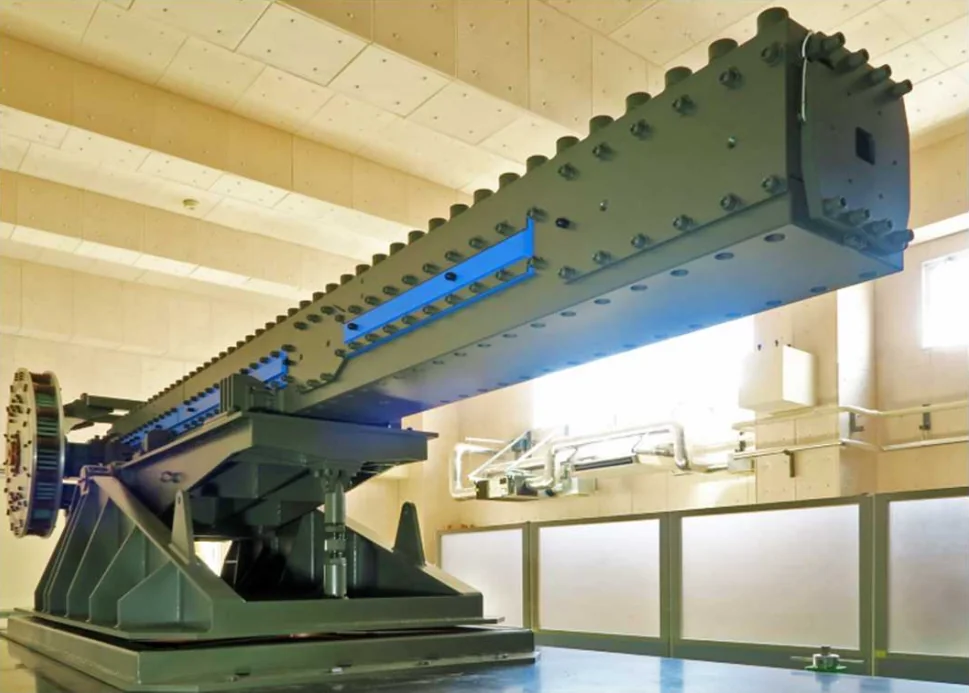
According to ATLA, the test took place in May and June 2026 at its Ground Systems Research Center in Sagamihara, Kanagawa Prefecture. The gun has a 16 by 16 mm bore and a 2 m acceleration length, and it fired projectiles of about 15 grams. The test was set for 240 m/s at six rounds per minute. The ten rounds actually averaged 245 m/s (about 880 km/h, or 800 ft/s), with the slowest at 235 m/s and the fastest at 252 m/s.
The power chain is the point of the experiment. LTO batteries with a maximum capacity of 50 MJ supply 540 volts. A rapid charger steps that up to 8.5 kilovolts and fills a capacitor module, which then dumps a huge current pulse into the rails to fire each shot. The battery stores energy for the whole string of shots; the capacitor delivers the brief burst. The rig also has an automatic loader with a circular magazine.
ATLA first ran ten discharges with no projectile loaded, then fired the ten live rounds. It said the stable muzzle velocities confirmed the power supply’s rapid charging and discharging and its suitability for railguns. The work was first presented in September at the EAPPC-BEAMS-EML2026 conference in Nagaoka.
Background: Japan’s two railguns
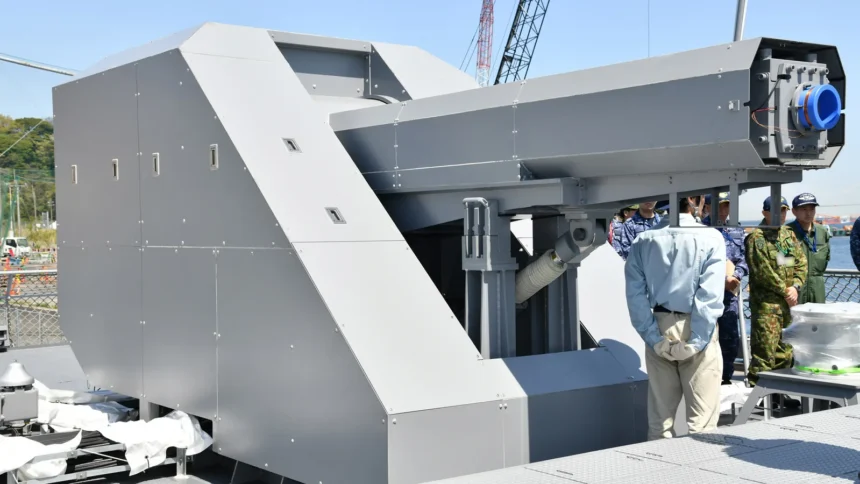
Japan is running two railgun lines at once, and it helps to keep them apart. The headline-grabbing one is a 40 mm research gun, about 6 m long and 8 tonnes, built under a programme that ran from fiscal 2016 to 2022. ATLA says that programme reached muzzle velocities above 2,300 m/s and rail life of more than 200 shots, according to its own 2025 symposium presentation. Its capacitor bank stores 5 MJ and fills four 20-foot shipping containers.
That gun was modified for sea and mounted on the stern flight deck of JS Asuka, the Japan Maritime Self-Defense Force (JMSDF) test ship. ATLA announced in October 2023 what it called the first railgun firing at sea from a ship, and in September 2025 it said the Asuka gun had hit a real target ship during trials in June and early July 2025 (Naval News). Those were single shots. The new 16 mm rig is about firing many shots in a row from a power system small enough to fit a ship.
Japan is not working alone. On 30 May 2024 its Ministry of Defense signed terms of reference on railgun technology with France, Germany and the French-German Research Institute of Saint-Louis (ISL), which the ministry said would support work toward early practical use (Japan Ministry of Defense, in Japanese). ATLA told Naval News at the time it intended “to steadily work towards the early practical application of railguns” (Naval News). For the wider picture of Tokyo’s build-up, see our look at Japan’s defence transformation, and for the hub of our technology coverage, the GRYD Tech section.
The Japan railgun programme at a glance
| Item | 16 mm repeat-fire rig (2026) | 40 mm research gun (JS Asuka) | Source |
|---|---|---|---|
| Bore / calibre | 16 x 16 mm | 40 mm | Naval News; ATLA 2025 slides |
| Size | 2 m acceleration length | About 6 m long, about 8 tonnes | Naval News; ATLA 2025 slides |
| Projectile | About 15 g | Not publicly confirmed | Naval News |
| Muzzle velocity | 245 m/s average (235 to 252 m/s) | Above 2,300 m/s (programme result) | ATLA via Naval News; ATLA 2025 slides |
| Firing | 10 rounds, one every 10 seconds | Single shots at sea | Naval News |
| Energy storage | LTO batteries (50 MJ max) plus about 200 kJ capacitor per shot | 5 MJ capacitor bank in four 20-ft containers | Naval News; ATLA 2025 slides |
| Tested | May to June 2026, Ground Systems Research Center | June to early July 2025, at sea off Japan | ATLA via Naval News |
Why it matters
A railgun’s appeal is simple: very fast, cheap, solid projectiles instead of costly missiles, and no explosive propellant on board. Its weakness is just as simple. Every shot needs a huge pulse of electricity, and the gun must recharge before the next one. A gun that fires once and then waits minutes is a demonstrator, not a weapon.
That is why a slow, small gun is worth a headline. The muzzle energy of a 15 g round at 245 m/s works out to roughly 0.45 kJ, a tiny fraction of the 200 kJ the capacitor stores (our arithmetic). Nobody should read this as a weapon test. What ATLA demonstrated is that a battery-backed charger can refill the capacitor in under ten seconds, ten times running, with consistent results. On paper, 50 MJ of battery capacity is enough for about 250 full charges at 200 kJ, before any losses.
The scale-up is the hard part. If a 40 mm-class gun needed its full 5 MJ bank refilled every ten seconds, the charger would have to supply about 500 kW on average, 25 times the roughly 20 kW the small rig needs (again our arithmetic, assuming the same firing rate and ignoring losses). ATLA itself lists scaling the repeat-fire system to medium-calibre railguns as a key future task. The battery approach matters because the alternative, many separate capacitor banks, can deliver a high rate of fire but makes the whole system very large, according to ATLA’s conference paper as reported by Takahashi.
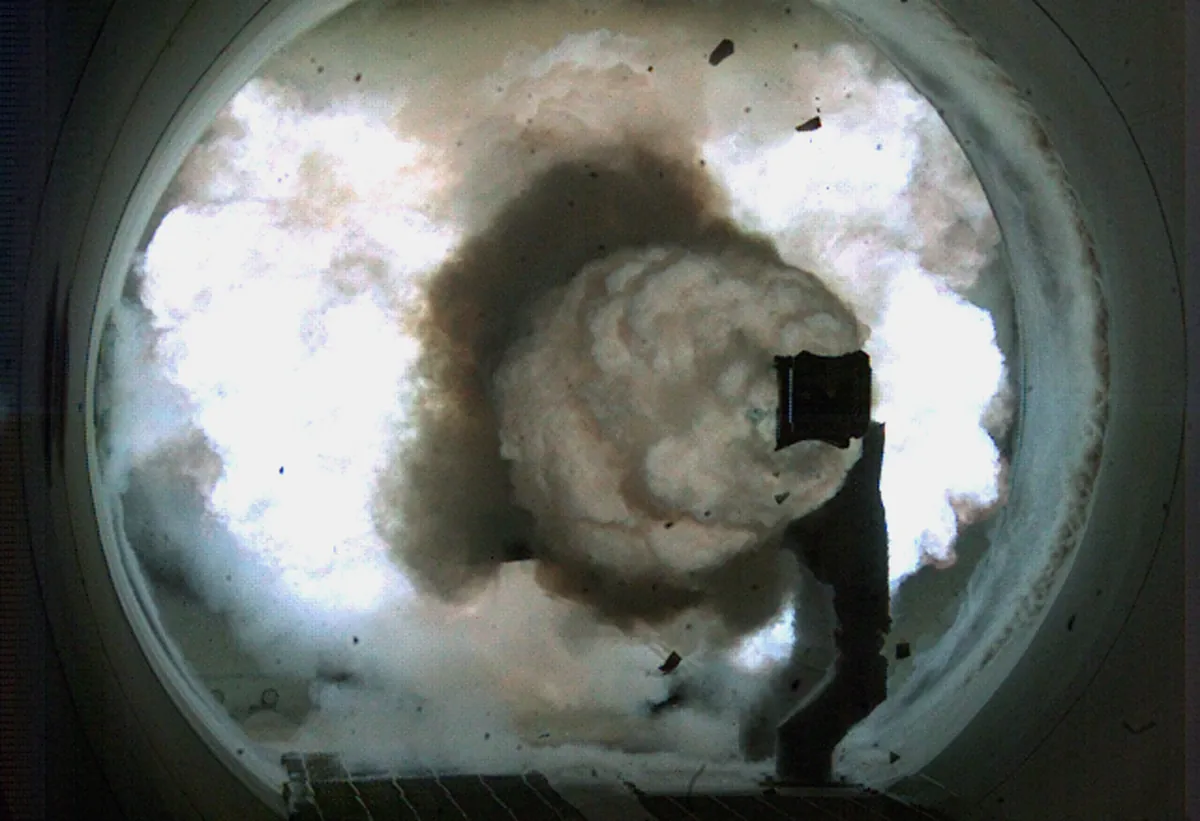
The comparison with the United States is telling. The US Navy developed its railgun from 2005, spent $954.6 million on it to 2021 according to the Congressional Research Service, and fired record shots at Dahlgren. It then paused the work at the end of 2021. A Navy statement quoted by the CRS gave the reasons: “Given fiscal constraints, combat system integration challenges and the prospective technology maturation of other weapon concepts”. Fitting power, cooling and fire control into a real ship is exactly the ground Japan is now covering step by step. In China, photos in 2018 showed what analysts assessed as a railgun under test on the landing ship Haiyangshan (RUSI), but has published far less than ATLA. Our earlier piece on China’s railgun ambitions covers that programme.
Cheap rounds fired quickly could, in theory, ease the pressure on expensive interceptor stocks. The same stored-energy idea sits behind electromagnetic aircraft catapults, as our steam vs EMALS explainer sets out.
What’s uncertain
- How the battery-and-capacitor design performs at medium calibre, where each shot needs far more energy. ATLA has not published results at that scale.
- Whether repeat fire can be combined with the high velocities of the 40 mm gun. The 16 mm test ran at about a tenth of that speed.
- Rail wear under sustained fire, and the guidance or fire control needed to hit fast, manoeuvring targets. ATLA’s roadmap lists stable flight outside the barrel and fire control as ongoing work.
- Timelines and cost. ATLA has not said when, or on which ship or vehicle, a railgun might enter service.
What to watch next
ATLA says the first phase of its future railgun prototype work runs from fiscal 2022 to fiscal 2026, with further performance tests planned. Watch for a medium-calibre repeat-fire demonstration, multi-shot trials at sea from JS Asuka, joint work with France and Germany, and whether Japan funds platform-specific development, the last step on ATLA’s roadmap.
Sources
- Naval News: Japan Confirms Ten-Shot Railgun Test Using Battery-Based Power Supply, 23 November 2026
- Yahoo! News Japan (Kosuke Takahashi): details of the railgun ten-shot test, 20 November 2026 (Japanese)
- ATLA Technology Symposium 2026, 10 to 11 November 2026 (Japanese)
- ATLA: Shipboard firing test of the electromagnetic acceleration system, symposium presentation, November 2025 (Japanese, PDF)
- Naval News: Japan Successfully Fires Ship-Mounted Railgun at Target Vessel for First Time, 11 September 2025
- Japan Ministry of Defense: signing of railgun technology terms of reference with France, Germany and ISL, 30 May 2024 (Japanese)
- Naval News: Japan joins European efforts for railgun research project, 16 October 2024
- Congressional Research Service: Navy Lasers, Railgun, and Gun-Launched Guided Projectile, updated 17 November 2021 (PDF)
- RUSI (Justin Bronk): Potential Chinese Railgun Testing Illustrates the US Navy’s Biggest Long-Term Challenge, 1 February 2018