

US Central Command (CENTCOM) has set up Task Force Iron Gate to stop Iran moving weapons, dual-use technology and money over land and across the Caspian Sea. The same day, 7 November 2026, a US aircraft disabled the cargo ship M/V Huda in the Gulf of Oman, the fifth merchant ship CENTCOM says it has disabled for running the blockade.
Key takeaways
- CENTCOM commander Adm. Brad Cooper ordered the formation of Task Force Iron Gate, a staff of about 20 civilian and military personnel based in Tampa, Florida, CENTCOM said.
- Its remit is Iran’s land borders and the Caspian Sea, a landlocked sea that US warships cannot reach.
- A US aircraft fired precision munitions at the stern of the St Kitts-flagged M/V Huda after it left an Iranian port, according to CENTCOM.
- CENTCOM’s tally now stands at 147 ships redirected and five disabled since July, up from 135 and four on 10 October.
What we know
CENTCOM announced Task Force Iron Gate on 7 November. It said the new team will work with other US government agencies to prevent “the movement of advanced weapons systems, dual-use technologies, sanctioned materials, and illegal revenue streams across Iran’s land borders and the Caspian Sea”.
“The establishment of Task Force Iron Gate reinforces the success of our ironclad blockade against Iran at sea,” Cooper said in the CENTCOM release. He added that closer work with other agencies “will further constrain Iran’s ability to finance terrorism, rebuild weapons factories, and replenish their military.”
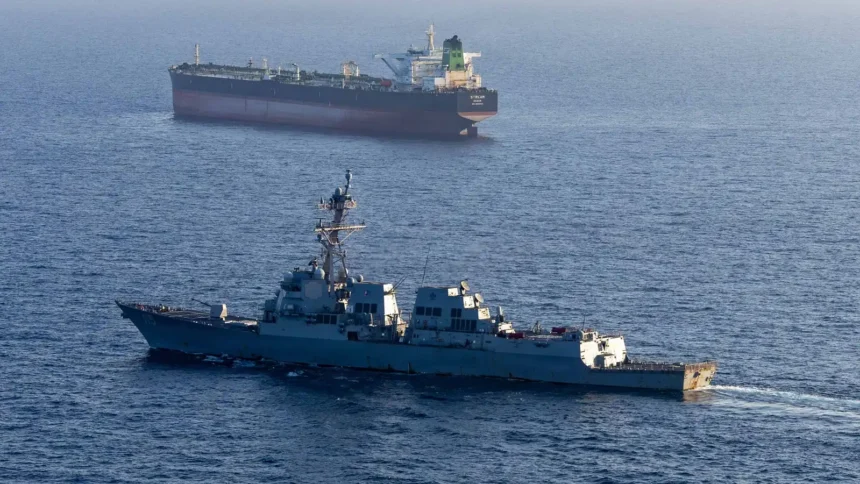
The same day, CENTCOM said its forces disabled M/V Huda in the Gulf of Oman after the civilian crew “ignored repeated warnings and attempted to violate the naval blockade against Iran multiple times.” The ship had visited an Iranian port and was trying to leave regional waters. CENTCOM said its forces told the crew to abandon the targeted spaces before the aircraft fired at the stern. It did not name the aircraft type or describe the damage beyond saying the ship was disabled. Stars and Stripes reported the strike from CENTCOM’s statement.
Background: a blockade at sea since July
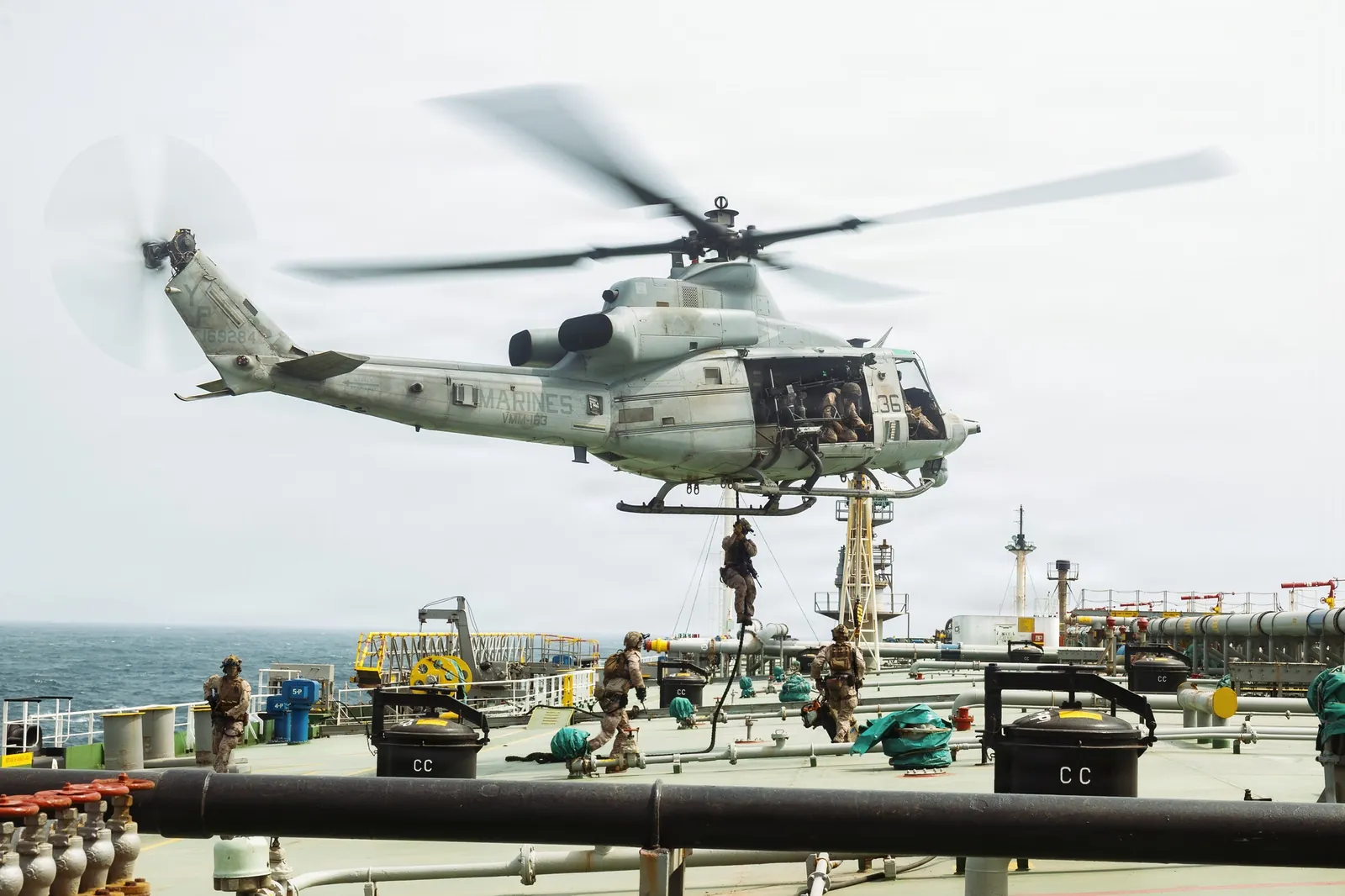
CENTCOM said its forces resumed the blockade of all ships “entering or departing Iranian ports on July 14”, Al Jazeera reported on 11 October. That update came after a US fighter jet disabled the Panama-flagged M/V Ocean Molica, also known as the Arika Sun, in the Gulf of Oman on 10 October, as CENTCOM posted on X.
The new figures show how the campaign has moved in four weeks. On 10 October CENTCOM counted 135 ships turned around and four disabled. By 7 November the totals were 147 redirected and five disabled. Separately, CENTCOM’s 7 November release said it had previously destroyed 10 tankers linked to Iran’s Islamic Revolutionary Guard Corps (IRGC). Al Jazeera had already reported that count on 11 October, so it is a historical figure, not 10 additional destructions during this four-week comparison. The 7 November release does not date those earlier destructions. CENTCOM says the blockade has stopped Iran exporting more than US$25 billion of crude oil “in recent months”. That figure is CENTCOM’s own and has not been independently verified.
For more on the wider conflict, see GRYD’s Conflict coverage and our 30 October Weekly Briefing, which covered missile fire towards Riyadh.
Iran blockade at a glance
| Item | Figure or detail | Source |
|---|---|---|
| Blockade resumed | 14 July 2026, all ships entering or leaving Iranian ports | CENTCOM, via Al Jazeera |
| Ships redirected | 135 (10 Oct) to 147 (7 Nov) | CENTCOM (Oct, Nov) |
| Merchant ships disabled | 4 (10 Oct) to 5 (7 Nov), latest M/V Huda | CENTCOM (Nov release) |
| IRGC-linked tankers destroyed | 10 | CENTCOM (Nov release) |
| Crude exports blocked (CENTCOM claim) | More than US$25 billion “in recent months” | CENTCOM (Iron Gate release) |
| Task Force Iron Gate size and base | About 20 civilian and military staff, Tampa, Florida | CENTCOM (Iron Gate release) |
| Task Force Iron Gate remit | Iran’s land borders and the Caspian Sea | CENTCOM (Iron Gate release) |
Why Task Force Iron Gate matters
A blockade at sea only covers the sea. Iran’s other routes run overland and across the Caspian, where Russia is its main partner. Russia has shipped drone components, ammunition and TNT to Iran across the Caspian, NBC News reported in August, citing a European government document verified by a Western official. The Institute for the Study of War (ISW) summarised the report as more than two dozen Russian ships delivering to Amirabad port in Iran’s Mazandaran province. Neither Moscow nor Tehran has acknowledged such transfers.
The Caspian is also a stretch of water the US Navy cannot reach. Radio Free Europe/Radio Liberty described it as “an inland sea that Western navies cannot directly enter.” The five coastal states went further on paper. The Convention on the Legal Status of the Caspian Sea, signed at Aktau in 2018 by Azerbaijan, Iran, Kazakhstan, Russia and Turkmenistan, lists the “non-presence in the Caspian Sea of armed forces not belonging to the Parties” among its principles, and limits navigation to ships flying one of their flags.
That explains the shape of the new unit. Iron Gate is a staff cell of about 20 people in Florida, not a flotilla or a ground force. GRYD’s reading, based on CENTCOM’s wording, is that its tools are likely to be intelligence sharing, sanctions targeting and pressure on transit states, carried out with other agencies rather than by force. Others have already struck the Caspian route: ISW notes Israel hit facilities at Bandar Anzali earlier in the war, and Ukraine struck sanctioned cargo ships in the Caspian on 25 July. For how sanctioned states keep buying parts despite restrictions, see our explainer The Dark Market after Sanctions.
The sea campaign itself is also hardening. Since 10 October, 12 more ships have turned back and one more has been disabled. That works out at roughly three ships a week turned around, a GRYD calculation from CENTCOM’s two tallies. Firing on merchant ships remains contested in the US: after the 10 October strike, Senator Chris Murphy wrote on X, “Why are taxpayers paying billions to hit commercial ships?”, Al Jazeera reported.
What’s uncertain
- Cargo and crew: CENTCOM has not said what M/V Huda was carrying, who owns it or whether anyone was hurt. In October it said the crew of Ocean Molica was unharmed; its 7 November statement does not say so.
- Iron Gate’s powers: CENTCOM describes coordination with other agencies. It has not said whether the task force can direct strikes, interdictions or seizures on land routes.
- The Caspian traffic itself: RFE/RL notes that the contents of individual Caspian shipments are largely unknown, and much of the traffic is ordinary trade such as grain.
- The US$25 billion figure: this is CENTCOM’s estimate. No independent tally has been published.
What to watch next
- New US Treasury or State Department designations aimed at Caspian shipping or overland transit firms, which would be the first visible sign of Iron Gate’s work.
- Reactions from Russia and the other Caspian states, which in their 2018 convention declared the sea’s affairs their “exclusive competence”.
- CENTCOM’s next blockade tally, and whether it names the aircraft or says anything more about the Huda’s crew and cargo.
- Any Iranian response at sea in the Gulf of Oman and the Strait of Hormuz.
For the human side of the US naval deployment, read A Supercarrier Can Stay at Sea. But Can Its Crew?
Sources
- U.S. Central Command: CENTCOM Launches Task Force to Disrupt Iranian Ground Transit Routes Supporting Illegal Shipments, 7 November 2026 (DVIDS copy)
- U.S. Central Command: U.S. Forces Disable Cargo Vessel Attempting to Violate Naval Blockade, 7 November 2026 (DVIDS copy)
- U.S. Central Command on X: U.S. Forces Disable Cargo Vessel Attempting to Violate Blockade, 11 October 2026
- Stars and Stripes: CENTCOM disables commercial cargo vessel in Gulf of Oman, 7 November 2026
- Al Jazeera: US forces disable ship attempting to run Iran blockade in Gulf of Oman, 11 October 2026
- NBC News: Russia is shipping explosives to Iran to bolster its missile and drone arsenal in U.S. war, 17 August 2026
- Institute for the Study of War: Iran Update Special Report, 18 August 2026
- RFE/RL: Is Putin’s ‘Caspian Express’ A New Lifeline Between Russia And Iran?, 19 August 2026
- Convention on the Legal Status of the Caspian Sea, Aktau, 12 August 2018 (English text)