

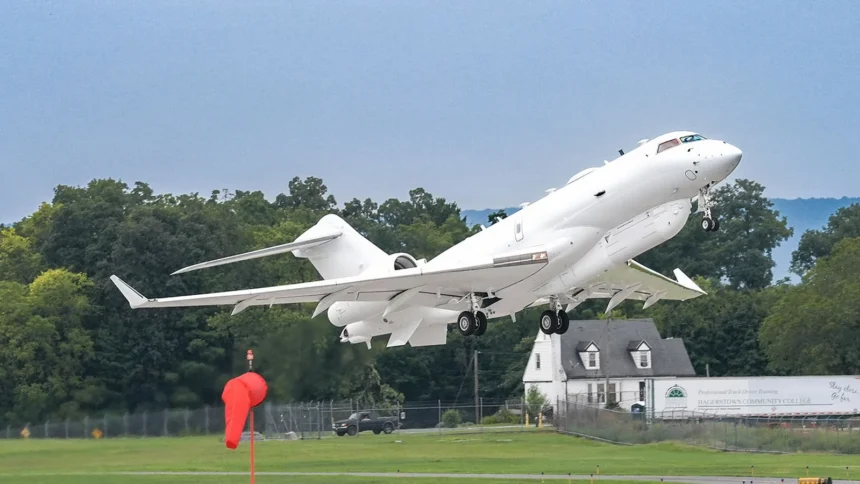
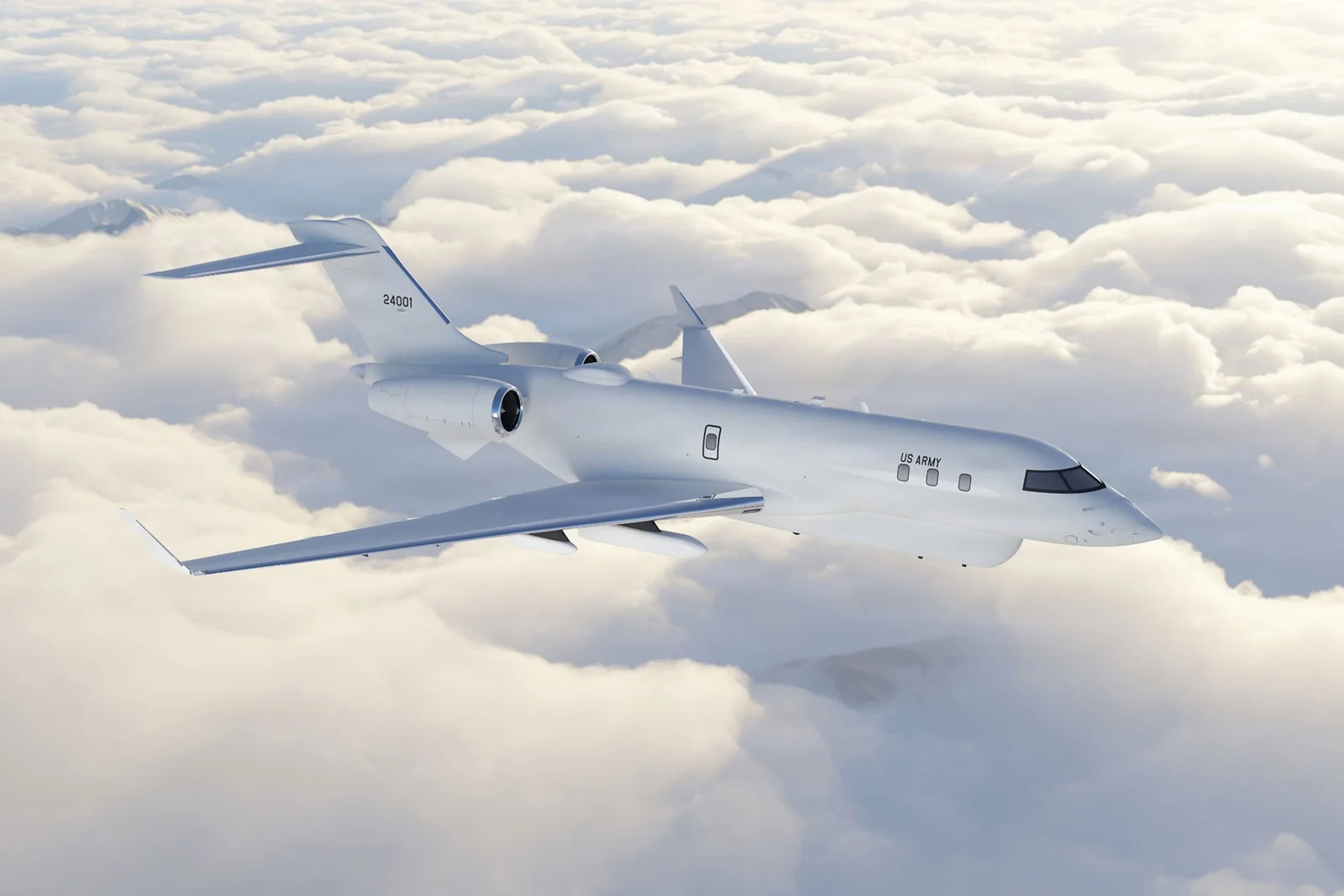
The US Army’s new spy jet has flown. HADES Prototype 1, a Bombardier Global 6500 business jet modified by Sierra Nevada Corporation (SNC), made its first flight on 11 September, the Army revealed on 30 October. It is the aircraft meant to replace a retired fleet of turboprop spy planes, and it starts flight testing with its production funding still in doubt.
Key takeaways
- The Army says HADES Prototype 1 flew on 11 September after a flight readiness review, and now moves into mission system integration and developmental flight testing.
- HADES is the Army’s planned replacement for the Guardrail, ARL-M and EMARSS turboprops, which all flew their last missions in 2025.
- The jet is built to fly higher, faster and farther than the turboprops, so it can sense deep behind enemy lines from a safer distance.
- The first prototype is now due around January 2027, later than the fiscal 2026 date the Army gave in December 2025, and a production deal is stuck behind a stopgap budget.
- Reports say the planned fleet has been cut to six jets, against a contract written for up to 14.
What we know
In a release dated 30 October, the Army said the High Accuracy Detection and Exploitation System, or HADES, Prototype 1 aircraft completed its first flight on 11 September. The Fixed Wing Project Office led the flight with SNC, the programme’s lead systems integrator, following a flight readiness review. The release, distributed through DVIDS, says the event moves HADES “to the next phase of mission system integration and developmental flight testing”.
That testing will check whether the jet’s sensors actually work as a system. In the Army’s words, it will “validate multi-domain sensing and signals intelligence (SIGINT) capabilities to determine their effectiveness, integration, and operational readiness in support of upcoming operational demonstrations.”
“The first flight of HADES Prototype 1 transitions our vision for deep sensing from concept to reality,” said Lt. Col. (P) James Hickey, project manager for the Fixed Wing Project Office. He added: “HADES will help commanders see farther, understand faster, and act with greater precision across the multi-domain battlefield.”
The Army gave no performance figures and no detail of the sensors fitted for the flight. The Army did not explain why it waited seven weeks to announce the flight.
Background: why the Army needs a new spy plane
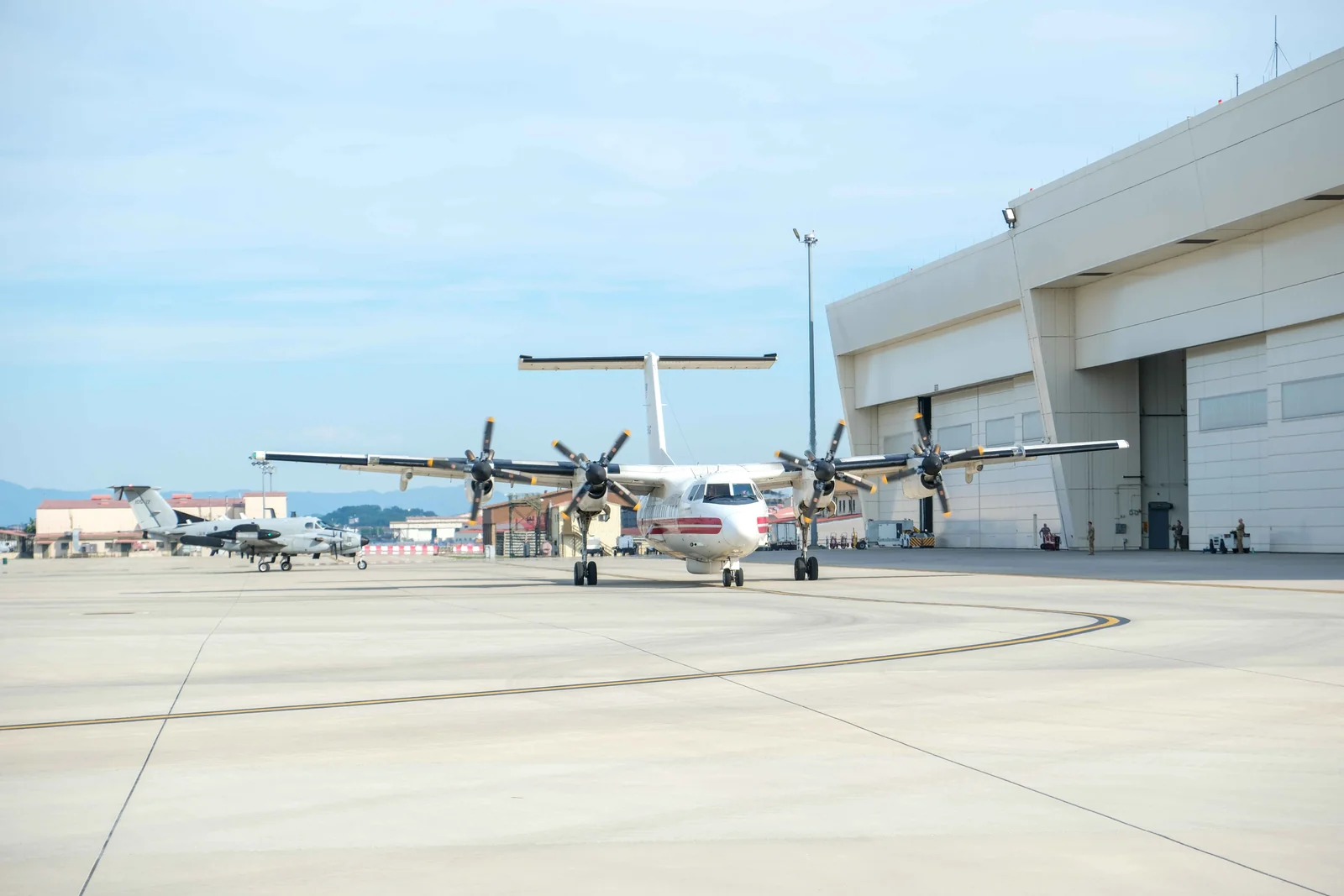
For more than five decades the Army flew its own turboprop spy planes. The RC-12X Guardrail listened for enemy radio and radar signals. The EO-5C ARL-M, a converted Dash 7, and the MC-12S EMARSS, a King Air 350ER, carried mixed sensor packages. According to the Army’s own account of the divestment, ARL-M and Guardrail flew their final missions in Korea in July 2025, ending 54 years of turboprop support on the peninsula, and the last EMARSS mission followed in September.
Those aircraft were built for Iraq and Afghanistan, where they could circle low and slow without being shot at. Against Russia or China they would have to stay well back from the front, and from there a low, slow turboprop cannot see far enough. Julie Isaac, the Army’s project director for aerial intelligence sensors, put the logic plainly: “A smaller fleet of aircraft that can cover much larger footprints for longer periods of time is now the way forward.”
Altitude is the point. An Army request for information in January 2026, reported by The Aviationist, asked for a jet able to operate between 41,000 and 51,000 feet, and a sensor that high sees much further over the horizon than one on a turboprop at medium altitude. That is the same reasoning behind the airborne early warning jets we compared in our look at LoyalEye, GlobalEye and the E-7. For a primer on the signals side of the mission, see our explainer on electronic warfare.
HADES at a glance
| Item | Detail | Source |
|---|---|---|
| Airframe | Bombardier Global 6500 business jet, government owned and government operated | U.S. Army, Dec 2025 |
| Integrator | Sierra Nevada Corporation (SNC) | U.S. Army, Oct 2026 |
| First flight | 11 September 2026 (announced 30 October) | U.S. Army, Oct 2026 |
| Missions | Multi-domain sensing and signals intelligence | U.S. Army, Oct 2026 |
| Replaces | RC-12X Guardrail, EO-5C ARL-M, MC-12S EMARSS | U.S. Army, Dec 2025 |
| Contract | Up to 14 aircraft, estimated $991.3 million, 5-year base plus seven 1-year options | GAO decision, Dec 2024 |
| Planned fleet | Reportedly six aircraft | Breaking Defense, via The Aviationist |
| Prototype deliveries | No. 1 around January 2027, No. 2 about six months later, No. 3 in 2028 | Army G-2 official, via Breaking Defense |
| Designation | ME-11B | The Aviationist |
Why it matters
HADES is a bet on altitude and range over numbers. The Army retired a whole fleet of turboprops and plans to replace them with a handful of jets, each expected to watch a far larger area. If it works, a single HADES orbit could pick up radar sites, command posts and air defences far behind the front line and pass targets quickly to long-range artillery and missiles. The Army has said the system will use on-board artificial intelligence and “provide sensor-to-shooter links to shorten the kill chain”.
That matters most in the Pacific, where the US is spreading long-range missile units across island chains, as seen in exercises like Keen Sword 27. Missiles that reach hundreds of kilometres are only as useful as the sensors that find the target, and the Army does not want to depend entirely on Air Force or national assets for that.
There is also an industrial story. The Army chose SNC in 2024, and the Government Accountability Office denied a protest from L3Harris on 23 December 2024, finding the rival bid had been reasonably rated technically unacceptable. SNC now has a flying prototype, which strengthens its hand for any production order.
What’s uncertain
- Money. The Army planned to award a production contract around the start of 2027. “We cannot do that … until we clear a CR,” Andrew Evans of the Army G-2 told Breaking Defense, referring to the continuing resolution funding the government into December.
- Schedule. In December 2025 the Army expected the first fully developed prototype in fiscal 2026, which ended on 30 September. Evans now points to delivery around January 2027. A slip of a few months is modest, but it comes with the turboprops already gone.
- Fleet size. The contract allows up to 14 aircraft, and an Army request for information in January 2026 described an acquisition objective of 14. Reporting since May says the fleet has been cut to six. The Army has not published a final number.
- The gap. With the turboprops retired, the Army leans on contractor-owned jets from its ATHENA and ARTEMIS demonstration programmes until HADES arrives. How long that bridge must last is unclear.
- Sensors. The first flight proves the modified airframe. It does not prove that the sensor packages, including signals intelligence, work together, which is what the test campaign must show.
What to watch next
- Developmental flight test results and any public detail of the sensors fitted to Prototype 1.
- Delivery of Prototype 1 around January 2027 and its first operational demonstration.
- Whether Congress passes a full-year 2027 defence budget, which would clear the way for a HADES production contract.
- A final Army decision on the fleet size, and whether allies show interest in a similar jet. More on new airborne sensors is on our Airpower page.
Sources
- U.S. Army via DVIDS: HADES Prototype 1 completes first flight, advances Army deep sensing capability, 30 October 2026
- DVIDS: HADES Prototype 1 first flight image and caption
- U.S. Army: Army completes A-ISR turboprop fleet divestment, 11 December 2025
- U.S. Army: U.S. Army retires two most distinguished aerial intelligence platforms, 15 September 2025
- GAO: L3Harris Technologies Integrated Systems L.P., B-422943, B-422943.2, 23 December 2024
- Breaking Defense: Continuing resolution could ‘complicate’ Army’s HADES spy plane production
- The Aviationist: U.S. Army’s HADES prototype completes first flight, 31 October 2026