

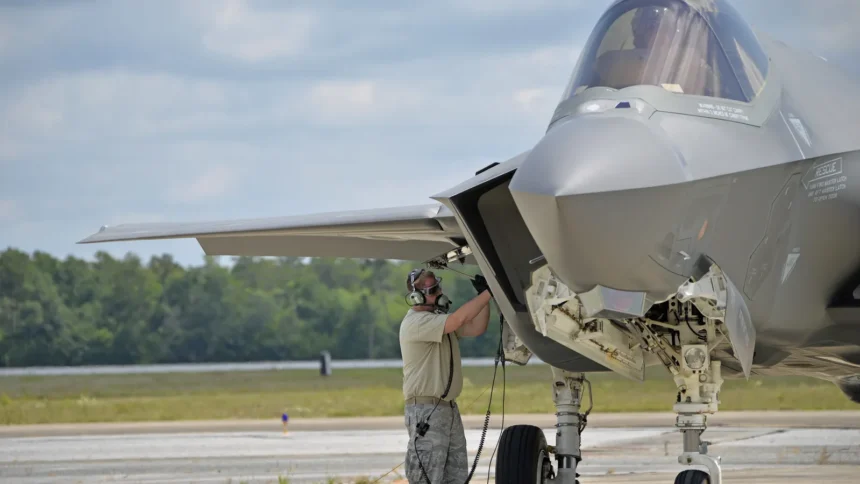
The Pentagon cannot fully account for the roughly 26 million F-35 spare parts it owns, worth about US$31 billion, the US Government Accountability Office (GAO) said in a report released on 9 November 2026. As of March 2026, about 17,000 parts in maintenance or repair were missing from the programme’s own inventory records.
Key takeaways
- The F-35 programme holds about 26 million parts worth about US$31 billion at more than 700 facilities worldwide, and the Department of Defense (DOD) does not keep complete records of them (GAO).
- About 17,000 parts in maintenance or repair, valued at US$1.3 billion to US$2.5 billion, had not been entered into the programme’s inventory system as of March 2026 (Breaking Defense, citing GAO).
- Parts worth more than US$85 million that GAO flagged as lost in 2023 had still not been traced (GAO).
- GAO made four recommendations and the DOD concurred with all of them.
What we know
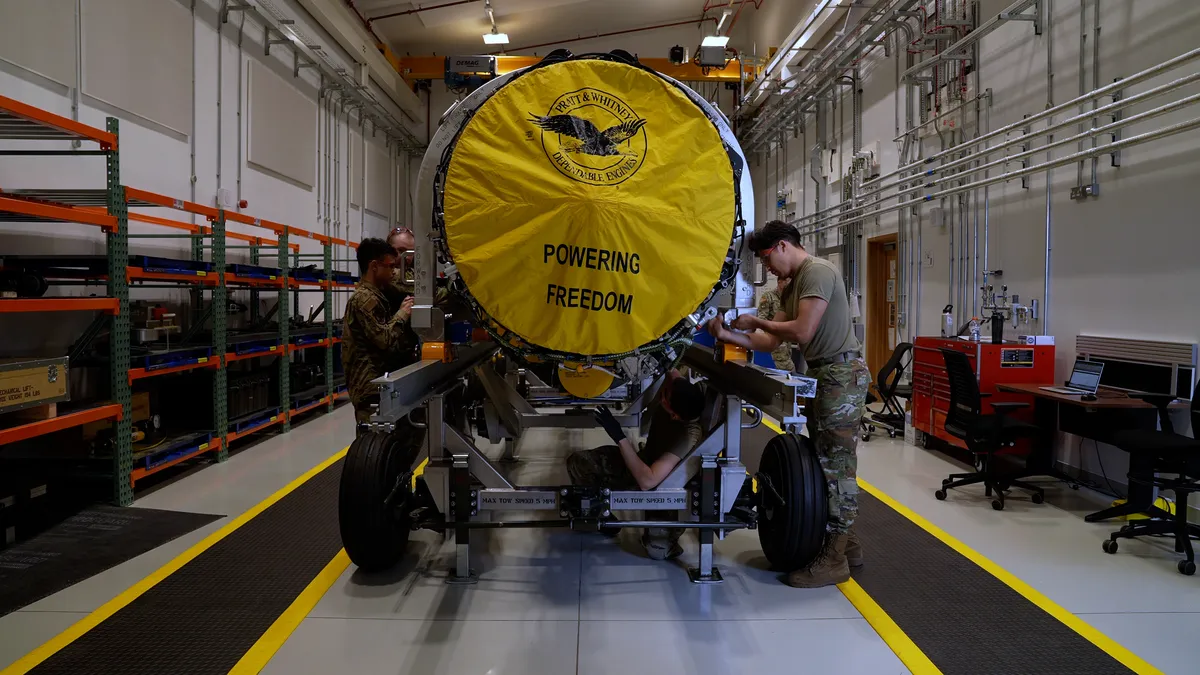
The report, “F-35 Program: DOD Needs to Strengthen Oversight of Tens of Billions of Dollars in Parts” (GAO-27-108713), was published on 9 November. GAO says the parts, which range from engines to tyres, are owned by the DOD but sit at more than 700 contractor-managed and government-managed facilities around the world. It found the records in the programme’s accountable property system of record (APSR) are “outdated, inaccurate, and incomplete” and do not show changes in real time.
The F-35 Joint Program Office (JPO) uses the Enterprise Logistics Management System (ELMS) to manage the inventory, but it updates that system from periodic contractor submissions. Air & Space Forces Magazine reports that one of those sources is updated quarterly, so some records can be more than three months old. According to Breaking Defense, a December 2025 contractor submission included serial numbers for only 29 percent of parts records.
Physical counts have not closed the gap. GAO found that the JPO’s inventory procedures “did not adequately verify the existence and validate the completeness” of the parts. Stars and Stripes reports that prime contractors often cannot see parts held below the subcontractor level, and that parts moving through commercial shippers may be left out of the records. Air & Space Forces Magazine reports that the JPO has spent at least US$17 million on physical inventories since fiscal year 2020.
The watchdog’s conclusion is blunt: “Without accurate data in its APSR and properly executed inventory procedures for F-35 parts, DOD management will not have the information it needs to support warfighter readiness and reliable financial reporting.”
Background
This is not a new problem. Stars and Stripes notes that this is the third GAO report since 2019 on the financial management of the F-35 programme. A 2023 GAO report found that one prime contractor had lost more than 1 million spare parts worth more than US$85 million since May 2018, and GAO still has an open recommendation on data accuracy from a 2022 report. GAO describes the F-35 as the DOD’s costliest weapon system, with life-cycle costs estimated at more than US$1.9 trillion. For the wider programme, see our F-35 coverage and the Airpower section.
The audit lands weeks after a separate scare. In September, Politico reported that a shipment of F-35 parts sent from Australia to the United States for repair was diverted to Hong Kong. The JPO confirmed “a shipment issue” and told Military.com: “We are actively working with U.S. authorities and industry partners to retrieve these components, investigate the incident, and place safeguards to avoid a future occurrence.” GAO did not link that incident to the problems in its report, Breaking Defense notes.
F-35 parts audit at a glance
| Item | Figure | Source |
|---|---|---|
| F-35 parts in the global pool | About 26 million | GAO-27-108713 |
| Estimated value of those parts | About US$31 billion (officials told GAO it is probably an undercount) | GAO; Air & Space Forces Magazine |
| Facilities holding parts | More than 700, contractor and government | GAO |
| Parts in maintenance or repair not in the inventory system (March 2026) | About 17,000, valued at US$1.3bn to US$2.5bn | Breaking Defense, citing GAO |
| Lost parts from the 2023 report still untraced | Valued at more than US$85 million | GAO |
| Spent on physical inventories since FY2020 | At least US$17 million | Air & Space Forces Magazine, citing GAO |
| Estimated programme life-cycle cost | More than US$1.9 trillion | GAO |
| Recommendations / DOD response | Four / concurred with all | GAO |
Why it matters
A GRYD calculation from the figures above puts the scale in context. The untracked maintenance-and-repair parts alone are equal to roughly 4 to 8 percent of the official US$31 billion spares pool, and that pool is itself thought to be undercounted. That is a sizeable blind spot in a fleet that depends on a shared global spares system.
Readiness is the first concern. If the JPO cannot see in real time which parts exist and where they are, it is harder to move a spare engine or tyre to a jet that is grounded waiting for it. GAO links the record problems directly to “warfighter readiness”, not only to accounting.
Security is the second. The F-35 is flown by the US Air Force, Navy and Marine Corps and, according to Breaking Defense, by 19 international customers, including Australia, which has a fleet of 72 F-35s according to Australian Defence Magazine. Parts cross borders through commercial shippers. GAO warns that without loss monitoring the JPO’s ability “to detect fraud, waste, or theft” will be reduced. After the Hong Kong diversion, that sentence will be read closely in allied capitals.
Money is the third. Because the DOD cannot reliably value these parts, they are not yet fully on its financial statements. GAO says the DOD is developing procedures to value parts with missing cost information, but those are still under review.
What’s uncertain
A part missing from a database is not necessarily a lost or stolen part. The 17,000 items were in maintenance or repair status; the problem GAO describes is that the programme’s own records did not show them. GAO’s public summary does not say how many parts are physically lost, and there is no public finding on what happened to the Hong Kong shipment or whether it has been recovered.
What to watch next
- Whether the DOD publishes timelines for the four recommendations, which GAO lists as open.
- Congressional reaction, given the existing inquiry into the Hong Kong diversion.
- Whether F-35 parts appear on the DOD’s next agency-wide financial statements.
For other recent airpower analysis, read why the US Army is trading turboprops for altitude with HADES and our earlier comparison of the F-35 and the Su-57.
Sources
- US GAO, F-35 Program: DOD Needs to Strengthen Oversight of Tens of Billions of Dollars in Parts (GAO-27-108713), 9 November 2026
- US GAO, GAO-23-106098 (2023 F-35 spare parts report)
- US GAO, GAO-22-105002 (2022 report, open recommendation)
- Breaking Defense, Pentagon can’t track thousands of F-35 parts: GAO, 9 November 2026
- Stars and Stripes, Pentagon cannot track all of its F-35 parts, watchdog says, 9 November 2026
- Air & Space Forces Magazine, New Report: More Than 1 Million F-35 Spare Parts Remain Missing, November 2026
- Politico, Hill investigates after F-35 parts diverted to Hong Kong, 18 September 2026
- Australian Defence Magazine, Classified Australian F-35 parts disappear in Hong Kong, September 2026
- Military.com, Missed email behind F-35 fighter jet parts diverted to China: report