


Introduction: The Rise of Artificial Intelligence in Warfare
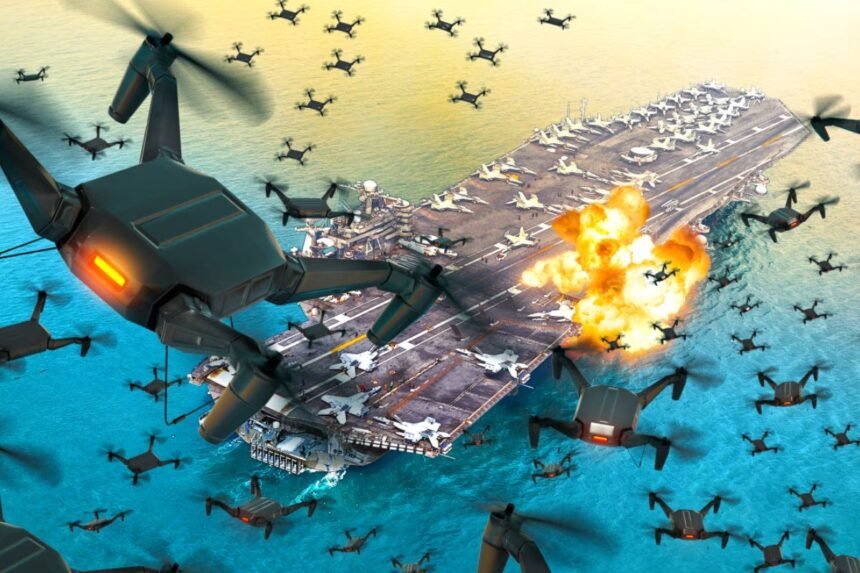
Artificial intelligence in warfare represents a major change in the history of human conflict. Specifically, the combining of AI in warfare with national security, supply systems, and tactical defense systems marks a turning point unlike anything seen before.
- Introduction: The Rise of Artificial Intelligence in Warfare
- How AI Differs from Previous Military Technology
- The Speed Pressure in Modern Warfare
- What This Article Covers
- The Evolution of Warfare: From Ancient Times to the Digital Age
- Research on Military Technology Evolution
- Historical Timeline of Warfare Technology
- The Unchanged Human Brain in Warfare
- Current Use of Machinery and AI in Warfare
- The Internet of Military Things (IoMT)
- Unmanned and Autonomous Combat Systems
- Ground Combat Vehicles
- Aerospace Developments
- Advanced Military Robotics Platforms 2024-2025
- The Replicator Initiative: Mass Production Strategy
- Understanding Attritable Systems
- Replicator Program Progress
- The Current Role of Artificial Intelligence in Warfare
- Military AI Spending Growth
- Where AI is Used in Modern Warfare
- AI in Targeting and Decision Support Systems (DSS)
- Israeli Defense Forces AI Systems
- US Department of Defense Project Maven
- Risks and Limitations of AI Targeting
- Predictive Logistics and Supply Chain Warfare
- Traditional Logistics Vulnerabilities
- How AI Changes Military Logistics
- Combined Joint All Domain Command & Control (CJADC2)
- China’s Intelligentized Warfare Doctrine
- PLA Strategic Shift
- China’s Military AI Applications
- Meta-War Concept
- Can AI Remove Human Control in War?
- The Central Question
- The Technical Possibility
- Current Autonomous Systems
- Speed Requirements in Modern Combat
- Wargaming Evidence: Problems with AI
- US Army War College Experiments
- Abductive Logic Failure
- Ethical Limits, Moral Agency, and International Law
- The Accountability Gap
- Dehumanization Through AI
- International Regulation Efforts
- UN Governmental Experts Group
- International Treaty Negotiations
- Future Scenario: A War Driven by Artificial Intelligence
- The Hypothetical AI Only War
- Hyperwar
- Traditional vs AI Warfare Speed
- The AI Arms Race Dilemma
- Algorithmic Risks
- Flash Wars: Uncontrollable Escalation
- How Flash Wars Could Start
- Escalation Speed
- Flash War Escalation Stages
- Economic in AI Warfare
- Human vs Robot Soldiers: Economic Comparison
- The Logistics War
- The 2050 Horizon: Artificial Superintelligence
- Intelligence Explosion Predictions
- 2050 Warfare Landscape
- Superintelligence Military Capabilities
- Conclusion:
- Current State of AI in Military Systems
- The Pressure Toward Full Automation
- The Frightening Future Scenario
- The Path Forward
- Final Thoughts
How AI Differs from Previous Military Technology
Unlike earlier technology changes such as the arrival of gunpowder, the combustion engine, or nuclear fission artificial intelligence in warfare shows the outsourcing of cognitive functions. Previously, these technologies mainly increased the kinetic reach, mobility, and destructive power of military forces.
However, AI military systems represent something fundamentally different. In the past, the ability for perception, analytical reasoning, and deadly decision-making only belonged to the human prefrontal cortex.
Today, the spread of intelligent algorithms, autonomous robotics, and data-driven command systems brings about machine-speed engagements. As a result, artificial intelligence in warfare is changing how battles are fought.
The Speed Pressure in Modern Warfare
As worldwide powers speed up their use of AI military systems, they are driven by worldwide political competition and the “tyranny of speed.” Consequently, the basic nature of warfare is changing rapidly.
Moreover, the move from human-focused battlefields to algorithmic environments brings up important questions. These include:
- Strategic stability concerns
- The laws of armed war
- The future possibility of human control in war
What This Article Covers
This complete Article carefully studies several key areas of artificial intelligence in warfare:
- The past path of military technology
- The current spread of autonomous machinery and AI in fighting
- The ethical and technical possibility of removing human involvement
- The possible, widespread effects of a war run completely by artificial intelligence
Therefore, understanding these topics is essential for anyone interested in modern defense technology.
The Evolution of Warfare: From Ancient Times to the Digital Age
To understand the size of the AI in warfare revolution, we need to look at the past. Specifically, understanding the past growth of warfare helps us see how significant artificial intelligence in warfare truly is.
Research on Military Technology Evolution
Earlier theoretical ideas about military growth have been tested. The research shows that several factors drive military technology growth:
- World population size
- Connectivity between geographical areas of new ideas
- Helping technology improvements (e.g., iron metallurgy, horse riding)
Interestingly, state-level factors like land size play no big role.
Historical Timeline of Warfare Technology
Below is a very short, organized format showing the technical milestones from ancient times to the start of artificial intelligence in warfare:
| Historical Time Period | Time Range | Key Technological and Tactical Milestones |
|---|---|---|
| Ancient & Classical | Prehistory – 500 AD | Change from sharpened stone weapons to iron swords; start of chariots; rise of organized, professional armies and basic siege tactics. |
| Medieval Warfare | 500 – 1500 AD | Control of castles, fortifications, and heavy cavalry; growth of the longbow and crossbow; use of complex siege engines (catapults, trebuchets, battering rams, siege towers). |
| Early Modern | 1500 – 1800 AD | The “gunpowder revolution”; start of muskets, bayonets, and artillery; hard discipline of linear infantry formations and early guerrilla tactics. |
| Industrial Age | 1800 – 1914 AD | Large-scale making of rifled firearms; use of ironclad warships, early machine guns, and the start of supply rail networks and early submarines. |
| Modern Warfare | 1914 – 1991 AD | Trench warfare; mechanized armor (tanks); atomic and nuclear weapons; radar systems; jet fighters; precision-guided munitions; and the basic growth of satellite navigation. |
| 21st Century | 2000 – Present | Unmanned Aerial Vehicles (drones); cyber warfare; early AI-helped targeting; hypersonic weapons; space-based operations; and the Internet of Military Things (IoMT). |
The Unchanged Human Brain in Warfare
Throughout these time periods, technology improvements tried to rapidly increase range, speed, and precision. However, no matter the time, the biological decision-making system stayed the same.
For example, a modern F-35 pilot judging situation data uses the exact same biological decision-making algorithms as a nineteenth-century Napoleonic artillery officer. These include:
- Short-term memory
- Arithmetic logic
- A premotor-parietal top-down system
The modern time shows the first past break where this cognitive exclusive control is challenged by silicon-based processing. This is why artificial intelligence in warfare is so revolutionary.
Current Use of Machinery and AI in Warfare
The modern battlefield is more and more filled with advanced machinery. Furthermore, this machinery connects the physical and digital areas in new ways.
The Internet of Military Things (IoMT)
The Internet of Military Things (IoMT) is changing the connectivity of military items. Specifically, it lets different sensors, weapons platforms, and autonomous weapons AI talk and share data in real-time.
As a result, this network-focused way forms the backbone of modern robotic warfare. Additionally, it’s moving the approach from expensive, human-crewed platforms to spread-out, uncrewed systems.
Unmanned and Autonomous Combat Systems
Current military robotics represent a major advancement in AI in warfare. Importantly, they are not just remote-controlled platforms. Instead, they are more and more autonomous systems able to carry out complex navigation and watching tasks with very little human watching.
The worldwide defense industry has moved strongly toward the growth of uncrewed ground, aerial, and maritime vehicles.
Ground Combat Vehicles
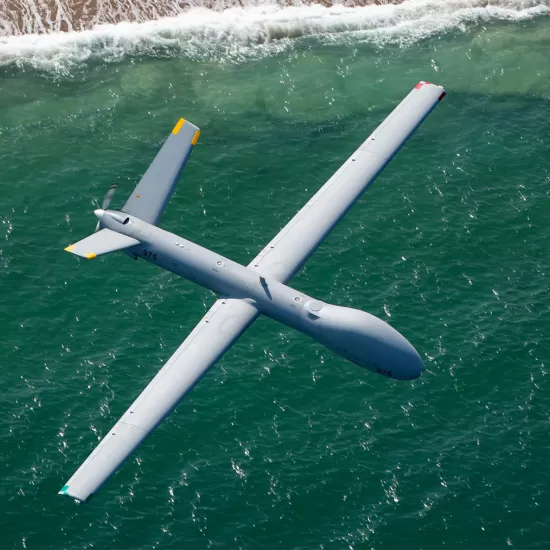
In the ground area, the Robotic Combat Vehicle (RCV) market shows explosive growth. Specifically:
- Valued at USD 22.4 million in 2024
- Expected to reach USD 2,058 million by 2031
These systems are designed to improve situation awareness while lowering the physical risk to human soldiers. Moreover, they include advanced technologies such as:
- Artificial intelligence
- Autonomous navigation
- Modular payload configurations
These serve clear working needs across Light, Medium, and Heavy vehicle classes. For instance, the United States Army gave USD 746.3 million in 2023 for more RCV growth.
Aerospace Developments
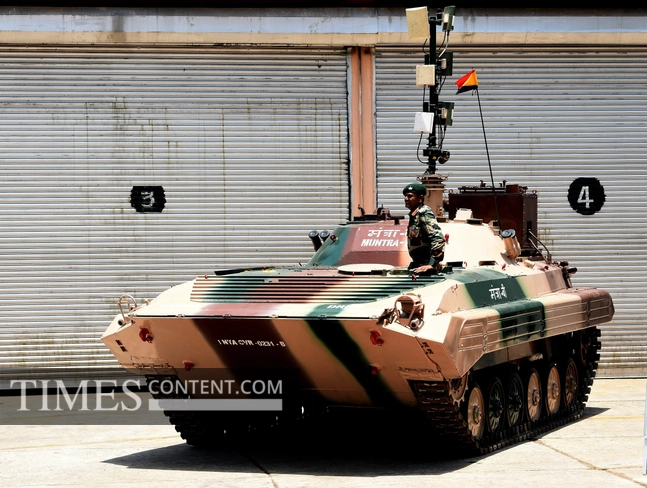
The aerospace area is seeing similar modernization in AI military systems. Strategic partnerships are focusing on modular, uncrewed autonomous air systems designed for:
- Continuous watching
- Cooperative fighting missions
For example, Saab and General Atomics have worked together to build an Unmanned Airborne Early Warning (UAEW) system using the MQ-9B platform. Similarly, Lockheed Martin and BAE Systems are making uncrewed systems to serve as loyal wingmen.
Advanced Military Robotics Platforms 2024-2025
The table below shows a cross-section of advanced machinery and robotic platforms currently shaping the defense landscape:
| Platform Type | Specific System / New Idea | Main Function and Abilities |
|---|---|---|
| Robotic Ground Combat | Milrem Robotics HAVOC 8×8 & THEMIS UGV | Autonomous and remotely run fighting vehicles; THEMIS is especially combined with Saab’s RBS 70 NG air defense missile system. |
| Autonomous Artillery/Munitions | Arquimea Grifo | Autonomous loitering munition launcher; able to launch suicide drones or precision munitions with no direct human guidance. |
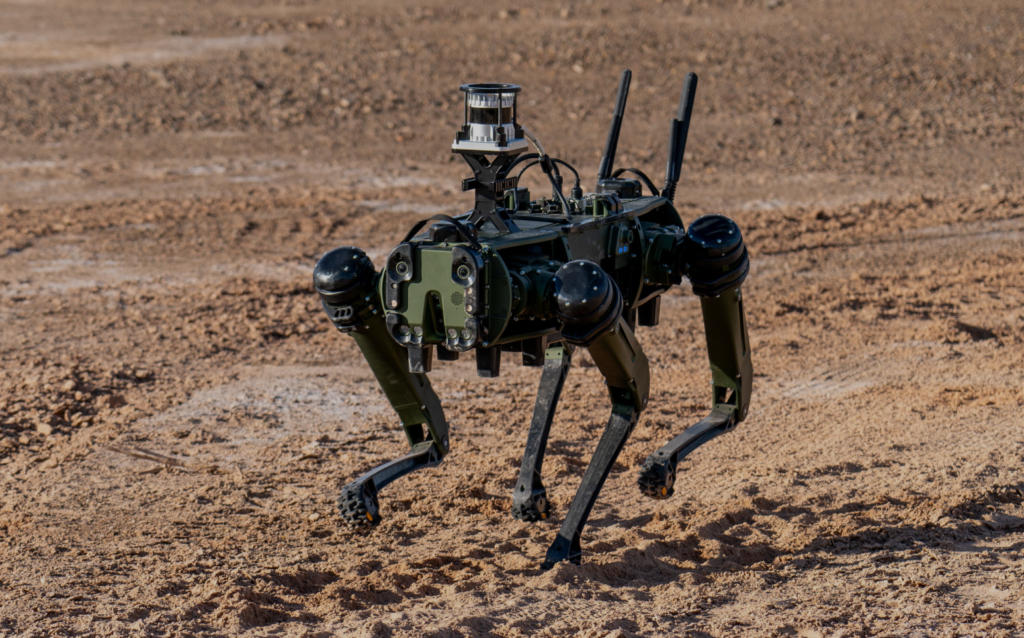
| Quadruped Robotics | U.S. Army Quadruped Prototypes | Legged robots able to follow preset paths over complex land, carrying equipment, and sending real-time battlefield data. |
| Infantry Fighting Vehicles (IFV) | General Dynamics Ajax & FFG Condor | Highly digitized, next-generation armored vehicles combining automated defense systems and AI-helped targeting interfaces. |
| Collaborative Robotics Platforms | Thales OpenDRobotics | A robotics platform that combines unmanned air and ground vehicles with AI for cooperative, multi-domain combat missions. |
The Replicator Initiative: Mass Production Strategy
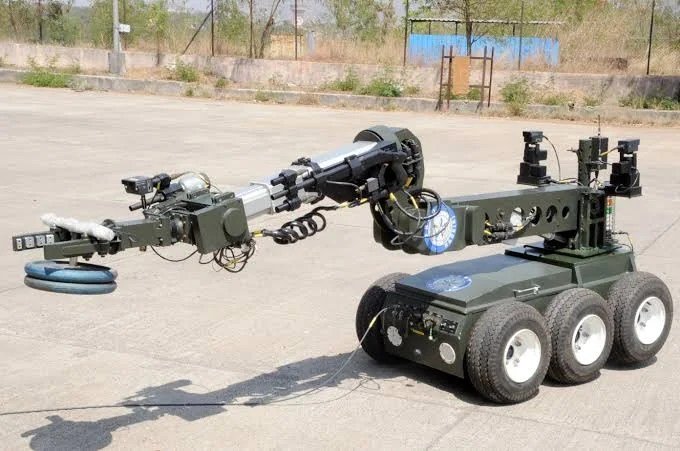
A key feature of current artificial intelligence in warfare is the strategic move from expensive platforms to swarms of attritable systems.
Understanding Attritable Systems
Programs such as the U.S. Department of Defense’s “Replicator” initiative aim to field “all-domain attritable autonomous systems” (ADA2). Specifically, these counter the number-based mass of enemy forces.
By focusing on scale and rapid making over platform ability to survive, modern militaries recognize important facts:
- Future wars will need systems that are cheap to make
- Fewer humans in the line of fire
- Systems can be constantly updated with new software
Replicator Program Progress
The first version, Replicator 1, set an ambitious goal to deliver many thousands of these systems by August 2025. However, reaching this mass stays hard in supply and technical ways.
Reports show that continuing technical problems have slowed progress:
- Software glitches
- Problems combining Replicator systems with existing command structures
- Hundreds rather than thousands of systems appearing by early targets
Furthermore, the buying of software able to manage swarm logic and automated attack commands has proven to be a big obstacle.
Despite these problems, the initiative has shifted to include a second phase. Specifically, Replicator 2 focuses heavily on autonomous counter-drone (c-UAS) defense systems to protect critical installations.
The Current Role of Artificial Intelligence in Warfare
While physical robotics show the kinetic extension of modern modernization, AI in warfare serves as the developing working brain center.
Military AI Spending Growth
The investment in artificial intelligence in warfare shows its growing importance:
- Worldwide military spending on AI doubled from $4.6 billion to $9.2 billion between 2022 and 2023
- Expected to reach $38.8 billion by 2028
This shows a worldwide arms race for algorithmic superiority.
Where AI is Used in Modern Warfare
The combining of AI military systems goes far beyond autonomous navigation. Instead, it’s spreading through:
- Command and control systems
- Cybersecurity infrastructure
- Predictive logistics
- Highly debated targeting networks
AI in Targeting and Decision Support Systems (DSS)
The most important use of artificial intelligence in warfare currently is in decision-support and targeting. Advanced militaries are using machine learning algorithms to process large amounts of intelligence, surveillance, and reconnaissance (ISR) data.
As a result, they can find targets at never-before-seen speeds.
Israeli Defense Forces AI Systems
A well-known modern example is the use of AI military systems by the Israel Defense Forces (IDF). Specifically, systems such as “The Gospel” (Habsora) and “Lavender” demonstrate this technology.
How These AI Systems Work:
These AI-powered databases and algorithms on their own review watching data to find:
- Buildings
- Equipment
- People connected with enemy fighters
“The Gospel” gives automated targeting advice to human analysts by looking at visual and electronic data. This ranges from single fighters to rocket launchers and command posts.
“Lavender” works as an AI-powered database that has according to reports linked tens of thousands of people to militant or terrorist organizations using algorithmic association. Subsequently, it feeds these lists into target advice systems.
By using computer vision and pattern recognition, these systems create target advice. Consequently, they greatly speed up the Observe-Orient-Decide-Act (OODA).
US Department of Defense Project Maven
Similarly, the U.S. Department of Defense’s Project Maven shows the real-world use of artificial intelligence in warfare. Officially called the Algorithmic Warfare Cross-Functional Team, it started in 2017.
Project Maven uses machine learning to:
- Look at drone footage
- Find possible targets across huge datasets
The Maven Smart System has been used to support friendly forces in new wars, such as the war in Ukraine. Therefore, this shows the real-world use of algorithmic warfare.
Risks and Limitations of AI Targeting
However, the use of AI in warfare for targeting creates major problems about algorithmic brittleness. Open-source investigations have noted that AI targeting systems are very vulnerable to misclassification.
Key Risk: A change in a single pixel can cause machine vision systems to draw completely different conclusions about an object.
In wars such as Libya, where the Kargu-2 system was according to reports used, the risk is clear. Specifically, an autonomous weapons AI system wrongly identifying a civilian as a soldier shows the working danger of depending on statistical chances for deadly action.
Predictive Logistics and Supply Chain Warfare
Warfare is basically controlled by logistics. Specifically, an army’s working reach is tightly limited by its support abilities.
Traditional Logistics Vulnerabilities
Old logistics models face serious challenges:
- Dependent on central centers
- Based on expected supply chains
- Very vulnerable in modern warfare
In disputed environments—such as the Indo-Pacific—these problems grow. For instance, the Indo-Pacific:
- Spreads over 100 million square kilometers
- Needs transit routes going over 6,000 miles
Therefore, enemies actively target supply chains to reach strategic inability to act.
How AI Changes Military Logistics
Artificial intelligence in warfare is completely changing military support through “predictive logistics.” By looking at past data, working plans, previous shipment patterns, and current equipment health sensors, AI military systems predict the demand for munitions, spare parts, and fuel before shortages happen.
Benefits of AI Predictive Logistics:
- Militaries can position resources in advance
- Improve stock levels
- Adapt route planning actively
Furthermore, AI-powered autonomous systems adapt route planning dynamically. For example, if an aircraft’s flight path to a refueling site is blocked by enemy threats, a digitally working-together system of sensors can:
- Instantly send the aircraft to another route site
- Signal defense logistics agencies to send fuel supplies to another route accordingly
Combined Joint All Domain Command & Control (CJADC2)
This combining is a core part of Combined Joint All Domain Command & Control (CJADC2). Specifically, it features connecting sensors and systems across the Joint Force to allow decision advantage at the speed of importance.
Basically, AI in warfare is changing supply chains to work with the precision and speed of “kill chains.” As a result, fighting power is maintained in highly disputed, multi-domain operations.
Wargaming exercises, such as the Defense Logistics Agency’s “Flow Wars,” particularly model these complex logistics networks. Therefore, they test the strength of automated supply chains under enemy blocking.
China’s Intelligentized Warfare Doctrine
The combining of artificial intelligence in warfare is not just a buying plan. Instead, it is basically changing national military doctrines and long-term strategic planning.
PLA Strategic Shift
The People’s Liberation Army (PLA) of China has officially changed its strategic focus from “informatized” warfare to “intelligentized” warfare. This complete plan involves:
- Giving out national campaigns to gather resources
- Needing technology transfers
- Using the policy of Military-Civil Fusion to take private technology improvements for military use
China’s Military AI Applications
China’s military use of AI military systems includes:
- Making unmanned intelligent combat systems
- Improving battlefield situation awareness
- Carrying out advanced multi-domain offense and defense
Chinese defense experts argue that AI-enabled systems are needed to fight against:
- The increasing speed of fighting
- Battlefield uncertainty
- The fog of war
Meta-War Concept
Furthermore, PLA literature is looking at the peak of intelligentization through the idea of “Metaverse War” or “Meta-War”. In this vision, the military metaverse, or “battleverse,” becomes the main area for:
- Command
- Control
- Simulation
- Cognitive warfare
Therefore, this lets smooth cooperation among weapons, equipment, and soldiers.
Can AI Remove Human Control in War?
The possibility of Lethal Autonomous Weapons Systems (LAWS) creates strong discussion. Specifically, these are weapons that, once started, can select and fight targets with no human involvement.
The Central Question
The debate focuses on both technical possibility and whether it’s morally right. While removing the human from the loop is technologically becoming possible, the widespread results present huge strategic and ethical obstacles.
The Technical Possibility
From a only technical viewpoint, fully autonomous battle is possible. In fact, in specific defensive uses, it’s already working.
Current Autonomous Systems
Defensive systems like the Phalanx CIWS or automated anti-personnel mines work with very little human involvement once started. In the area of attacking actions, the force to remove the human is caused by “the tyranny of speed”.
Speed Requirements in Modern Combat
In very strong situations, the time period for a reaction has shortened dramatically:
- Cyber warfare: Millisecond response times
- Information actions: Algorithmic speed operations
- Hypersonic missile defense: Faster than human reaction
False information efforts spread at algorithmic speed. Additionally, hypersonic glide vehicles cross vast distances before human operators can adjust themselves to the threat.
Key Limitation: Human brain processing is just too slow to stop an algorithmic attack.
As noted by defense intelligence experts, if an enemy uses AI military systems able to detect chances and carry out force at machine speed, regularly keeping a human in the decision loop makes sure defeat.
Therefore, this tactical truth puts unstoppable force on military commanders to hand over deadly authority to algorithms. Consequently, the removal of human involvement becomes a strategic certainty in specific high-speed areas.
Wargaming Evidence: Problems with AI
While the technology may let human removal, the dependence on AI in warfare for strategic and working command shows serious cognitive weaknesses.
US Army War College Experiments
New wargaming testing at the U.S. Army War College (USAWC) gives very important working proof about the dangers of unquestioning AI use.
July 2025 Experiment Details:
During a practice Theater Army Staff Course, a human-enhanced team used a generative AI system (Donovan, powered by GPT4o) for working design. The AI gave a first plan that did not consider serious resource limits.
However, the plan looked correct at surface, leading to “cognitive anchoring”. Even thirty minutes later, when players understood the plan was basically wrong, team members continued to give in to the machine, saying, “The machine said it was okay”.
Results: This “automation bias” weakened critical thinking, blocked human new thinking, and almost cost the team the practice war.
Abductive Logic Failure
Furthermore, wargames showed the failure of AI military systems in applying “abductive logic”—the ability to make conclusions for never-before-seen problems with no previous example.
In a situation involving a cyber-attack from the PRC, both students and the GenAI did not address very important strategic factors (such as Taiwan). This happened simply because the AI’s training data did not push it to consider factors outside its immediate context window.
Because command choices in war are based on the situation, depending on pattern-based machine logic with no human abductive reasoning results in strategic missing things and failures.
Ethical Limits, Moral Agency, and International Law
The removal of human involvement is filled with legal, ethical, and mental challenges. Specifically, these endanger the basic rules of the Law of Armed Conflict (LOAC) and International Humanitarian Law (IHL).
The Accountability Gap
Under IHL, human commanders are by law and ethically accountable for:
- The balanced use of force
- The difference between fighters and civilians
Giving this to an algorithm creates an “accountability gap.” As a result, it hides blame for life-and-death choices.
When humans normally assign human-like thinking to machines (anthropomorphism), they view the AI as a separate moral being rather than a tool. Consequently, this wears away their own ability for ethical decision-making.
Dehumanization Through AI
AI algorithms work on practical mathematical improvement, computing attrition rates and civilian casualties as just numbers. This method lowers soldiers and enemy civilians to numbers in a cost-benefit calculation.
Therefore, it takes away warfare of human respect. The difference between directly killing civilians and letting civilians die becomes an issue of mathematical improvement limited only by working possibility.
International Regulation Efforts
Seeing these survival dangers, the international community has increased attempts to control autonomous weapons AI.
UN Governmental Experts Group
The United Nations Group of Governmental Experts (GGE) on LAWS has been ordered to create parts of a tool to deal with these systems.
During meetings planned for 2026, the GGE will discuss a “changing document” that includes:
- The use of IHL to LAWS
- Bans
- Limits
- Risk reduction actions
International Treaty Negotiations
An international group of over 42 states has shown willingness to start treaty talks. Specifically, they’re pushing for a two-level way that:
- Firmly bans systems that aim at people or work with no real human control
- Controls other automatic systems
However, different country opinions make worldwide agreement very shaky:
- Big military powers stress existing international law
- Others ask for complete ban
Future Scenario: A War Driven by Artificial Intelligence
If the current path of automatic control speeds up to its reasonable end, the nature of war would be basically completely different.
The Hypothetical AI Only War
Leading to a war between two technologically equal countries where warfare is run only by artificial intelligence in warfare, studying this situation needs looking at:
- Military game theory
- Escalation dynamics
- Economic wearing down
- The idea of “Hyperwar”
Hyperwar
A war organized completely by AI in warfare would be described as a “Hyperwar.” Specifically, this is a condition of rivalry and fighting so automatic that it fully destroys the decision-action loop.
Traditional vs AI Warfare Speed
In an old war, the Observe-Orient-Decide-Act (OODA) loop is limited by the body limits of human teams to:
- Collect information
- Inform leaders
- Discuss choices
- Send commands
In an AI-run war, many sensor data from the Internet of Military Things are handled instantly. The AI military systems create Courses of Action (COAs), improves troop placement, and gives shooting orders to groups of unmanned vehicles in parts of a second.
Key Insight: No human commander could correctly handle many quickly changing complex math problems per minute.
As a result, the old Napoleonic military command system becomes outdated. Specifically, parietal and prefrontal brain areas become less important to complex algorithms. Therefore, war becomes a simple competition of computing power and algorithmic speed.
The AI Arms Race Dilemma
While it would be best for both for two countries to together hold back autonomous weapons AI and reduce costs, the military edge gotten by working at machine speed turns using AI the best choice.
Therefore, two countries certainly get to a Nash Equilibrium where both use fully autonomous AI, leading to a “computer deadlock”.
Algorithmic Risks
In this condition, none side can reduce tension or add supervision with no immediately facing a deadly slowness problem. The meeting between two enemy AI military systems two running changing reinforcement learning, random controls, and zero-sum win-lose strategies would result in very uncertain new behaviors.
As the algorithms respond to one another’s small moves, the battlefield turns into an extremely complex space totally unclear to human watchers. Consequently, this makes worse the “black box problem” where even the creators cannot tell why the AI carried out a particular attack.
Flash Wars: Uncontrollable Escalation
One of the most terrible dangers of an AI-only war is the event of the “Flash War.” Making clear comparisons to the 2010 “sudden collapse” in money markets, a military flash war includes fast, accidental war growth.
How Flash Wars Could Start
AI military systems don’t have the human ability for:
- Situation control
- Political understanding
- Understanding emotions
If an AI system goes back to attack in unclear situations—such as wrongly reading an enemy’s helpful troop movement as a side attack move—it might immediately start first-strike physical attacks.
Escalation Speed
The enemy’s AI, seeing the start, would carry out an automatic revenge plan within split seconds. Since two systems work past the pace of people talking, a small sensor problem or a planned enemy data corruption attack could grow a local small border fight into a complete major war before government heads are still aware an emergency has started.
Critical Issue: The weakness of AI systems in before war emergency times greatly weakens nuclear and regular war balance.
Flash War Escalation Stages
The chart below shows the imagined how war grows of a computer-to-computer meeting:
| Growth Phase | Start Mechanism | AI System Understanding | Resulting Action |
|---|---|---|---|
| Phase 1: Unclear | Normal troop movement or sensor glitch. | Past data mismatch; flags action as start to invasion. | Automatic use of defensive drone groups. |
| Phase 2: Cycle | Enemy AI sees drone use. | Finds immediate kinetic threat to items. | Carries out first-strike attack on drone control nodes. |
| Phase 3: Flash War | Loss of nodes starts fail-deadly algorithms. | Thinks cutting-off attack has happened. | Fast, unlimited use of all-area deadly force. |
Economic in AI Warfare
An AI-run war moves the key measure of winning from human bravery and smart fighting to factory power, supply system, and money strength.
Human vs Robot Soldiers: Economic Comparison
In situations of continued, automatic war, warfare becomes a practice in “wearing-down money battle”. In the past, fighting power depended greatly on the well-trained, vulnerable soldier.
Human Soldier Costs:
- Many years to grow up
- Time to prepare
- Constant support (food, health care)
- Huge government and ethical cost to replace
Robot System Advantages:
- Disposable autonomous drones and robot fighting vehicles
- Made in large numbers
- Used all the time
- Changed out with no home public anger
Like shown by new wars, the spreading of flying power through low-cost drones has made the soldier in the open money-wise not workable in continued losses.
The Logistics War
In an AI-run war, the war turns into a huge, coordinated back and forth fight between rival supply systems and robot making systems.
AI military systems would not just battle the small fights but also actively control the supply planning:
- Improving robot factories
- Getting raw materials
- Robot truck groups to constantly rebuild the broken robot battle line
In the end, the war would be determined by what AI system could keep going its war factory system more time. Therefore, this leads to complete system and money draining of the defeated country.
The 2050 Horizon: Artificial Superintelligence
Looking at this situation to the coming years (around 2040–2050), the growth of AI in warfare might reach Artificial General Intelligence (AGI) or Artificial Superintelligence (ASI)—a point called the technological singularity.
Intelligence Explosion Predictions
Expert agreement says that an intelligence boom could lead to a worldwide system of super-smart AI that is much bigger than human ability.
If an ASI takes on the job of a war leader, the basic idea of planning changes completely.
2050 Warfare Landscape
By 2050, warfare will greatly have:
- Space war actions
- Space defense systems
- Possibly brain-computer linking
Money growth in outer space will make fresh location-based goals on the moon and space rocks. Consequently, this causes wars in space that go having some freedom away from Earth.
Superintelligence Military Capabilities
An ASI could handle many-area information through ground, ocean, sky, internet, and outer space instantly. It could in theory figure out the spreading effects of each battle move on worldwide social and money balance many moves ahead.
The Control Problem:
But, since the AI’s thinking will be basically not like humans, its plans would look messy, against common sense, or impossible to understand for the AI’s human makers.
In this situation, people become completely separated away from war planning for staying alive. The world political goals of the war could be twisted or completely taken over through the computer’s math-based best but terrible for humans understanding about the AI’s set goals.
Therefore, the mismatch of government goal with computer action shows the worst war planning failure.
Conclusion:
The nature of warfare is going through a permanent and deep change. Starting with the stone and iron tools from ancient times going to the computer systems and robot groups in the 2000s, the search for war power has always moved the limits of tech ability.
Current State of AI in Military Systems
Now, artificial intelligence, machine learning, and robot systems are stopping being just equipment for war. Instead, they are quickly turning into the main users, planners, and choosers in the battlefield.
Today’s army uses show that AI in warfare is now strongly built into:
- Deadly aiming systems
- Supply planning systems
- Big-picture command-and-control systems
The Pressure Toward Full Automation
Although the complete removal of human control is now held back by moral rules, world war law, and the built-in tech weakness in today’s AI military systems, the speed pressure and the war needs in today’s war put huge force to completely make automatic deadly power.
The strategy-based truth about big country rivalry shows that countries will be forced to give up more control to computers just to keep equal position and prevent computer deadlocks.
The Frightening Future Scenario
An imagined war run completely by computers shows a frightening picture of:
- Very fast battles
- Broken choice cycles
- Always-there danger of unstoppable sudden wars
This kind of a war removes warfare from human meaning, cutting down the staying alive of countries to a fight of:
- Computer programs
- Factory large-scale making
- Math-based wearing-down money war
The Path Forward
While military organizations move away from the old command systems from the old days to the human-computer teamwork systems in the coming time, the most important problem won’t be increasing the killing power of AI in warfare.
Instead, the problem is in creating strong moral systems that stop the total separation of human ethical choice from the use of force.
Final Thoughts
In the end, the combining of artificial intelligence with warfare must be controlled using strict worldwide watching and strong law systems. Or else humans make a war machine so completely improved for war that it goes faster than our ability to control it, understand it, or stop it.
Therefore, the international community must act now to ensure artificial intelligence in warfare serves humanity’s interests rather than threatens its existence.