


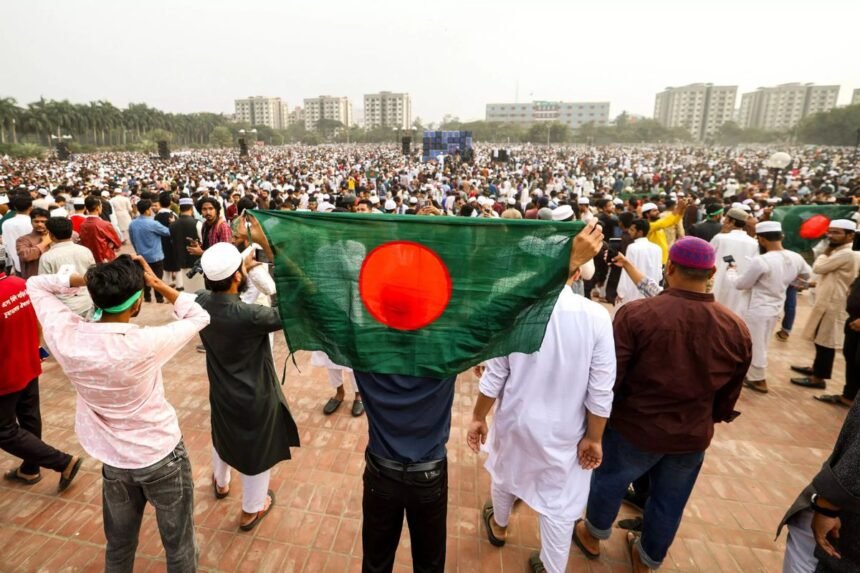
Introduction: Bangladesh crisis 2024
South Asia experienced significant geopolitical upheaval in 2024 when Prime Minister Sheikh Hasina’s government collapsed suddenly. While mainstream narratives attributed the crisis to domestic student protests about job quotas, deeper analysis reveals a complex pattern of coordinated foreign interference from the United States, China, and Pakistan—each pursuing distinct strategic objectives against India’s regional stability.
- Introduction: Bangladesh crisis 2024
- 1. The Collapse of Sheikh Hasina’s Government: Understanding Internal Weakness
- 1.1 The Quota Reform Protest: From Student Grievance to Political Movement
- 1.2 The July 2024 Massacre: Violence as Political Weapon
- 1.3 Military Withdrawal: The Final Collapse
- 2. United States Strategic Pressure: Saint Martin’s Island and Military Positioning
- 2.1 Saint Martin’s Island: Geography as Geopolitical Leverage
- 2.2 The “Christian State” : A Coordinated Regional Plan
- 2.3 Post-Hasina Government: American Strategic Success
- 3. China’s Military Encirclement: The “Ring of Fire” Strategy
- 3.1 The Ring of Fire: From Commercial Strategy to Military Encirclement
- 3.2 The Lalmonirhat Airbase: Threat to the Siliguri Corridor Lifeline
- 3.3 The Pekua Submarine Base: Naval Dominance in the Bay of Bengal
- 3.4 Debt Trap Economics: Converting Financial Leverage into Political Control
- 4. Pakistan’s Strategy: “Bleed India 2.0” and the Revival of 1971
- 4.1 Historical Erasure: Attempting to Undo 1971
- 4.2 ISI-BNP Coordination: Intelligence Agency Operational Support
- 4.3 Pakistan-Bangladesh Direct Connection: The Symbolic Ship
- 4.4 Released Terrorists and Renewed “Bleed India” Operations
- 5. Anti-India Propaganda Campaign: Key Personalities Driving Regional Division
- 5.1 Pinaki Bhattacharya: Social Media Amplification of Anti-India Sentiment
- 5.2 Sharif Osman Hadi: Martyrdom as Radicalization Tool
- 5.3 Hasnat Abdullah: Direct Territorial Threat to India
- 6. Religious Violence and Minority Persecution: Coordinated Campaign Against Hindu Communities
- 6.1 Scale and Geographic Distribution of Violence
- 6.2 The Murder of Dipu Chandra Das: Lawlessness and Communal Breakdown
- 6.3 Destruction of Religious and Cultural Infrastructure
- 6.4 Government Complicity and Constitutional Changes
- 7. Strategic Threat to India’s Northeast: The Siliguri Corridor and Regional Stability
- 7.1 The Siliguri Corridor: Geographical challange
- 7.2 The Chinese-Bangladesh Threat
- 7.3 Insurgency Revival: The “Sever the Seven Sisters” Threat
- 8. India: The Stabilizing Force and the Primary Provider of Regional Stability
- 8.1 Electricity: Maintaining Basic Infrastructure
- 8.2 Food: Preventing Famine
- 8.3 Employment: Supporting the Garment Industry
- 8.4 Healthcare: Providing Life-Saving Medical Services
- 8.5 Water: Sharing Information Despite Accusations
- 9. Strategic Imperatives: India’s Path Forward
- 9.1 The Reality of Bangladesh-India Interdependence
- 9.2 Strategic Imperatives for India
- 9.3 Long-Term Strategic Vision
The “July Revolution” and subsequent interim government under Muhammad Yunus have created a dangerous power vacuum threatening regional security. This report identifies three critical interference patterns:
- China’s “Ring of Fire”: Military encirclement strategy surrounding India with strategic bases
- Pakistan’s “Bleed India” Strategy: Revival of terrorism support and insurgency funding through Bangladesh
- United States Pressure: Demands for military control of Saint Martin’s Island in the Bay of Bengal
Simultaneously, India emerges as the primary stabilizing force, providing critical resources:
- Electricity through Adani Power plant (1,600 MW)
- Food supplies (90% of onions, wheat, sugar)
- Medical care and healthcare access
- Raw materials supporting 4 million garment industry workers
The report also documents systematic violence against Hindu minorities since August 2024—over 2,010 incidents across 52 of 64 districts—indicating a coordinated campaign contradicting the secular principles Bangladesh’s independence was built upon.
Geographic Strategic Concern: If Bangladesh becomes hostile to India, the security of India’s Northeast states connected to mainland India by the vulnerable 22-kilometer-wide Siliguri Corridor (“Chicken’s Neck”) faces existential threat.
1. The Collapse of Sheikh Hasina’s Government: Understanding Internal Weakness
Prime Minister Sheikh Hasina governed Bangladesh for 15 years before her sudden loss of power in August 2024. Understanding this crisis requires examining both internal governmental vulnerabilities and how external powers exploited these weaknesses to engineer regime change.
1.1 The Quota Reform Protest: From Student Grievance to Political Movement
The immediate catalyst emerged in mid-2024 when Bangladesh courts reinstated a 30% job quota reserved for descendants of independence war veterans. This policy triggered significant student discontent given Bangladesh’s persistent youth unemployment crisis and limited job availability.
A localized student movement demanding merit-based employment evaluation rapidly escalated into a nationwide political crisis. Several factors accelerated this transformation:
Government’s Inflammatory Response: Prime Minister Hasina’s controversial statements labeled protesters as “Razakars” a term referencing radical Islamist individuals who collaborated with Pakistani forces during the 1971 genocide. This incendiary language transcended the original quota debate, mobilizing previously apolitical students into active resistance.
Ideological Exploitation: Radical Islamic organizations, including the Islamic Student Federation (Islami Chhatra Shibir), recognized the movement’s momentum and strategically infiltrated protests to advance their own political agenda. These groups transformed economic grievances into platforms for ideological radicalization.
Youth Mobilization: The convergence of legitimate employment frustrations with historical grievances created unprecedented youth engagement, with protesters spanning diverse socioeconomic and educational backgrounds.
1.2 The July 2024 Massacre: Violence as Political Weapon
The government’s response to escalating protests marked a critical turning point. Official security forces and the Chhatra League (the ruling party’s student organization) employed lethal force against predominantly unarmed demonstrators. The “July Massacre” resulted in:
- Over 300 confirmed deaths including students and civilians
- Hundreds of injuries and disappearances
- Widespread psychological trauma across Bangladeshi society
- Complete erosion of public trust in governmental institutions
However, critical observers noted distinctive operational characteristics of the protest violence suggesting organized paramilitary coordination rather than spontaneous mob action:
- Strategic targeting: Specific infrastructure including metro stations and police headquarters faced coordinated attacks
- Military-style tactics: The assault on the Prime Minister’s residence displayed organizational sophistication inconsistent with student-led protests
- Training indicators: The systematic nature of barricades, communication coordination, and tactical maneuvers reflected professional paramilitary instruction
These operational patterns suggest involvement of trained intelligence operatives, likely affiliated with organizations like Islami Chhatra Shibir, working to transform a legitimate protest movement into an instrument for regime change.
1.3 Military Withdrawal: The Final Collapse
The government’s ultimate collapse occurred on August 5, 2024, when General Waker-Uz-Zaman (Bangladesh Army Chief) issued a 45-minute ultimatum: Prime Minister Hasina must resign or face military intervention. Hasina fled to India, creating an immediate power vacuum.
The subsequent interim government, led by Muhammad Yunus, implemented actions suggesting ideological reorientation away from Bangladesh’s founding secular principles:
- Removal of founding father statues: Destruction of monuments honoring Sheikh Mujibur Rahman, Bangladesh’s independence leader
- Symbolic erasure: Burning of the 1971 independence war museum
- Historical revisionism: Actions designed to undermine collective memory of Bangladesh’s freedom struggle against Pakistani occupation
These symbolic actions represented more than political expression—they signaled potential alignment shifts toward Pakistan-affiliated religious political movements that had historically opposed Bangladesh’s independence.
2. United States Strategic Pressure: Saint Martin’s Island and Military Positioning
While internal Bangladeshi political vulnerabilities created regime change opportunity, external American pressure appears to have been the decisive force driving the crisis toward Hasina’s removal. This section examines concrete evidence of US strategic demands and their connection to the interim government’s formation.

2.1 Saint Martin’s Island: Geography as Geopolitical Leverage
Saint Martin’s Island—a small, strategically positioned territory covering approximately 3 square kilometers in the Bay of Bengal near Myanmar—represents the nexus of US-Bangladesh tensions. Despite its modest size, the island’s geographic location provides extraordinary strategic value:
Monitoring Capabilities:
- Complete surveillance of Chittagong port traffic—Bangladesh’s primary maritime commercial hub
- Comprehensive oversight of Bay of Bengal shipping lanes
- Direct observation of all maritime commerce entering and exiting the region
Strategic Proximity:
- Close proximity to the Strait of Malacca, a critical global shipping chokepoint
- Direct positioning relative to Kyaukphyu port in Myanmar—a Chinese Belt and Road Initiative megaproject
- Potential platform for projecting American military power throughout Southeast Asia
Geopolitical Leverage:
- Control of the island enables influence over both Myanmar and Bangladesh
- Platform for countering China’s regional infrastructure expansion
- Base for monitoring Chinese military activities in Southeast Asian waters
Critical Evidence of US Pressure:
Prime Minister Sheikh Hasina herself publicly disclosed that an American official offered her “problem-free re-election” in January 2024 conditional upon granting the United States permission to construct an air base on Saint Martin’s Island. Hasina refused this demand, viewing it as unacceptable national sovereignty violation. She explicitly connected this refusal to her subsequent removal from power—a claim gaining credibility through subsequent events.
2.2 The “Christian State” : A Coordinated Regional Plan
Beyond the immediate Saint Martin’s Island demand, Prime Minister Hasina alleged a broader American strategic design: creation of a “Christian state” carved from territories in:
- Chittagong Hill Tracts (Bangladesh)
- Chin and Rakhine states (Myanmar)
- Manipur and Mizoram (India)
This theory appeared speculative until examined against actual concurrent violence patterns in these geographically contiguous regions:
Simultaneous Conflict Escalation:
- Manipur, India: Systematic violence between Kuki- Meitei communities ( Kuki are predominantly Christian) and local ethnic (Hindu) groups, involving documented military-style operations and heavy weapons
- Chin State, Myanmar: Active rebellion by the Chin National Army against the Myanmar military government
- Chittagong Hill Tracts, Bangladesh: Recent armed insurrection launched by the Kuki-Chin National Front
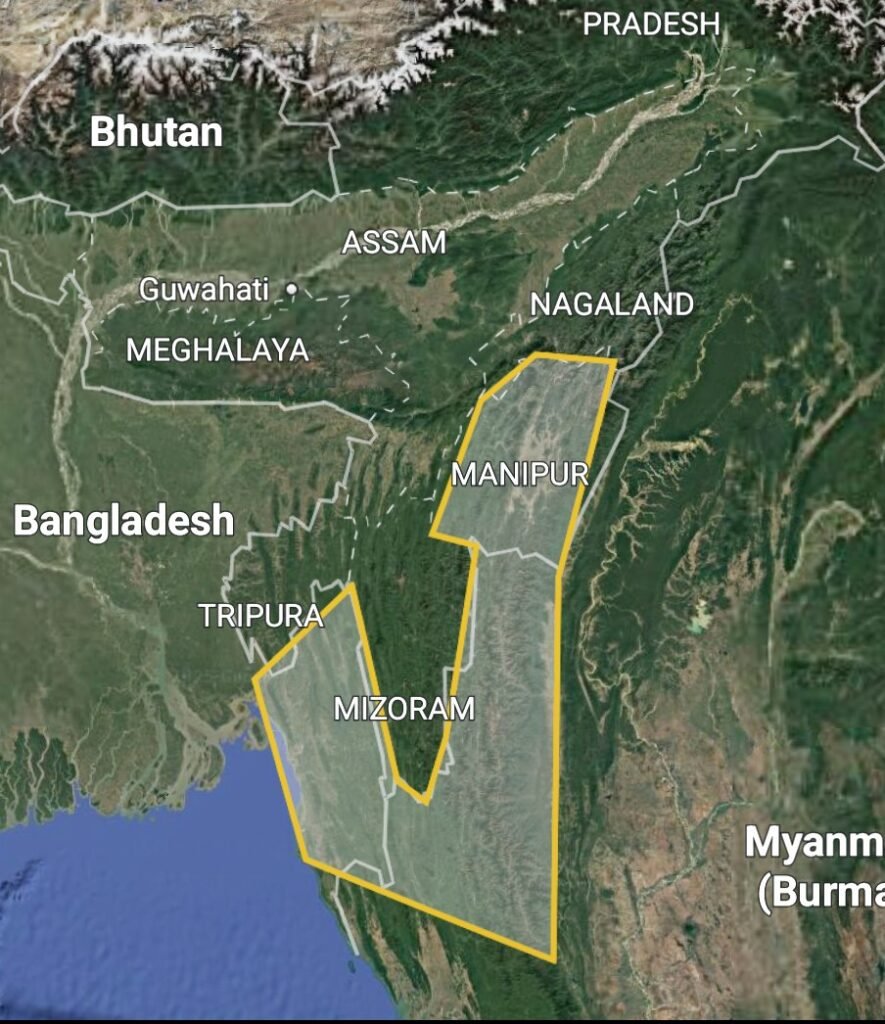
Pattern Analysis: The synchronization of these distinct conflicts across connected geographic areas, combined with each region’s significant Christian populations, suggests coordinated destabilization rather than coincidental ethnic tensions.
Strategic Purpose: These interconnected conflicts would create a “buffer zone” controlled by Western-aligned forces, simultaneously:
- Blocking India’s Kaladan transport project infrastructure designed to provide India alternative maritime access to Northeast states
- Disrupting China’s Belt and Road initiatives particularly Myanmar-connected transport corridors
- Creating leverage over both Indian and Chinese strategic interests
2.3 Post-Hasina Government: American Strategic Success
Since Muhammad Yunus assumed leadership of the interim government, several indicators suggest Bangladesh’s trajectory toward greater American alignment:
Leadership Connections:
- Yunus maintains long-standing relationships with prominent American political figures and institutions
- His historical involvement with microfinance initiatives created extensive networks within American policy circles
- Yunus supporters believe his governance will facilitate American strategic objectives
Saint Martin’s Island Development:
- Reports of “tourism development” projects on the island terminology frequently used as cover for military base construction in geopolitical literature
- Accelerated infrastructure development following the regime change
Strategic Implications for India:
Establishment of a US military base on Saint Martin’s Island would represent a fundamental strategic liability for India:
- Extends American military reach into India’s own maritime domain
- Enables sophisticated intelligence collection against Indian naval operations
- Complicates India’s entire eastern defense architecture
- Provides the United States with leverage in India-China disputes
3. China’s Military Encirclement: The “Ring of Fire” Strategy
While American pressure destabilized Bangladesh, China has seized the opportunity to execute an aggressive military expansion strategy. China is transitioning from its historical “String of Pearls” (commercial port network) to an active military encirclement strategy termed the “Ring of Fire” placing India in a strategic vice with military bases positioned along its entire periphery.
3.1 The Ring of Fire: From Commercial Strategy to Military Encirclement
For decades, China pursued the “String of Pearls” strategy—establishing commercial ports in countries surrounding India. These ports maintained dual-use potential but remained primarily economic entities.
Contemporary Shift: China now transitions to explicit military encirclement. By removing Hasina—who maintained stronger India relationships China gained freedom to construct forward military bases in Bangladesh without significant domestic political resistance.
This shift represents a fundamental escalation in regional strategic competition, transforming Bangladesh from a geopolitical balancer into a Chinese military platform threatening India’s core national security interests.
3.2 The Lalmonirhat Airbase: Threat to the Siliguri Corridor Lifeline
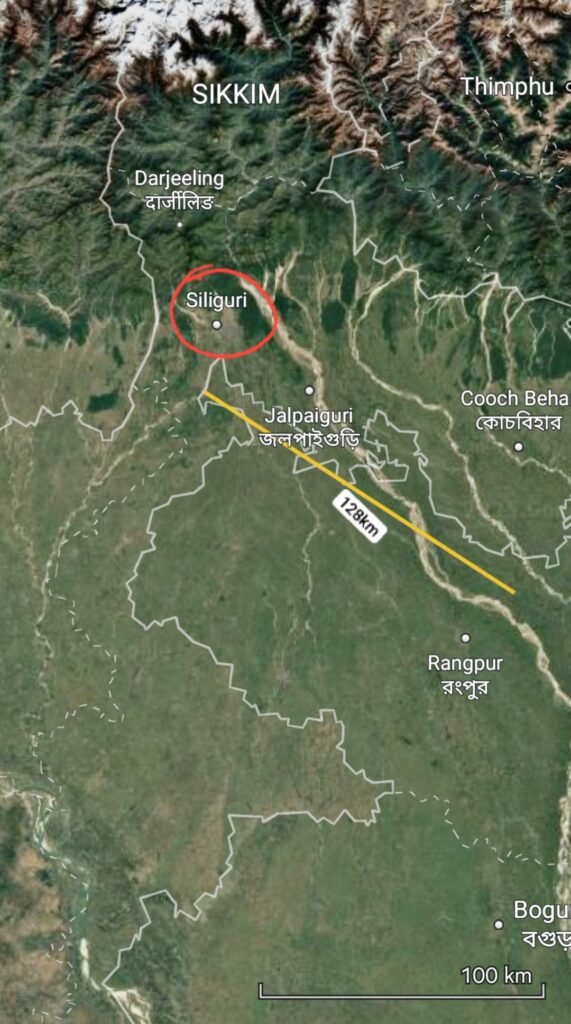
The Lalmonirhat Airbase in northern Bangladesh, upgraded with Chinese military support, represents perhaps the most strategically dangerous Chinese initiative threatening India’s territorial integrity.
Critical Geographic Positioning:
- Located only 15 kilometers from the Indian border
- Positioned directly adjacent to the Siliguri Corridor a 22-kilometer-wide land strip representing India’s sole connection between mainland and Northeast territories
Strategic Vulnerability:
India’s Northeast comprises eight states containing 50 million Indian citizens:
- Assam
- Meghalaya
- Tripura
- Manipur
- Mizoram
- Nagaland
- Arunachal Pradesh
- Sikkim
These states are connected to mainland India exclusively through the narrow Siliguri Corridor. This geographic configuration creates profound strategic vulnerability.
Military Implications in Conflict Scenarios:
If armed conflict erupts between India and China, or between India and Bangladesh:
- Chinese aircraft or Bangladesh military planes supplied by China could interdict the Siliguri Corridor within minutes
- Road and rail links supporting 50 million people would be severed
- Supply lines to Indian troops defending against Chinese aggression in Arunachal Pradesh would be cut
- Military reinforcement of the Northeast would become operationally impossible
- This creates a classic “pincer movement” where China attacks from two directions simultaneously:
- Northern pincer: Direct Chinese military pressure in Arunachal Pradesh
- Southern pincer: Bangladesh-based aircraft interdicting supply corridors
The Catastrophic Scenario:
Interruption of the Siliguri Corridor would result in:
- Effective isolation of 50 million Indians in the Northeast
- Impossible military logistics for Indian forces defending against Chinese aggression
- High probability of Chinese territorial gains in Arunachal Pradesh due to inability to supply defending forces
- Existential threat to India’s territorial integrity
3.3 The Pekua Submarine Base: Naval Dominance in the Bay of Bengal
China’s military presence in Bangladesh extends to naval dominance through the BNS Sheikh Hasina submarine base at Pekua in Cox’s Bazar constructed at a cost of $1.2 billion.
Operational Capacity:
- Purpose-built for housing and maintaining submarines
- Specifically designed for Chinese Ming-class submarines purchased by Bangladesh
- Chinese engineering standards requiring continuous Chinese technical personnel for operation and maintenance
Strategic Purpose:
While nominally a “Bangladeshi base,” the facility functions as a Chinese forward naval facility:
Intelligence Capabilities:
- Submarines operating from Pekua can track Indian naval movements at Vishakhapatnam—India’s primary eastern naval base
- Monitor Indian ballistic missile test launches
- Gather signals intelligence on Indian naval communications and operations
Naval Force Distribution:
- Forces Indian Navy to disperse resources across expanded operational area
- Reduces Indian naval concentration in critical areas
- Challenges Indian maritime dominance in the Bay of Bengal
Geopolitical Control:
- Provides China with permanent presence in India’s traditional maritime sphere of influence
- Enables forward positioning for potential conflict scenarios
- Represents long-term strategic commitment to encirclement of India
3.4 Debt Trap Economics: Converting Financial Leverage into Political Control
China’s Ministry of State Security likely funded organizations and individuals instrumental in removing Hasina, viewing her government as insufficiently aligned with Chinese strategic interests. With the Bangladesh Nationalist Party (BNP) and Jamaat-e-Islami (organizations maintaining stronger Pakistan and Islamic ideological orientations) gaining influence, China can now:
Accelerate Strategic Projects:
- Resume Belt and Road Initiative projects that Hasina had slowed or blocked
- Expand infrastructure development with reduced political resistance
- Integrate Bangladesh more deeply into Chinese-controlled regional economic networks
Establish Debt Dependency:
- Create unsustainable debt levels from infrastructure projects (replicating the Sri Lankan Hambantota port model)
- Bangladesh cannot repay accumulated obligations to Chinese entities
- Convert financial dependency into political leverage
Historical Precedent Sri Lanka’s Hambantota Port:
When Sri Lanka could not service debt from its Hambantota port development, China demanded:
- 99-year lease of the port
- Effective loss of sovereignty over critical national infrastructure
- Political dependency on Chinese interests
Bangladesh Risk: Similar dynamics now threaten Bangladesh, where Chinese debt accumulation could result in:
- Loss of control over critical infrastructure (ports, energy facilities)
- Permanent Chinese military presence justified as “debt repayment”
- Erosion of national sovereignty through financial subordination
4. Pakistan’s Strategy: “Bleed India 2.0” and the Revival of 1971
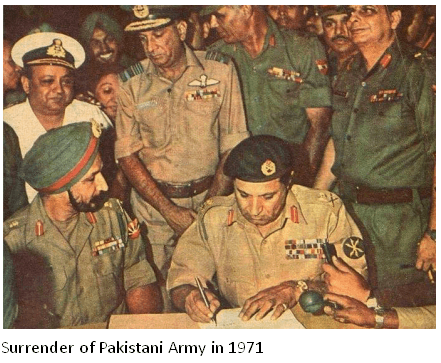
Pakistan’s military establishment and Inter-Services Intelligence (ISI) perceive the Bangladesh crisis as an opportunity to reverse the 1971 war outcome when East Pakistan (now Bangladesh) seceded with Indian military support and it was also a historic day when 93000 Pakistani soldiers were surrender this is highest ever recorded military surrender ever. Pakistan is actively exploiting the power vacuum to install a Pakistan-aligned government capable of supporting terrorism and insurgency against India’s Northeast.
4.1 Historical Erasure: Attempting to Undo 1971
Pakistan’s primary objective involves negating the historical reality and significance of Bangladesh’s 1971 independence struggle. The destruction of monuments honoring founding father Sheikh Mujibur Rahman and the burning of the independence war museum represent coordinated attempts to erase national memory of:
- Pakistan’s systematic genocide against Bengali population (estimated 300,000-3,000,000 deaths)
- India’s military intervention enabling Bangladesh’s liberation
- Collective trauma of occupation and independence struggle
Historical Reclamation: The return to power of:
- Jamaat-e-Islami—the organization that collaborated with Pakistan during the 1971 war
- Islamic Student Federation (Islami Chhatra Shibir)—youth wing of Jamaat-e-Islami with direct 1971 collaboration history
These political movements’ resurgence signals Pakistan’s ideological reassertion in Bangladesh—potentially creating pathways for renewed Pakistan-Bangladesh strategic alignment.
4.2 ISI-BNP Coordination: Intelligence Agency Operational Support
Intelligence reports document active coordination between Pakistan’s Inter-Services Intelligence (ISI) and the Bangladesh Nationalist Party (BNP), suggesting Pakistan provided direct operational support for the government removal operation.
Documented Coordination Mechanisms:
Secret Meetings in Saudi Arabia:
- Tarique Rahman (BNP leader, residing in London) held clandestine meetings with ISI officials in Saudi Arabia
- Discussions focused on operational planning for Hasina’s removal
- Saudi Arabia served as a neutral venue for conducting sensitive negotiations away from intelligence service surveillance

Tactical Intelligence Support:
- ISI provided financial resources to student protest leaders
- Paramilitary training in organized protest methodologies
- Strategic guidance transforming an economic grievance movement into a government-removal operation
Evidence of Professional Coordination:
The protests exhibited characteristics inconsistent with spontaneous student movements:
- Coordinated blockade operations on major transportation routes
- Synchronized attacks on critical communication infrastructure
- Disciplined tactical formations deployed with military precision
- Strategic targeting of specific governmental facilities
These operational characteristics reflect ISI training methodologies established through decades of operations in Kashmir and India’s Northeast.
4.3 Pakistan-Bangladesh Direct Connection: The Symbolic Ship
In late 2024, a Pakistani cargo vessel docked at Mongla Port—the first direct ship connection between Pakistan and Bangladesh in 53 years, ending Pakistan’s effective isolation from Bangladesh since the 1971 war.
Symbolic Significance:
This maritime connection represents far more than ordinary commercial shipping:
- Restoration of Pakistan-Bangladesh relations after 53 years of separation
- Explicit reversal of Bangladesh’s 1971 choice to separate from Pakistan
- New transportation corridor for goods, money, and materials
Hidden Cargo Concerns:
Beyond official manifest contents, this direct shipping route enables:
- Unmonitored financial transfers between Pakistan and Bangladesh entities
- Potential drug trafficking through established smuggling networks
- Weapons and explosives movement to support militant organizations
- Operational support for insurgent groups operating in India’s Northeast
The direct Pakistan-Bangladesh connection represents Pakistan’s return to political and strategic presence in Bangladesh after five decades of exclusion.
4.4 Released Terrorists and Renewed “Bleed India” Operations
The new Bangladesh government has released individuals convicted of serious terrorism charges, suggesting ideological alignment with radical Islamic organizations:
Released Terrorist Organizations:
- Harkat-ul-Jihad-al-Islami (HuJI): Organization with documented ISI connections and historical involvement in Kashmir operations
- Ansarullah Bangla Team (ABT): Group with alleged Al-Qaeda affiliations
Strategic Implications:
These organizations’ release enables:
- Organizational reconstitution in Bangladesh
- Recruitment of radicalized Bangladeshi youth
- Cross-border operational planning targeting India
- Support for India’s Northeast insurgencies through safe-haven provision
Pakistan’s “Bleed India” Strategy Revived:
This represents revival of Pakistan’s historical strategy: incremental territorial degradation through multiple simultaneous insurgencies—causing sufficient security pressure that India cannot effectively respond to all threats simultaneously. The approach involves:
- Supporting Kashmiri separatists in Jammu & Kashmir
- Funding Northeast insurgencies (ULFA, NSCN, etc.)
- Enabling terrorist attacks across Indian territory
- Creating perpetual security stress preventing economic development
New Geographic Dimension: Unlike the past, where pressure came primarily from Pakistan’s western border, the revived “Bleed India” strategy now threatens India from the east through Bangladesh-based insurgent support networks.
This dual-front pressure (Kashmir from the west, Northeast from the east) multiplies India’s security challenges at precisely the moment China is escalating pressure on the northern border.
5. Anti-India Propaganda Campaign: Key Personalities Driving Regional Division
The Bangladesh crisis has been sustained and intensified by a relentless propaganda campaign led by specific individuals who leveraged social media platforms and public discourse to transform Indian assistance into perceived oppression. This section identifies key propagandists and analyzes their operational methodologies.
5.1 Pinaki Bhattacharya: Social Media Amplification of Anti-India Sentiment

Dr. Pinaki Bhattacharya, a physician-turned-activist residing safely in France, has emerged as the primary voice of anti-India sentiment in Bangladesh and the Bangladeshi diaspora. His coordinated social media campaign has achieved unprecedented reach among young Bangladeshis.
“India Out” Campaign Strategy:
Bhattacharya launched a systematic boycott campaign urging Bangladeshis to:
- Reject Indian consumer products
- Avoid purchasing Indian goods
- Treat Indian commerce as betrayal of national interests
- Mobilize social ostracism against pro-India sympathizers
False Historical Narrative:
His campaign successfully disseminated deliberate falsehoods:
- Claims that 2024 elections were manipulated by Indian intelligence to maintain Hasina in power
- Assertion that India controlled Bangladesh elections through covert operations
- Framing Hasina as a “puppet of India” rather than Bangladesh’s democratically elected leader
Signature Propaganda Phrase:
His statement—“Hasina is India, India is Hasina”—created powerful psychological association equating Bangladesh’s government with Indian foreign control, effectively delegitimizing the elected administration through nationalist appeals.
Radicalization Effectiveness:
Despite residing in France, Bhattacharya has achieved remarkable success in:
- Radicalizing young Bangladeshis through nationalist rhetoric
- Influencing diaspora communities to adopt anti-India positions
- Creating social pressure against India-favorable political positions
- Undermining India-Bangladesh people-to-people relationships
His propaganda effectiveness cannot be overstated—he has single-handedly shifted public perception of India from beneficial ally to imperial oppressor.
5.2 Sharif Osman Hadi: Martyrdom as Radicalization Tool

Sharif Osman Hadi led the Revolution Platform (Inqilab Moncho), an explicitly anti-India political organization. His activism focused on:
Anti-India Messaging:
- Water sovereignty claims: Accusations of Indian control over Ganges River and other shared waterways
- Border security criticisms: Denunciations of Indian Border Security Force (BSF) actions resulting in Bangladeshi civilian deaths
- Public agitation: Organization of mass protests against Indian influence in Bangladesh
Strategic Death and Exploitation:
In December 2024, Hadi was killed by rival political actors. His death was strategically exploited by radical elements who:
- Fabricated claims that Indian security agencies assassinated Hadi
- Spread false narratives of killers escaping to India
- Converted his death into nationalist martyrdom
- Mobilized youth anger toward anti-India radicalization
Recruitment Amplification:
Hadi’s death, regardless of actual perpetrators, has become a powerful radicalization tool:
- Symbolic martyr status attracts idealistic youth to anti-India movements
- Perceived Indian complicity (whether accurate or not) deepens nationalist sentiment
- Emotional mobilization supersedes factual analysis
The strategic exploitation of Hadi’s death illustrates how even apolitical deaths become weaponized in the anti-India propaganda campaign.
5.3 Hasnat Abdullah: Direct Territorial Threat to India

Hasnat Abdullah, a key organizer of the 2024 student protest movement, represents the most existentially threatening anti-India figure due to explicit statements regarding India’s territorial integrity.
Direct Threat to India’s Territorial Integrity:
Abdullah has publicly articulated intentions to:
- Support separatist movements in India’s Northeast
- Enable the “severing of the Seven Sisters”—breaking India’s northeastern states away from mainland India
- Provide military and strategic support to ULFA (United Liberation Front of Assam), NSCN (National Socialist Council of Nagaland), and other Northeast insurgencies
- Transform Bangladesh into a staging ground for India’s disintegration
Military Security Significance:
Unlike other propagandists whose impact remains primarily informational, Abdullah’s statements represent operational intentions to:
- Revive dormant insurgencies that had been suppressed under Hasina
- Provide sanctuary in Bangladesh for fugitive insurgent leaders
- Supply weapons and financial resources to separatist organizations
- Coordinate military operations threatening India’s northeast stability
Strategic Existential Threat:
Abdullah represents the direct military threat to India’s territorial integrity emanating from the new Bangladesh government. His public statements, combined with the government’s apparent tolerance, suggest institutional support for anti-India separatism.
6. Religious Violence and Minority Persecution: Coordinated Campaign Against Hindu Communities
Since the fall of Sheikh Hasina’s government on August 5, 2024, the new Bangladesh regime has witnessed systematic, widespread violence against Hindu and other religious minorities. This violence transcends random communal incidents—it represents a coordinated campaign suggesting institutional acquiescence or active support.

6.1 Scale and Geographic Distribution of Violence
Incident Documentation:
Human rights organizations monitoring communal violence have recorded:
- 2,010+ violent incidents documented in merely the first two weeks post-Hasina
- 52 of 64 districts affected—representing 81% of Bangladesh’s administrative divisions
- Nationwide coordinated campaign rather than localized communal friction
Systematic Targeting Pattern:
Violence was not random but methodically organized:
- Hindu homes marked with identifying symbols (paint, chalk markings)
- Property systematically looted before burning
- Businesses owned by minorities targeted to destroy economic capacity
- Temples and prayer spaces attacked to eliminate religious institutional capacity
These patterns suggest coordinated operational planning rather than spontaneous mob violence.
6.2 The Murder of Dipu Chandra Das: Lawlessness and Communal Breakdown
The killing of Dipu Chandra Das in Mymensingh illustrates the complete breakdown of law and order and normalization of communal violence:

The Incident:
- Das was accused of blasphemy (insulting Islamic faith) a charge frequently fabricated to target minorities or settle personal disputes
- Mob violence resulted in his death, with his body burned
- Witnesses stood silently, neither intervening nor reporting to authorities ( they were celebrating )
Systemic Failure:
- Complete breakdown of police protection
- Judicial system failure (fabricated blasphemy charges proceed without investigation)
- Social acceptance of mob justice against religious minorities
This single incident epitomizes the wholesale collapse of secular legal systems and the triumph of vigilante religious justice in the new Bangladesh.
6.3 Destruction of Religious and Cultural Infrastructure
Violence extended beyond targeted individuals to wholesale destruction of Hindu religious and cultural institutions:
Temple and Prayer Space Destruction:
- 152+ temples and prayer areas damaged or destroyed
- Sacred statues (religious idols central to Hindu worship) systematically smashed
- Desecration of holy sites representing centuries of religious tradition
Cultural Institution Destruction—The Rahul Ananda Case:
The attack on Rahul Ananda, a celebrated Baul singer representing centuries-old Hindu-Islamic cultural synthesis:
- Home destroyed
- 3,000+ handcrafted musical instruments demolished
- Baul tradition (spiritual music expressing Hindu-Islamic mystical unity) targeted for elimination
Ideological Meaning:
These actions against the Baul tradition specifically target cultural evidence of Hindu-Islamic coexistence. The Baul tradition represents:
- Spiritual synthesis bridging Hindu and Islamic mysticism
- Secular cultural expression transcending religious boundaries
- Antithesis to the radical Islamic ideology now dominant in Bangladesh
The targeting of Baul culture suggests deliberate ideological assault on any cultural expression suggesting Hindu-Muslim harmony, replacing it with explicitly separatist religious ideology.
6.4 Government Complicity and Constitutional Changes
While Muhammad Yunus visited temples (performative gestures supporting religious minorities), his actual governance actions contradict these symbolic displays:
Actions Suggesting Government Support for Religious Violence:
Release of Radical Leaders:
- Yunus’s government released Jamaat-e-Islami leaders and Islamic Student Federation organizers—groups whose rhetoric explicitly dehumanizes “idol worshippers” (Hindu population)
- Released individuals have preached hatred against religious minorities
- Government provides no counterbalance to their radicalization
Absence of Accountability:
- No prosecution of individuals responsible for July-August violence against minorities
- No protection mechanisms established for vulnerable communities
- Complete impunity for perpetrators of communal violence
Constitutional Secularism Removal:
- Government discussions regarding removal of “secularism” from Bangladesh’s constitution
- Proposed constitutional amendments would eliminate state neutrality on religious matters
- Would institutionalize religious discrimination in governance
Interpretation:
These actions—combined with inaction—suggest the government either:
- Actively supports the religious violence against minorities, or
- Tolerates such violence as acceptable cost of political consolidation
- Either interpretation indicates institutional failure to protect religious minorities
7. Strategic Threat to India’s Northeast: The Siliguri Corridor and Regional Stability
The Bangladesh political transformation poses the most serious existential threat to India’s Northeast since the 1962 Sino-Indian War. The geographic vulnerability of the Siliguri Corridor, combined with simultaneously deteriorating security environment, creates conditions for potential territorial disintegration.
7.1 The Siliguri Corridor: Geographical challange
Physical Geography:
The Siliguri Corridor is a narrow land strip connecting mainland India with eight northeastern states containing 50 million Indian citizens:
- Width: 20-22 kilometers at narrowest point
- Length: Extends approximately 180 kilometers
- Strategic Function: Only land connection between mainland and Northeast India
The Eight Northeastern States (The “Seven Sisters” + Sikkim):
- Assam
- Meghalaya
- Tripura
- Manipur
- Mizoram
- Nagaland
- Arunachal Pradesh
- Sikkim
National Integration Mechanism:
Every resource flowing to the Northeast—military supplies, food, fuel, manufactured goods—must traverse the Siliguri Corridor. Interruption of this corridor would:
- Isolate 50 million people from mainland India
- Create humanitarian crisis conditions within days
- Enable regional fragmentation and separatist movements
- Jeopardize territorial integrity
7.2 The Chinese-Bangladesh Threat
The simultaneous militarization of both northern and southern approaches to the Siliguri Corridor creates a strategic vice threatening to isolate India’s Northeast:
Northern Pincer—Chinese Military Positioning:
- Heavy military deployments in Chumbi Valley (Tibet)
- Strategic proximity to Siliguri Corridor from north
- Capable of interdicting corridor from northern direction
Southern Pincer—Bangladesh Military Positioning:
- Chinese-upgraded Lalmonirhat Airbase positioned 15 km from corridor
- Bangladesh military aircraft (supplied by China) capable of rapid interdiction
- Operational capability to cut corridor from southern direction
Scenario Analysis—Conflict Situation:
In a hypothetical conflict involving China and India:
- Chinese ground forces attack from north and east toward Arunachal Pradesh
- Bangladesh-based aircraft (potentially Chinese-piloted or -directed) attack corridor infrastructure
- Pincer movement creates operational nightmare for Indian military
- Supply routes severed, Indian defensive positions in Arunachal Pradesh cannot be reinforced
- Military defeat becomes likely due to inability to supply defensive forces
- Territorial loss of Arunachal Pradesh becomes probable
Existential Threat Assessment:
This represents an existential threat to India’s territorial integrity—not a peripheral concern but a core national security challenge demanding urgent strategic response.
7.3 Insurgency Revival: The “Sever the Seven Sisters” Threat
Beyond military threats, the new Bangladesh government potentially enables revival of dormant insurgent movements that had been suppressed under the Hasina administration.
Historical Insurgencies Suppressed:
ULFA (United Liberation Front of Assam):
- Organization seeking Assam’s separation from India
- Leadership arrested and extradited by Hasina government
- Currently fugitive operatives in Bangladesh and Pakistan
NSCN (National Socialist Council of Nagaland):
- Organization seeking Nagaland independence
- Leadership captured and handed to India by Hasina
- Potential operatives sheltering in Bangladesh
Other Northeast Separatist Groups:
- KLO (Kuki Liberation Organization)
- ZPM (Zoram People’s Movement)
- Various other ethnic separatist organizations
Potential Bangladesh Support:
Under the new Bangladesh government:
- Safe haven provision in Bangladesh territory for fugitive insurgent leaders
- Financial support through Pakistan-Bangladesh channels
- Weapons supply via maritime routes from China and Pakistan
- Cross-border sanctuary enabling hit-and-run operations
Hasnat Abdullah’s Threat Operationalized:
Abdullah’s public threats to “sever the Seven Sisters” would transition from propaganda to military reality through:
- Coordination with ULFA, NSCN, and other organizations
- Supply of weapons and explosives
- Strategic planning for coordinated insurgent operations
- Creation of ungovernable zones in India’s Northeast
Consequence for India:
The security situation would deteriorate dramatically:
- Indian military would need massive force expansion in Northeast to counter insurgencies
- Resources required for China border defense would be diverted to Northeast counterinsurgency
- China could exploit this force dispersion to attack in Arunachal Pradesh
- India would face simultaneous threats from three directions: China (north), Pakistan (west), Bangladesh-supported insurgencies (east)
This represents a strategic catastrophe for Indian national security.
8. India: The Stabilizing Force and the Primary Provider of Regional Stability
Paradoxically, while the United States destabilized Bangladesh, China surrounded it with military bases, and Pakistan injected terrorism and money, India has emerged as the only genuine stabilizing force providing essential resources ensuring Bangladesh’s survival. This section documents India’s critical contributions despite deteriorating diplomatic relations and anti-India propaganda.
8.1 Electricity: Maintaining Basic Infrastructure
Bangladesh’s Complete Power Dependency:
Bangladesh’s electrical power grid fundamentally depends on Indian electricity imports. The Adani Power plant in Godda, Jharkhand (an Indian state) provides approximately 1,600 megawatts (MW) of electricity to Bangladesh—supplying sufficient power for:
- Millions of homes in Bangladesh’s major cities
- Industrial manufacturing facilities including the critical garment industry
- Hospital and healthcare infrastructure
- Water purification and distribution systems
- Government and administrative functions
The Payment Crisis:
Despite receiving continuous electricity, Bangladesh owes over $1 billion to Indian power companies for accumulated unpaid invoices. Specifically:
- Adani Power alone is owed approximately $800 million
- Unpaid bills accumulate due to severe dollar shortage in Bangladesh’s foreign currency reserves
- Monthly electricity costs represent significant drain on limited foreign exchange
India’s Humanitarian Choice:
Under normal commercial practices, any power company facing non-payment of $1 billion would immediately cut service to force payment. However, India has chosen to continue electricity supply despite non-payment because:
- Power cut-off would cause immediate humanitarian crisis
- Dhaka and other cities would experience complete darkness
- Factories would close, causing mass unemployment
- Hospitals would become non-functional, resulting in deaths
- Water systems would fail, creating sanitation crises
- Widespread chaos and starvation would follow within days
India’s Strategic Choice:
By continuing to supply electricity despite $800 million non-payment, India has made a conscious decision to prioritize human welfare over commercial profit. This action:
- Prevents immediate humanitarian collapse in Bangladesh
- Maintains minimum functional government capability
- Prevents mass refugee flows toward India
- Preserves regional stability despite political hostility
India’s willingness to absorb $1 billion debt loss to maintain Bangladesh’s basic functionality demonstrates profound commitment to regional stability and humanitarian principles.
8.2 Food: Preventing Famine
Bangladesh’s Agricultural Insufficiency:
Bangladesh cannot produce sufficient food for its population of 170+ million people. The nation fundamentally depends on agricultural imports, particularly:
Onions:
- Over 90% of Bangladesh’s onion consumption comes from Indian imports
- Onions form staple vegetable in Bangladeshi cuisine
- Price fluctuations directly affect household food security
Wheat:
- Significant portion of wheat supplies come from India
- Critical for bread and staple grain consumption
Sugar:
- Substantial sugar imports from India support domestic consumption
- Critical for food security and industrial use
Spices and Other Foodstuffs:
- Additional food products including spices, pulses, and processed foods from India
The Onion Crisis and Indian Forbearance:
When onion prices rise in India due to supply shortages, Indian governments typically restrict exports to protect domestic prices and consumer welfare. However:
- During the Bangladesh crisis, India continued onion exports despite domestic price pressures
- Bangladesh onion prices would spike dramatically if Indian exports were restricted
- Poor Bangladeshi families depend on affordable onions for nutrition
- Indian government chose domestic price rises to maintain Bangladesh food security
Export Volume:
In 2024, despite the “India Out” boycott campaign and anti-India rhetoric, India exported over $11 billion in goods to Bangladesh, including:
- Food products preventing famine
- Consumer goods maintaining market supply
- Industrial materials enabling manufacturing
Humanitarian Consequence of Export Cessation:
If India ceased food exports to Bangladesh:
- Famine conditions would develop within weeks
- Mass starvation would occur in urban areas dependent on food imports
- Humanitarian catastrophe would create political instability
- Refugee flows toward India would become inevitable
India’s continued food export, despite bilateral political tensions, represents strategic humanitarianism enabling Bangladesh’s survival.
8.3 Employment: Supporting the Garment Industry
Bangladesh’s Economic Engine:
The Ready-Made Garment (RMG) industry represents Bangladesh’s largest export sector and primary source of employment for over 4 million workers—primarily women from economically disadvantaged backgrounds. This industry is:
- Backbone of Bangladesh’s foreign exchange earnings
- Primary source of income for millions of families
- Mechanism for women’s economic empowerment and social mobility
- Critical to Bangladesh’s economic survival
Complete Dependency on Indian Raw Materials:
The garment manufacturing process completely depends on Indian-supplied raw materials:
- Raw cotton from Indian cotton fields
- Processed yarn from Indian textile mills
- Fabric and textiles from Indian manufacturing
- Thread and fasteners from Indian suppliers
The entire supply chain for garment manufacturing originates in India or depends on Indian processing.
Industrial Supply Continuity:
During the 2024 political crisis, India maintained continuous supply of these materials, ensuring:
- Factory operations continued despite political chaos
- 4+ million workers retained employment despite domestic instability
- Families avoided income loss during crisis period
- Economic activity prevented complete collapse
Prevention of Youth Radicalization:
This employment continuity served a critical social function:
- Unemployed youth are prime recruits for radical movements
- Economic desperation drives participation in insurgencies and extremism
- By maintaining employment through Indian supply chains, India prevented radicalization of millions of unemployed youth
- Social stability was preserved through maintained economic activity
If India had ceased raw material supplies:
- Factories would close immediately
- 4+ million workers would become unemployed
- Young people without income would become recruitment targets for radical organizations
- Social chaos would compound political instability
India’s maintenance of the garment supply chain represents a deliberate strategy to prevent radicalization and maintain social stability despite political ruptures.
8.4 Healthcare: Providing Life-Saving Medical Services
Bangladesh’s Medical Limitations:
Bangladesh possesses insufficient medical expertise, advanced equipment, and healthcare infrastructure to treat complex illnesses. Bangladeshi patients with:
- Cancer requiring chemotherapy and advanced oncology
- Heart disease requiring advanced cardiac surgery
- Complex surgical needs
- Specialized pediatric care
These conditions require advanced medical facilities beyond Bangladesh’s capabilities.
India as Regional Medical Hub:
India has developed world-class healthcare institutions in major cities:
- Kolkata’s AMRI Hospital and CMO Institutes
- Chennai’s Apollo Hospitals
- Vellore’s Christian Medical College
- These facilities provide advanced, world-standard medical care at costs substantially below comparable treatments in developed countries
Medical Tourism Flows:
Approximately 70% of India’s medical tourists originate from Bangladesh. These patients:
- Come for cancer treatment, cardiac surgery, and specialized procedures
- Pay for treatments in Indian facilities
- Return home with life-saving medical interventions
- Would face certain death without access to Indian medical facilities
Continued Access During Political Tension:
During the 2024 crisis, despite:
- Closure of Indian visa offices in some locations due to security concerns
- Deteriorating diplomatic relations
- Anti-India propaganda campaigns
- Security threats to Indian diplomatic missions
The Indian High Commission continued issuing medical visas to Bangladeshi patients with:
- Life-threatening cancer diagnoses
- Critical heart disease
- Serious pediatric conditions
Humanitarian Priority Over Diplomacy:
India’s decision to continue medical visa issuance, despite political hostility and security concerns, demonstrates that human life takes precedence over diplomatic dispute resolution. This represents:
- Commitment to humanitarian principles
- Recognition of shared humanity transcending political boundaries
- Willingness to prioritize lives over political leverage
Life-Saving Impact:
Bangladeshi cancer patients, cardiac patients, and critical care cases owe their lives to India’s unwavering commitment to providing medical access despite political tensions.
8.5 Water: Sharing Information Despite Accusations
The False Narrative of Water Warfare:
During the catastrophic August 2024 floods in Bangladesh, anti-India propagandists claimed that India deliberately opened dam gates to flood Bangladesh as a strategic weapon. This narrative blamed India for the deaths and destruction of the flooding.
The Scientific Reality:
The Dumbur dam (also called Dumur river dam) uses “run-of-river” design—an engineering approach where:
- Dams do not store large water quantities
- Gates automatically release water when water levels reach dangerous heights
- No human control over water release during flood conditions
- Automatic safety mechanism prevents dam failure and catastrophic flooding downstream
India cannot and did not “deliberately control” water release—the dam’s engineering design makes this physically impossible.
India’s Actual Flood Assistance:
Despite false accusations, India provided critical flood information to Bangladesh:
- Real-time water level data from dams and rivers
- Rainfall monitoring information
- Advance warning of dangerous water conditions
- Forecast information enabling evacuation preparation
This data sharing provided Bangladeshi authorities with precious hours to:
- Evacuate vulnerable populations
- Move people to higher ground
- Save lives through advance warning
Strategic Information Sharing Despite Hostility:
India’s willingness to share flood information, despite being accused of causing the flooding, demonstrates:
- Commitment to humanitarian data sharing
- Prioritization of Bangladeshi lives over political dispute
- Refusal to weaponize information despite serious accusations
- Mature recognition that human welfare transcends political conflict
The false “water warfare” narrative was created by anti-India groups to distract from their own failures in flood preparation and response. India’s actual response demonstrates humanitarian commitment despite political hostility.
9. Strategic Imperatives: India’s Path Forward
The 2024 Bangladesh crisis reveals a complex pattern of coordinated hybrid warfare involving multiple foreign powers pursuing distinct but ultimately aligned anti-India objectives. Understanding India’s strategic options requires recognizing both the severity of the threat and the constraints imposed by humanitarian principles and geographic proximity.
9.1 The Reality of Bangladesh-India Interdependence
Geographic Permanence:
Bangladesh and India share a 1,468-kilometer border—the second-longest international border in the world (after India-China). This geographic proximity is:
- Unchangeable and permanent
- Creates inescapable economic interdependence
- Requires long-term cooperative relationship regardless of political tensions
Economic Reality:
Bangladesh fundamentally depends on India for:
- Electricity (1,600 MW supply)
- Food (90% of onions, major wheat supplies)
- Industrial raw materials (garment industry supplies)
- Healthcare access (70% of medical tourists)
- Financial stability (remittances, trade relationships)
This dependency is structural and cannot be quickly replaced by alternative suppliers.
India’s Humanitarian Burden:
India’s decision to continue essential supplies despite political hostility has created a humanitarian obligation:
- If India ceases electricity supplies, Bangladesh collapses within days
- If India ceases food exports, famine follows within weeks
- If India closes medical access, thousands die annually
- Withdrawal of these services would cause humanitarian catastrophe
This humanitarian burden constrains India’s ability to use economic leverage as a punitive measure.
9.2 Strategic Imperatives for India
Containment of Military Threats:
India must address the military threats created by Chinese bases and American strategic positioning:
Lalmonirhat Airbase Monitoring:
- Continuous surveillance of construction and military activity
- Preparation of defensive strategies for potential interdiction threats
- Possible military buildup near the Siliguri Corridor to deter interdiction
Pekua Submarine Base Surveillance:
- Monitoring of submarine activity and Chinese naval presence
- Preparation of naval defensive strategies
- Possible enhancement of Indian naval presence in the Bay of Bengal
Saint Martin’s Island Prevention:
- Diplomatic engagement to prevent American military base establishment
- Regional diplomatic coordination (with ASEAN countries) to create diplomatic pressure
- Support for Bangladeshi nationalist sentiment opposing foreign military bases
Northeast Insurgency Prevention:
India must address the potential revival of Northeast insurgencies:
Diplomatic Engagement with Bangladesh:
- Despite political tensions, maintaining communication channels
- Regular dialogue with Bangladesh military and security establishment
- Building relationships with professional military leadership distinct from political leadership
Counter-Insurgency Preparation:
- Enhanced intelligence presence in Bangladesh to monitor insurgent activity
- Support for border security forces (BSF) with modern equipment and training
- Rapid response capability to emerging insurgent threats
Siliguri Corridor Defense:
India must address the geographic vulnerability of the Siliguri Corridor:
Strategic Infrastructure Hardening:
- Diversification of supply routes to Northeast (alternative corridors through Assam)
- Enhanced road and rail capacity through the corridor
- Military infrastructure improvements to defend the corridor
Air Defense Enhancement:
- Installation of air defense systems to defend against potential aircraft interdiction
- Possible establishment of air bases for rapid response capability
- Defensive preparation for potential Bangladesh-China coordinated operations
Information War Counter-Campaign:
India must address the anti-India propaganda campaign systematically:
Factual Counter-Narrative:
- Documentation of India’s humanitarian assistance (electricity, food, medical care)
- Public communication of India’s contributions to Bangladesh stability
- Counter-propaganda targeting diaspora communities in Western countries
Diplomatic Public Diplomacy:
- Regular public statements by Indian leadership highlighting cooperation
- Engagement with Bangladeshi civil society organizations
- Support for secular, India-friendly voices in Bangladesh
9.3 Long-Term Strategic Vision
Restoration of Normalcy:
India’s ultimate strategic objective should be restoration of normalcy in Bangladesh:
Conditional Support Continuation:
- Maintain essential supplies (electricity, food, healthcare) as humanitarian imperative
- Link non-essential economic support to security and political cooperation
- Use economic interdependence as incentive for normalization, not punishment
Government Transition Support:
- Anticipation of eventual political change in Bangladesh
- Building relationships with opposition political figures
- Preparation for potential future government transitions that might restore India-friendly policies
Regional Stability Building:
Beyond Bangladesh-specific concerns, India must address the broader regional encirclement strategy:
ASEAN Engagement:
- Building strategic partnerships with Southeast Asian countries threatened by Chinese expansion
- Support for ASEAN countries resisting Chinese Belt and Road dominance
- Coordination on shared concerns regarding Saint Martin’s Island militarization
Quadrilateral Alliance Strengthening:
- Coordination with Australia, Japan, and the United States on Indo-Pacific strategy
- Building counter-balance to Chinese military expansion
- Developing alternative economic partnerships to reduce China-dependency in region
Conclusion
The 2024 Bangladesh crisis was not a victory for democracy or people power it was a successful hybrid warfare operation involving multiple foreign intelligence agencies. The outcome was regime change designed not to improve Bangladeshi governance but to serve the strategic interests of external powers:
- United States seeking military base for Bay of Bengal dominance
- China establishing military encirclement of India
- Pakistan reviving terrorism and insurgency support networks
In this chaotic situation, India stands out uniquely as the country providing genuine humanitarian support with no strategic demand in return:
- Electricity provided despite $800 million non-payment
- Food exported despite boycott campaigns
- Medical care extended despite anti-India rhetoric
- Information shared despite false water warfare accusations
India’s challenge lies in maintaining this humanitarian commitment while defending against military threats created by external interference. The path forward requires strategic sophistication: continuing essential support to prevent humanitarian catastrophe while simultaneously preparing military and security responses to potential threats from China, Pakistan, and Bangladesh-based insurgencies.
The stakes are existential: failure to manage this crisis risks territorial disintegration of India’s Northeast through the Siliguri Corridor vulnerability and insurgency revival threatening India’s eastern border. Success requires sustained economic support combined with military preparedness and strategic diplomatic engagement a difficult balance requiring India’s most sophisticated strategic thinking.
Despite India being so polite towards Bangladesh in any situation Bangladesh pushing its limits for a war like scenario and also want to accelerate religious war with India but they forgot that India was the only country who give full military support without any compensation. On the other hand India has full ability to do any economical and military action against this Radical Islamist Bangladesh.
Bangladesh and India are bound together by geography, economics, and history in ways that cannot be undone by political rhetoric or propaganda campaigns. The only path to regional peace and prosperity lies in restoration of cooperative relationships based on mutual respect and recognition of interdependence.