


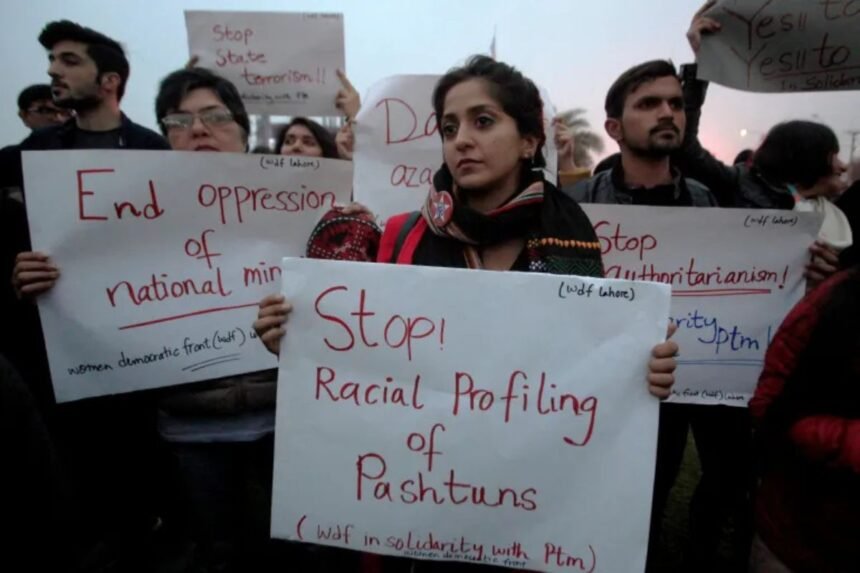
Pashtun Rights Day highlights the long struggle of the Pashtun people against systematic injustice. This observance recalls the colonial-era Durand Line which split the Pashtun homeland, and traces how Pakistan’s policies have deepened Pashtun grievances. For over a century, from British rule through modern Pakistan, Pashtuns have endured broken promises, armed conflict, displacement, and censorship. In the late 19th century, British officials drew the Durand Line in 1893, carving an arbitrary border between Afghanistan and India (now Pakistan). This thin red line (visible on the map below) cut Pashtun tribal areas in two, separating families and communities without local consent. After independence in 1947, Pakistan inherited that frontier, Kabul never recognized it. In fact, Afghanistan remains the only UN member to have voted against Pakistan’s admission, maintaining the Durand Line “void” and supporting an independent Pashtunistan for divided tribes.
- Military Operations and Displacements in Pashtun Lands
- Enforced Disappearances and Rights Violations
- Pakistan’s Proxy Wars on Pashtun Soil
- The Pashtun Tahafuz Movement (PTM) Rises
- State Crackdown on Dissent
- Economic Marginalization and Demographic Pressures
- Media Blackout and Stereotypes
- International Solidarity and the Road Ahead
Today the Durand Line still inflames tensions. Afghans and Pashtun activists argue it wrongly cuts through their historic homeland In Pakistan, nearly 20 million ethnic Pashtuns live along this rugged frontier (mainly in Khyber Pakhtunkhwa and former FATA regions), while millions more live on the Afghan side. Afghanistan’s governments from Daoud Khan to Karzai have repeatedly rejected this border. Within Pakistan, early leaders of Pashtun nationalism (like Khan Abdul Ghaffar Khan) had already opposed partition, after 1947, they and some Afghan rulers briefly pushed for a separate “Pashtunistan” state. These currents of history left Pashtuns split between two states, creating a legacy of mistrust and identity politics on both sides of the Durand Line.
Military Operations and Displacements in Pashtun Lands
Following partition, successive Pakistani governments militarized the borderlands. From the 1970s onward, Pashtun regions became strategic in Pakistan’s conflicts with Afghanistan and India. In 1979, Islamabad and its allies began recruiting Pashtun mujahideen in Pakistan (including from its tribal areas) against Soviet-backed Kabul. In the 1990s, Pakistan’s intelligence (ISI) helped train and supply the Afghan Taliban who were mostly Pashtun as a proxy force. Even into the 2000s, Human Rights Watch documented Pakistani military support for Taliban offensives in Afghanistan. In short, Pashtun territory has often been used as a battleground and training ground for wars not of their making, trapping villagers in proxy conflicts on both sides of the Durand Line.
After 2001, the “War on Terror” turned Pakistan’s Pashtun areas into a new front. Terrorist attacks and Pakistani counterinsurgency campaigns swept the Northwest Frontier. Major operations like Zarb-e-Azb (2014) and Radd-ul-Fasaad uprooted civilians en masse. UN and media reports estimate that since 2008 roughly five million people from Khyber Pakhtunkhwa (KP) and FATA have been displaced by this fighting. Pakistani officials themselves admit the casualty toll is devastating: more than 80,000 people killed or maimed in the tribal belt over two decades, and millions more driven from their homes. For example, by summer 2014, the Zarb-e-Azb offensive in North Waziristan alone had produced over a million registered internally displaced persons. Many are still unable to return home safely.
Even after military victories, Pashtuns have been treated as second-class. The old Frontier Crimes Regulation (a colonial-era law still governing FATA until 2018) allowed collective punishments and denied due process. Human Rights Watch notes that when about a million displaced families finally returned from Waziristan in 2016, they were forced to register with special “FATA ID cards” something no other Pakistani citizens had to do. In Punjab, officials even circulated notices urging people to spy on “suspicious individuals who look like Pashtuns” In short, ethnic Pashtuns have often been singled out by state policy under the guise of security.
Enforced Disappearances and Rights Violations
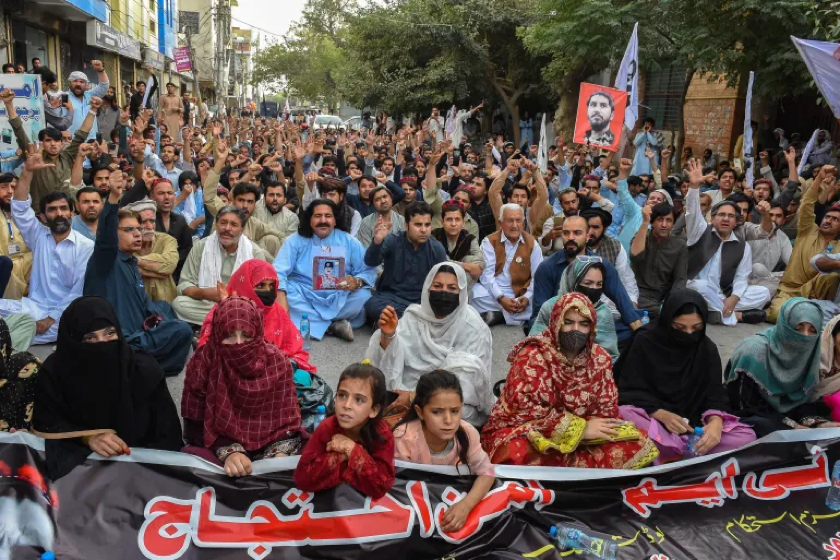
Pashtun men, women and children participate in a PTM rally in Peshawar. The grassroots movement has drawn large, peaceful crowds protesting killings and disappearances of Pashtuns
Worse still, thousands of Pashtuns have vanished. For years families of missing men have accused Pakistani security agencies of abduction. Credible human rights groups have tallied the victims: Amnesty International’s studies list Pashtuns among those disappeared, alongside Baloch, Sindhi, and other minorities. The Pashtun Tahafuz Movement (PTM) a grassroots advocacy group regularly highlights cases of “missing persons” from tribal districts and KP. These are alleged to be victims of secret detention, torture, or extrajudicial killing. While Islamabad rarely acknowledges such cases, NGOs have repeatedly demanded independent investigations.
The pattern is clear: in Pakistan’s counterterror offensives, local Pashtun villagers often pay the price. Checkpoints, sweeps, and airstrikes that target militants also terrorize civilians. Reports describe villages being bombarded or bulldozed, sometimes with no effort to evacuate residents. Pashtun survivors say that they are harassed at every turn: forced ID checks, extorted at army posts, even fired on as “collateral” in gun battles. Even in relatively peaceful times, Pashtun communities face profiling: landlords, students or activists can be jailed under terrorism laws with scant evidence, simply for protesting or speaking out. In the words of Amnesty International, Pakistan’s authorities have subjected such movements from “marginalized regions” to unlawful force, disappearances, and media bans.
Pakistan’s Proxy Wars on Pashtun Soil
Pakistan’s Pashtun areas have not only borne the brunt of foreign militants, but also of Pakistan’s own changing alliances. During the Soviet occupation of Afghanistan, Pakistan with CIA backing trained millions of Afghan and local Pashtun fighters to drive out the USSR. That strategy fueled the rise of Islamist groups whose goals often diverged from Pashtun interests. For example, Pakistan’s intelligence famously directed aid to pro-Islamist, mainly Pashtun warlords (like Gulbuddin Hekmatyar) instead of more secular Pashtun nationalists. Later, Islamabad pivoted to support the Afghan Taliban regime in the 1990s, providing them funds, logistics, and safe haven (all centered in Pashtun territories).
In the post 9/11 era, similar dynamics reemerged. The Pakistani army often carved secret pacts with militants. PTM leaders and independent analysts now openly accuse the military of allowing Pakistani Taliban (TTP) fighters to regroup in Pashtun border areas after launching operations. In other words, as one Brookings analyst notes, after fighting the TTP in Operation Zarb-e-Azb, the army allegedly “allowed the Taliban to return” a claim so fundamental that PTM’s slogan became: “This terrorism – behind it is the uniform.”. Whether or not these allegations are fully confirmed, they reflect a widespread Pashtun belief, that Pakistan has used and then blamed Pashtun militants for its own strategic goals.
The result is that ordinary Pashtuns feel they are stuck in a proxy war not of their choosing – first caught between Kabul and Islamabad during the 1980s and 90s, and now between Islamabad and extremist groups on its own soil. Villagers report that government forces and insurgents alike raid their homes, extort payments, and kill suspects on flimsy evidence. Invariably, the Pashtun frontline towns suffer the worst destruction while Islamabad’s high command retreats to safer cantonments.
The Pashtun Tahafuz Movement (PTM) Rises
Amid this backdrop, a new voice emerged: the Pashtun Tahafuz Movement (PTM). Founded in 2014 and gaining real momentum in 2018, PTM is a grassroots rights campaign of Pakistan’s Pashtun youth and families. Its leaders many of them from war torn tribal districts began organizing sit-ins and marches, demanding accountability for killings and kidnappings, de-mining of border regions, and equal treatment under the law. The movement explicitly eschews violence: PTM activists carry the Pakistani flag and have been known to raise slogans like “In democracy we trust” or “Human rights for all” during protests.
Despite state disinterest, PTM rallies drew unexpectedly large crowds. Tens of thousands of Pashtuns – men, women and even children travelled from villages to urban parks to sit in solidarity. Al Jazeera reports that at its peak PTM “pulled tens of thousands” of peaceful protesters onto the streets. They held up photos of the disappeared and shot. They chanted for justice after the police “encounter killing” of Naqeebullah Mehsud in 2018, a murder that PTM says was falsely justified. According to observers, PTM tapped into a deep well of frustration: Pakistan’s 40 million Pashtuns were demanding simply to be recognized as full citizens, not treated as security suspects.
The movement’s demands are straightforward. PTM leaders have called for an independent inquiry into extrajudicial killings and enforced disappearances of Pashtuns, de-mining of the tribal areas, and an end to unchecked harassment at checkpoints. In a speech RFE/RL summarizes: “We are determined to demand our due rights.” They emphasize constitutional protections for all citizens and an end to treating Pashtuns as second-class. Many of these demands echo international human rights norms: truth commissions, legal accountability, and development for neglected regions.
State Crackdown on Dissent
The Pakistani state reacted to PTM with alarm. Rather than engaging PTM’s grievances, authorities labeled the movement a threat. Security forces opened new court cases against its leaders, accusing them of “sedition” or spying for Afghanistan. In January 2020, dozens of PTM supporters (including elderly women and students) were arrested for peacefully protesting the detention of leader Manzoor Pashteen. Politicians were fearful to speak. Pashteen himself was charged with attacking national security simply for denouncing violence against his community.
By late 2024 the repression escalated: on October 7 Pakistan’s Interior Ministry officially banned the PTM, declaring it a “proscribed organization” under counterterrorism laws. This move came just days before a planned Pashtun national council (jirga) suggesting the ban was meant to pre-empt a major gathering. Amnesty International reacted immediately, demanding the ban’s reversal. Amnesty warned that this was part of a “systematic and relentless clampdown” on peaceful dissent. Indeed, the NGO noted that for years Islamabad had suppressed minority movements with “unlawful use of force, enforced disappearances, and media bans”.
Concretely, the crackdown has involved mass arrests and intimidation. In October 2024 alone, Amnesty reports, police used tear gas and even opened fire to break up a PTM protest camp in Khyber District; nearly 100 activists were detained under a draconian public order ordinance. Key PTM parliamentarians like Ali Wazir and Mohsin Dawar have spent months in jail, accused of vague offenses after leading protests. When large crowds formed in cities like Peshawar or Dera Ismail Khan, media and motorways were shut down to prevent coverage. (Human Rights Watch notes that mainstream Pakistani news won’t report PTM rallies or demands.) Meanwhile social media users face harassment for speaking in Pashto or about Pashtun issues. Even civil society figures fear to visit tribal areas.
The effect of this suppression is chilling. PTM leaders say ordinary Pashtuns are being stigmatized as “foreign agents” or terrorists for asking basic questions. In practice, the army’s media wing or Propaganda Wing (ISPR) portrays the activists as unpatriotic, while banning any sympathetic coverage. As Amnesty puts it, Islamabad is using overbroad terror laws to “criminalize peaceful protests” by ethnic minorities. Even the government’s own Human Rights Commission (HRCP) has protested the PTM ban, calling it “extreme” and unwarranted. Yet, until Pakistan’s writ changes, Pashtun grievances remain ignored.
Economic Marginalization and Demographic Pressures
Beyond security crackdowns, Pashtuns face chronic underdevelopment. Khyber Pakhtunkhwa (and the former tribal belt) have long lagged behind Pakistan’s heartland. According to UN-related indices, KP is designated one of Pakistan’s two “underdeveloped” provinces (the other being Balochistan). World Bank data reflect this gulf: roughly half of KP’s population survives on under $3.65 a day (2018 data), compared to just 33% in Punjab. Agriculture and industry remain rudimentary, literacy is low, and health indicators lag the national average. Much of the region’s young workforce is unemployed or forced to migrate. By contrast, decades of federal policy have channeled most development funds to Punjab and Sindh, fueling resentment. As one analysis observes, Pakistan’s “status quo” concentrates power and resources in Punjab and Karachi, “while people in much of the rest of the country can go largely unheard and unserved.”
On the cultural side, Pashtuns also feel demographically squeezed. The state’s counterinsurgency has encouraged settlement of other groups (or older refugees) in Pashtun areas, leading to claims of “changing the character” of tribal lands. Meanwhile, Pashtuns in urban Pakistan report being stereotyped or marginalized as “backward” or “outsiders” in economic and social life. Official apathy means that even population statistics on Pashtuns are often uncertain, fueling fear that their share of national power may shrink further. (For example, KP was only recently granted equal status in national budgeting.)
In short, Pashtun majority regions bear a double burden. they are the nation’s military frontline yet remain its developmental backwater. International experts warn that this economic neglect is a core grievance. Without serious investment in schools, clinics, and jobs for Pashtuns, protests like PTM’s demanding equality and rights will only grow.
Media Blackout and Stereotypes
Another invisible form of repression is the near-total blackout of Pashtun voices in Pakistani media. Newspapers and TV channels generally follow the military’s lead. PTM rallies and events are either underreported or completely ignored. When coverage does appear, it typically portrays Pashtun protesters as either pawns of foreign powers or as terrorists. This information blockade reinforces prejudice most Pakistanis in Punjab and Sindh see Pashtuns only as news items about suicide bombers or smugglers, never as citizens with legitimate concerns. Even the most basic Pashto language cultural programs are often starved of airtime.
Analysts note that without social or mainstream media platforms, Pashtuns have turned to mobile internet to spread their message. But the security establishment actively throttles or monitors internet in Pashtun regions whenever protests are planned. The result is that few outside KP even know what PTM demands; slogans like “Imprisonment is a disgrace – we want equal rights for Pashtuns” rarely break into English-Urdu press. This enforced silence ensures most Pakistanis remain indifferent or hostile toward Pashtun rights.
International Solidarity and the Road Ahead
Pashtun Rights Day is ultimately a call for global awareness. The voices demanding justice are peaceful and patriotic, they want to fix Pakistan’s soul, not break it. Human rights organizations from Amnesty International to Human Rights Watch and UN experts have repeatedly urged Pakistan to respect its Pashtun citizens. For example, Amnesty’s South Asia director has condemned the PTM ban and warned of a witch hunt targeting dissent on ethnic lines. The United Nations has noted with concern the use of excessive force and enforced disappearances against Pashtuns.
What does Pashtun Rights Day ask the world to do? First, acknowledge that Pashtuns are not an enemy of Pakistan but its victims. Pakistan’s neighbors and international partners should refrain from normalizing abuses. Pressuring Islamabad through diplomatic channels or conditional aid to halt extrajudicial measures can save lives. Media outlets worldwide should report Pashtun stories fairly, breaking the blackout. Civil society groups and governments must listen to PTM’s documented demands, safe return of displaced families, demining former war zones, release of political prisoners, and independent investigations of all killings and disappearances.
History shows Pashtuns have survived decades of conflict. But under current policies they risk becoming Pakistan’s permanent security colonels, not its citizens. Pashtun Rights Day reminds us that the end of oppression requires not just words but action. Only with international scrutiny, support for peaceful activism, and accountability can Pakistan’s Pashtuns hope for equal protection under law. On this day, global human rights defenders are urged to stand in solidarity, amplify Pashtun voices, report their plight, and insist that Pakistan honor the rights of all its people.