


Introduction:
The rise of electromagnetic launch (EML) technology marks a major break in how naval warfare works. This technology completely changes the need for chemical propellants that have powered guns for 500 years.
- Introduction:
- What Are Chemical Guns and Why They Have Limits ? Why Chemical Propulsion Cannot Go Faster?
- What the Railgun Guarantee?
- This technology has three big benefits:
- The Science and Hard Problems Behind the Railgun
- How China Built Its Railgun Program?
- How This Affects the World and Other Nations?
- India: Working Fast
- Russia: Help From the Sidelines
- What This Means for War and Power in the Ocean?
- Danger for India and the Indian Ocean
- Ways the Railgun can use in the war
- How to stop or Protect against Railguns
- Conclusion:
The PRC (People’s Republic of China) has carried out a focused, long-term plan to make the electromagnetic railgun ready to use. The United States stopped its work in 2021 to focus on hypersonic missiles instead. Chinese researchers have overcome major engineering problems, especially with barrel wear, power burst control, and fire accuracy. The People’s Liberation Army Navy (PLAN) is ready to field the world’s first working ship-mounted railgun by 2025.
This report provides a complete study of the Chinese railgun program. I break this down how it works, when it was made, and how it will go on future navy ships like the Type 055 destroyer and Type 076 landing ship. The article also looks at the big changes this brings to the world, the hard choices it poses to the United States, how Russia helps in a one-sided way, the protection needs driving Japan’s own railgun program, and the serious worries in India’s navy. Through careful study of public data, technical papers, and war plans, this guide says the railgun is not just a show project. Instead, it is a key part of China’s A2/AD plan. This plan is made to change the money cost of modern war and fight the current balance of navy power in the Indo-Pacific.
What Are Chemical Guns and Why They Have Limits ? Why Chemical Propulsion Cannot Go Faster?
For hundreds of years, the biggest limit on navy guns has been set by how heat and energy work. Regular guns use the burning of chemical propellants to push a bullet forward. Whether it is the 16-inch guns on old Iowa-class ships or the modern 155mm Advanced Gun System (AGS), all these guns work the same way. They burn chemicals to make pressure push the bullet forward.
The science of how gas spreads sets a highest bullet speed, usually around 1.5 to 2.0 km/s (Mach 4.5–6). If you go faster than this, the gas cannot expand quick enough to push the bullet more. The drag and heat stress grow very fast and give less and less value back.
This speed limit causes big problems in war. To hit targets far away (more than 100 kilometers), regular shells must follow curved paths in the air. This makes them easy to see and stop. Also, these guns need explosive warheads to do damage. This means storing lots of bomb material deep in the ship. If the ship gets hit and water gets in, it could cause a huge disaster.
What the Railgun Guarantee?
The electromagnetic railgun gets around all these heat limits completely. Instead of gas pressure, it uses electromagnetic push to speed up a metal bullet along two parallel rails. By turning electrical energy directly into movement energy, railguns can go much faster than Mach 7 (about 2,400 m/s) and hit targets from more than 200 kilometers (124 miles) away.
This technology has three big benefits:
1) Super-Fast Killing Power: The bullet goes so fast that it does not need an explosive warhead. The hit energy is enough to destroy targets, turning metal and stone to dust just from the force. We call this “kinetic kill.” This makes supply easier and makes the ship safer because there is no need for dangerous bomb storage.
2) More Bullets to Carry: A destroyer with a railgun can carry hundreds of small, safe bullets compared to 90-100 big missile storage spots on today’s ships. This “deep magazine” changes how navies think about battle. The ship can fire more shots and hit more targets without needing to go back for more bullets.
3) Low Cost Per Shot: Today, a defense missile costs tens of millions of dollars. A cruise missile costs over 1.5 million dollars. But a railgun bullet costs between 25,000 and 50,000 dollars. This big price difference could change how navies fight. A railgun lets you throw many cheap bullets instead of a few expensive missiles.
The Science and Hard Problems Behind the Railgun
How the Lorentz Force Works?
The railgun’s core works by the Lorentz force law. A railgun has two parallel metal rails hooked to high-power electricity. A metal part bridges the rails and completes the path. When huge amounts of electricity flow through the rails and the metal bridge, it makes a magnetic field all around. This field hits the electricity going through the metal bridge and makes a push force along the rails.
The push force is shown by this math: F = (1/2) L’ I²
Here, F is the push force, L’ is the electromagnetic property of the rail pair, and I is the electricity flow. Because the force grows with the square of the electricity (I²), getting super speeds needs electricity measured in millions of amps (Mega-amps). This square growth is good and bad at the same time. It lets you get huge push, but it also makes terrible heat loss and breaks the metal parts.
Rails Push Apart and Break Newton’s rule says for every push, there is an equal push back the other way. The same magnetic field that pushes the bullet also pushes the two rails apart. This push can be equal to millions of pounds of force and tries to rip the barrel open from the side. So the barrel must be made from super strong mixed materials that can handle this crush without bending. Even a small bend can make the bullet lose touch with the rails or jam, which can cause the gun to break in a bad way.
The Barrel Wear Problem
The biggest problem to making railguns work on ships is barrel life. As the bullet goes faster to Mach 6 or 7, the place where the metal bridge touches the rails faces huge friction and heat. If the touch is not perfect, or if the speed gets too high, the touch point can turn into plasma (super-hot gas). While plasma can still push the bullet (a “plasma bridge”), it gets burning hot (tens of thousands of degrees) and reacts with metal. This plasma acts like a welding torch, eating away at the rail material and making holes. In early U.S. tests, barrels often broke after just a few shots. For a ship gun to work, it must survive hundreds or thousands of shots.
China says it solved this problem in late 2023. They fired 120 shots in a row with no wear or breaks. They say they used new ideas like liquid metal touch points, special rail metals (like copper-tungsten mix), or cooling systems run by AI.
Storing and Using Massive Electricity
A railgun does not plug into a regular wall outlet. It needs a huge burst of electricity in just a few thousandths of a second. This needs a Pulse Forming Network (PFN) made from electricity storage boxes or spinning machines that store energy.
To fire a bullet with 32 Megajoules (MJ) of hit energy (like the U.S. prototype wanted), the system needs 60-100 MJ of stored electricity because some energy is lost. These storage boxes are huge. The Haiyang Shan test ship used shipping boxes on its deck to hold these systems. To put them in a fighting ship, the ship must be made from the start with lots of open space inside and high electricity making power.
How China Built Its Railgun Program?
Early Work and Research (2011–2017)
While the U.S. railgun program got news attention in the mid-2000s, China quietly got ready. U.S. spy reports show China first tested the weapon in 2011 and did ground tests in 2014. During this time, Chinese schools, mainly the Naval University of Engineering in Wuhan led by Rear Admiral Ma Weiming (called the “father of China’s railgun”), focused on the basic science of power bursts.
-From 2015 to 2017, they tested the weapon at far ranges to make it kill better and work more steady. Studies of science papers show that Chinese writing about electromagnetic firing, support structure, and recoil force grew a lot during this time. Many of these papers were written with Russian schools, showing strong school backing.
-The 2018 Sea Tests
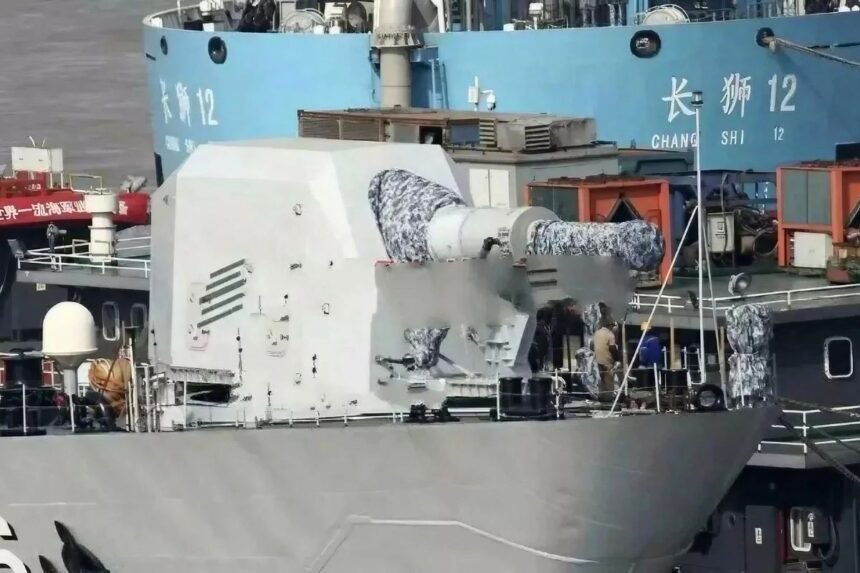
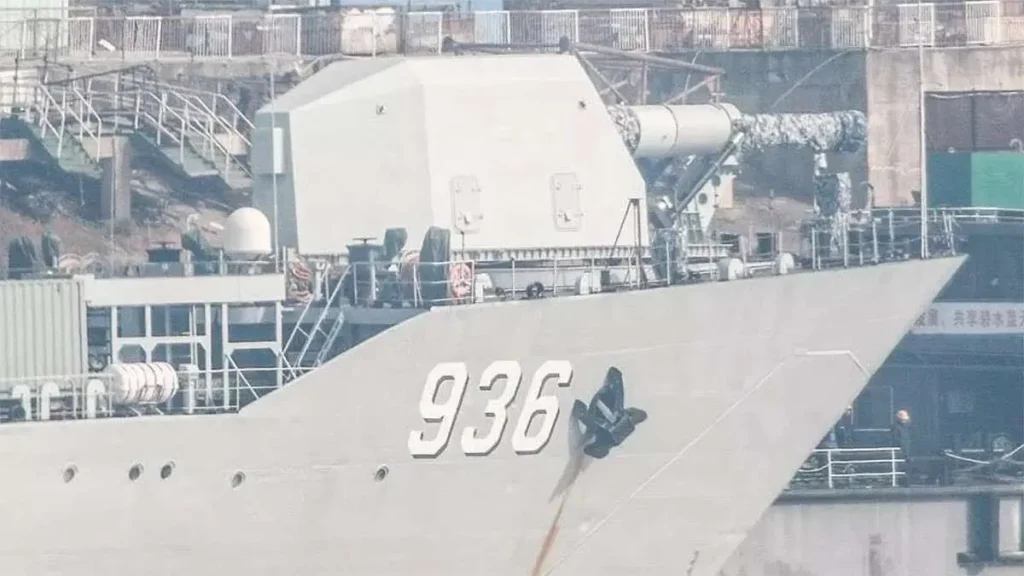
The big moment for people watching the world came in January 2018. The Type 072III-class landing ship Haiyang Shan (number 936) showed up at the Wuchang Shipyard with a big, closed gun house on its front.
Why use a landing ship? A tank landing ship (LST) was a smart choice. The Type 072III has a big open top and a huge inside tank hold. This is perfect for the big electricity makers and storage boxes needed to run the test gun. It was not a war move but a floating test place.
Tests from this time showed the gun could hit targets 200 km away at speeds up to 2.5 km/s (Mach 7.5). The bullet cost was guessed to be a tiny part of the same flying bombs. This made China the first nation to set up and test a railgun on water. The U.S. Navy never got this far with its Zumwalt program.
-The Big Return (2019–2023)
After the big news in 2018, the Haiyang Shan went away from public view. Some U.S. watchers thought China had hit problems too big to fix, like what happened to the U.S. program. But this quiet time was really about hard work to fix problems, not giving up. In late 2023, the Haiyang Shan came back into view, and news started to spread about big fixes. In December 2023, Chinese media and writing from the Naval University of Engineering said they did a successful test of firing many shots in a row. The gun fired 120 shots one after another without losing hit power or breaking. This shows China has solved the heat stress and wear issues. The paper said they used AI to watch tens of thousands of sensors to see damage coming and stop it as it happens.
-The May 2024 Sky Bomb Test
In May 2024, the program showed a new skill: firing a smart bomb into the sky. The gun fired a winged smart bomb to a height of 15 kilometers at speeds more than Mach 5. This test was called a fail because the bomb did not go as far. Tests showed the bomb was spinning too fast, making it angle wrong. But this “fail” shows something important. China is moving from just firing basic metal rods to firing smart bombs that can turn and steer. Making computer parts hard enough to survive the 20,000+ G-force of firing is very hard. The fact that the bomb lived through firing and got to the high air shows that China is getting good at protecting computer parts. Even if the flying path needs more work, this is real progress. Putting the Railgun on Future Navy Ships A railgun by itself does not mean much. The ship that carries it must be made to hold and use it. This brings new building and power challenges.
| Parameter | Specifications |
| Range | 200 km (124 miles) |
| Muzzle Velocity | 2500 m/s (Mach 7) |
| Projectile Mass | 15-25 kg (Kinetic Slug) |
| Fire Rate | Continuous fire capability (120 rounds) |
| Power Source | Integrated Electric Propulsion (IEP)+ Capacitor Banks |
| Targeting | AI- assisted Fire Control+ Satellite/ Radar Link |
| Guidance | “Smart Bomb” variant tested (stratospheric) |
The Type 055 Renhai Destroyer
The Type 055 is the best ship in the Chinese Navy and the right place to put the railgun. It weighs 12,000–13,000 tons, big enough to fit the weapon.
-Future versions of the Type 055 are said to use Integrated Electric Propulsion (IEP). IEP lets the ship’s main engines make electricity for a central power system. This power can then be sent to the engines for moving or to high-energy guns. This setup makes it easy to add a railgun. The ship has lots of space inside for the huge storage boxes and the power burst network needed for a 30-60 MJ shot.
Smart watchers and open study say the railgun will go on the Type 055. They think fighting ships with this gun will be ready by 2025.
The Type 076 Landing Ship
A surprise choice for the railgun is the coming Type 076 landing ship. The Type 076 is said to use electromagnetic plane throwers (EMALS) to send off robot planes and normal planes. EMALS works with the same basic science as railguns. Both need huge, fast bursts of stored electricity. The power making and storing machines for EMALS could also be used for a gun system to protect or attack. This would give the landing ship its own far-away firepower. It would need less help from destroyer guards for shore hits.
The Super Ship Plan
Chinese papers from schools show a plan for a “next-generation destroyer” that would come after the Type 055. Drawings from Harbin Engineering University show a future, sneaky ship with a railgun, light guns, and high-power wave systems. All powered by a nuclear or mixed-power plant. The plan focuses on being very hard to see on radar. The railgun barrel might be able to move in and out or be covered to make the ship harder to spot.
How This Affects the World and Other Nations?
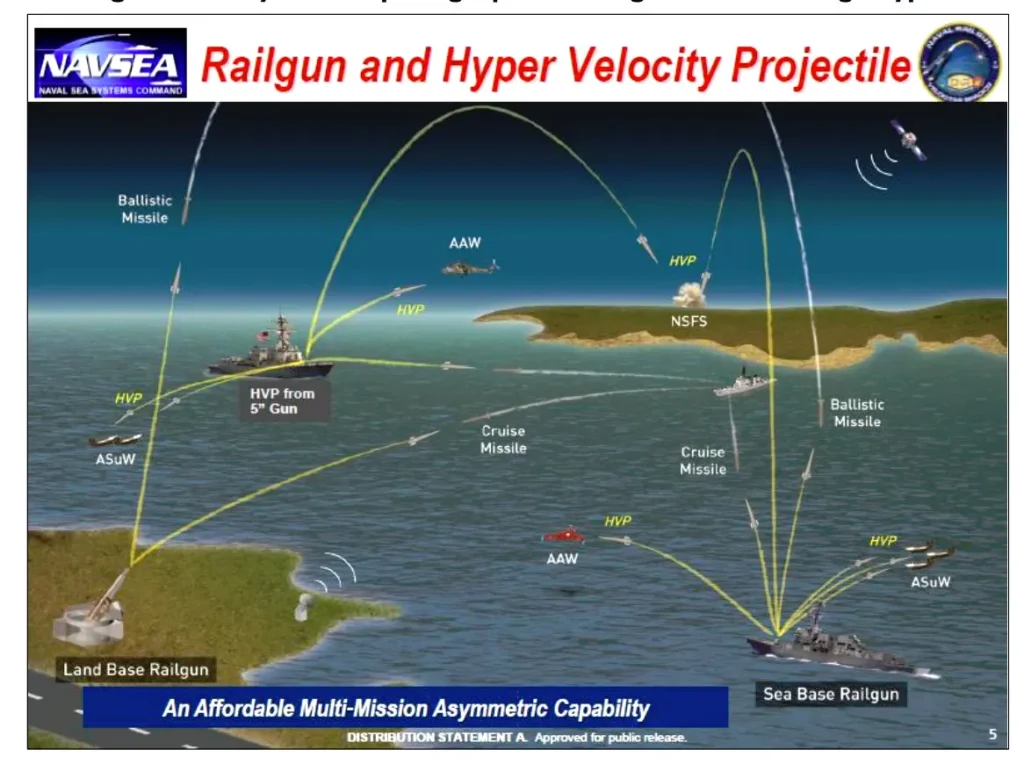
The United States: Stopped Early and Lost – The U.S. Navy was first to make modern railguns. It began the work in 2005. By 2010, the U.S. fired a 33-MJ shot on land. The plan was to put this on Zumwalt-class destroyers (DDG-1000).
But the program stopped in 2021 after spending more than $500 million. The U.S. said the reason was that the science was not ready (mainly barrel life) and they needed to spend money on hypersonic flying bombs to match Russia and China faster.
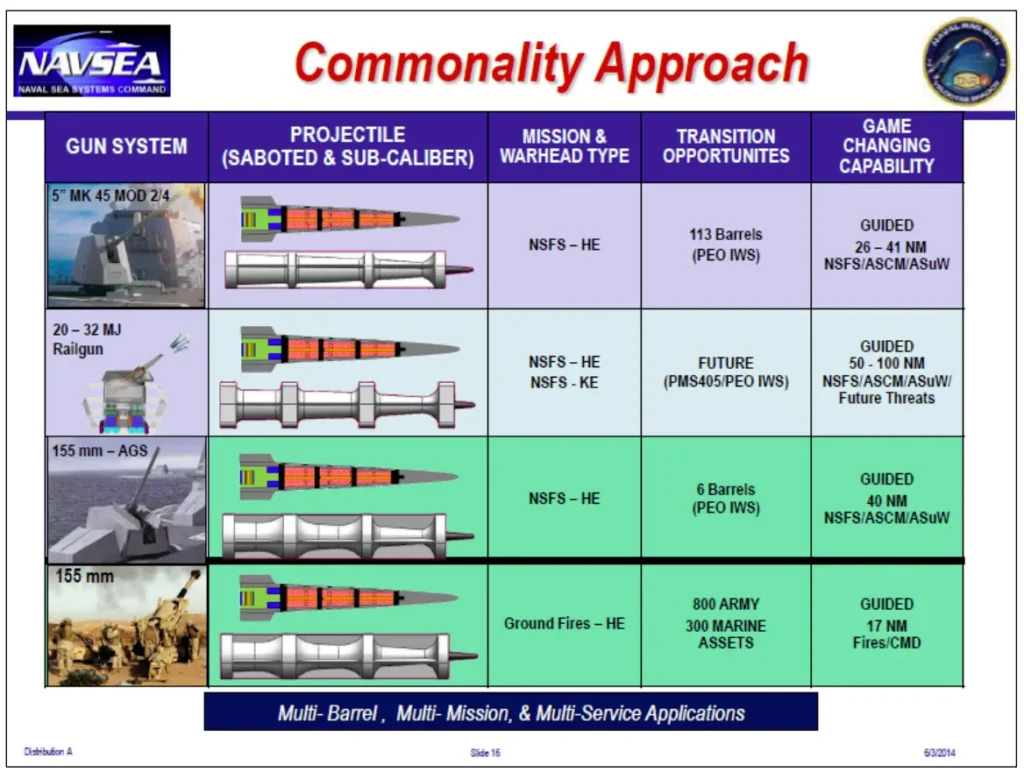
The U.S. did save one part: the Hypervelocity Projectile (HVP). This bullet was first made for railguns. Now it fires from normal 5-inch ship guns and 155mm army guns. Even at lower speeds (Mach 3 instead of Mach 7), the HVP gives old ships much better power. The U.S. did not need new ships or new power systems.
Japan: Building a Weapon to Block Fast Attack
Japan took a different path. It sees the railgun mainly as a way to stop super-fast bombs from China and North Korea.
Japan did its first railgun test from a ship in October 2023. The Japanese ship JS Asuka tried out the weapon. Japan’s thinking is that the only way to stop a bomb moving at Mach 7 is with a bullet that goes just as fast. Old defense bullets are too slow or cost too much. Japan’s test gun is smaller than China’s. It is 40mm wide and fires a 320-gram bullet at about Mach 6.5. Japan wants to scale this up to a 20MJ system. Japan is also working with France and Germany (ISL school) to share facts about rail wear and power supplies.
India: Working Fast
India sees China growing in the Indian Ocean as a serious danger. India has set up the Centre for Electromagnetic Launch Technology (CEMaLT) in Pune. The ARDE lab has tested a 10MJ storage box and is working on a 100MJ system that can fire 18kg bullets at 2,000 m/s. But India is guessed to be about 5 years behind China in getting a working system. Right now, India is working on key parts like Li-Si storage boxes and graphite-coated rails to cut down friction.
Russia: Help From the Sidelines
Russia’s role is tricky. Its own railgun work has not moved fast because of money problems. But Russia has strong science in power burst. Under their “no limits” deal, Russia and China are trading more and more science that can be used for many things. Russia is alone now, so it needs China’s help. Russia’s knowledge in high-power electricity (from old Soviet fusion work) likely helped China get past the power control problems of the railgun.
Papers show deep work between Russian and Chinese schools on the physics of electromagnetic firing. It is very likely that Russian learning in high-power electricity has helped China beat the power control hurdles of their railgun.
What This Means for War and Power in the Ocean?
It Changes the Rules of Naval War. A ship is judged by how many flying bombs it can fire and how many it can stop. A Type 055 with a railgun breaks this balance. It can fire hundreds of shots at a small cost of each one. If used to hit shore or ships, it forces the other side to use precious defense shots on cheap metal bullets. If it takes a $10 million defense shot to stop a $50,000 bullet, the math does not work for the side that has to stop them.
Puts China’s A2/AD Bubble Bigger – The railgun makes China’s “stay out” zone (A2/AD) (A2/AD: Area where the side can stop enemy ships and planes) grow bigger.
A bullet going at Mach 7 (2.4 km/s) covers 200 kilometers in about 83 seconds. This gives a ship less than 90 seconds to see the bullet, know where it is, and fire back. A slow flying bomb takes more than 10 minutes to go the same way. The bullet is small compared to a flying bomb. It has no hot air behind it, so heat tools cannot see it well or radar cannot track it until the last part of the flight.
Danger for India and the Indian Ocean
For India, Chinese ships with railguns in ports like Gwadar (Pakistan) or Djibouti (Africa) make big tactical problems. A railgun could hit shore bases or ships in harbor from far away with small warning and no sign of a flying bomb launch. Just having such a weapon is a powerful way to force India to do what China wants. It makes it hard for India to plan its navy moves in the Bay of Bengal and Arabian Sea.
Ways the Railgun can use in the war
Scenario 1: Taiwan
In a Taiwan situation, the railgun’s main job might not be hitting ships but hitting planes and flying bombs. Put in the Taiwan Strait, railguns on Type 055s could use super-fast bullets to shoot down flying bombs or planes coming at them. This acts like a hard shield for the ships bringing soldiers. Or they could hit coastal walls from far away, damaging the ground guns without using lots of expensive flying bombs.
Scenario 2: South China Sea
A railgun can fire at different power levels. A “warning shot” across the front of a ship at Mach 5 sends a scary message that a normal gun cannot match. Also, the bullet can be aimed carefully. You could disable a ship (hitting its front or plane deck) rather than sinking it. This gives a bullet choice between doing nothing and total war.
Scenario 3: India Ocean
If a Chinese navy group goes into the Indian Ocean, the railgun makes its force bigger. Far from home ports, the railgun’s deep bullet storage cuts the need for supply ships (which can be hit). One destroyer could keep a blockade or stay annoying for weeks.
How to stop or Protect against Railguns
Hard methods: Bullets hit bullets
Stopping a railgun bullet is much harder than stopping a flying bomb. The bullet is solid metal. You cannot blow it up in the air to make it safe. You must push it out of the way or burn it to nothing. The U.S. way is to use its own super-fast bullets to make a “wall of lead” in front of the bullet coming at you. The speed of two Mach 7 bullets hitting each other is Mach 14. Fire control systems need computer help to get a hit.
Soft methods: Light guns
Light guns offer the best theory way to stop it. Light moves at the fastest speed. A light gun hits right away. A powerful light beam (100kW or more) can heat the outside of the bullet. Even if it does not melt the metal, unequal heating can change how it flows through air, making it spin and miss. But light guns have limits. Hot air shaking stops them in wet ocean air, and the time needed to heat a super-fast bullet might be too long given the 90-second flight time.
Computer Fighting
Jamming the Guide: If China uses “smart” railgun bullets (like the one tested in May 2024), they can be stopped by messing with their brains. Blocking the GPS or radio signal could make the bullet lose its sharp aim. Then it becomes a scary gun that misses.
Dazzling: Light-sensing parts on the bullet can be blinded by ship light guns (like the U.S. Navy’s ODIN system).
Spread out the ships
The best protection may be a change in war thinking. By putting weapons on many small ships (Spread Out Ship War), the U.S. Navy cuts the value of any single target. A railgun cannot sink a group of robot boats well. It was made to kill big important ships.
Conclusion:
From 2011 to 2025, the proof shows one thing that is clear China has upper hand or advantage in technology in railgun making. By using special materials, computer help, and power burst science, and likely with help from Russia, the Chinese Navy is ready to put a weapon into use that the U.S. thought was not possible.
But the weapon is not perfect. Its need for huge electricity making stops it to the biggest Chinese ships (Type 055 and Type 076). Its bullets, even at super fast, still must follow the rules of science and can be stopped by light guns, computer tricks, and spread out ship fighting.
The world’s answer must be many sided. For the U.S., it proves that moving to light guns and hypersonic bombs was right. For Japan, it means hurrying up its own railgun shield. For India, it drives the need for home-made science and unequal navy war ways. The time of electricity and magnet war has begun. Who masters both the gun and the shield will set ocean safety in the future.